Have you ever told a colleague, “Let’s put that idea on the back burner for now only to wonder later if you used the phrase correctly? You’re not alone. This popular English idiom shows up in boardrooms, classrooms, and casual conversations every day. Yet despite its widespread use, it’s also one of the most misunderstood expressions in everyday language.
In this guide, you’ll discover the true meaning of where it came from, how to use it grammatically, and the common mistakes most people make. Whether you’re a native speaker polishing your writing or an ESL learner building vocabulary, this article gives you everything you need.
What Does “On the Back Burner” Mean?
At its core means to temporarily delay, deprioritize, or set aside a task, project, or goal—without abandoning it entirely.
The key word here is temporarily. Something placed on the back burner is still cooking; it’s just not receiving immediate attention. This is what separates it from phrases like “shelved” or “canceled.”
Quick Definition:
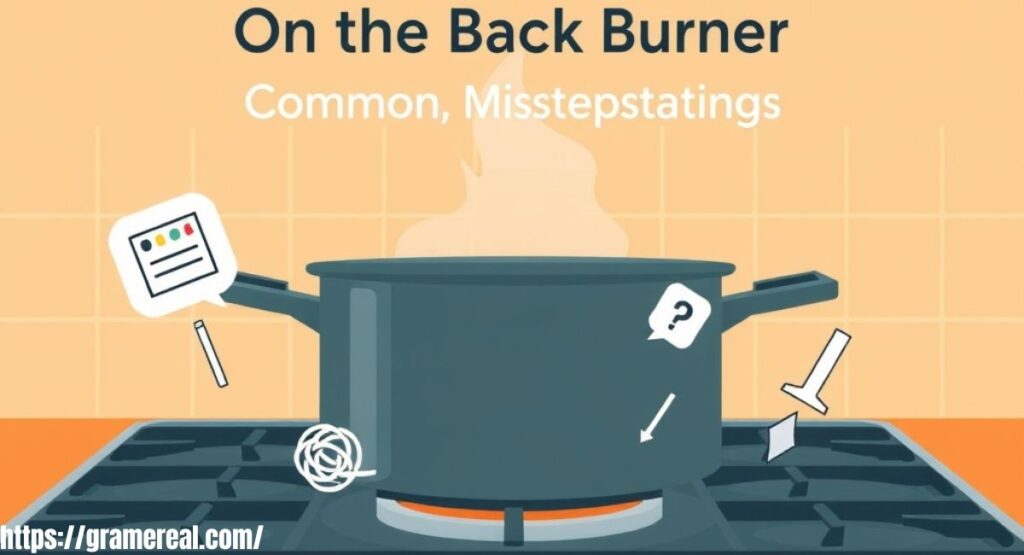
- Literal meaning: A pot placed on the rear burner of a stove, simmering quietly while more urgent dishes cook in front.
- Figurative meaning: Any task, plan, or idea that is intentionally postponed while more pressing priorities are handled.
“I’ve put my fitness goals on the back burner while finishing this big work project.”
Origin of the Phrase
The phrase dates back to the 1940s, when home cooking was central to daily American life. Stoves had multiple burners some at the front for active cooking and others at the back for simmering or keeping food warm.
In the early 20th century, gas stoves with front and back burners became household staples. By the 1940s, Business Week was already using the phrase to describe projects put on hold. By the 1950s and 60s, politicians had adopted it in speeches to describe delayed reforms without discarding them.
One of the earliest references can be traced in American newspapers, where writers used it to describe political and business priorities. Over time, it became a metaphor for any task or issue receiving less immediate attention.
Today, the expression spans cultures, professions, and media—from Netflix dialogues to corporate strategy meetings.
Grammar Structure
Using this idiom correctly requires attention to its fixed grammatical pattern. The standard structure is:
put/place + [object] + on the back burner
| Correct Form | Incorrect Form |
|---|---|
| Put the project on the back burner | Put the project in the back burner |
| The plan is on the back burner | The plan is at the back burner |
| We placed negotiations on the back burner | We placed negotiations to the back burner |
Always use the preposition “on” never “in,” “at,” or “to.”
The phrase also adjusts naturally across verb tenses:
- Present: The redesign is on the back burner.
- Past: We put the campaign on the back burner last quarter.
- Future: We’ll put that discussion on the back burner until next month.
- Passive: The proposal was put on the back burner by management.
Contextual Examples
Understanding an idiom in isolation is one thing; seeing it work in real sentences is what makes it stick. Here are examples across different contexts:
Professional / Business:
- “The software upgrade is on the back burner until we finalize the current release.”
- “The company placed product redesign on the back burner during the launch phase.”
Academic:
- “She put her dissertation research on the back burner while teaching three courses.”
- “I’ve put redecorating the living room on the back burner until the kids’ school schedule stabilizes.”
- “He put his guitar practice on the back burner because of work commitments.”
Political:
- “The government put healthcare reform on the back burner during the economic crisis.”
Common Mistakes to Avoid
Even experienced English speakers slip up with this phrase. Here are the most frequent errors and how to fix them.
1. Confusing “on the back burner” with “canceled”
This is the biggest misunderstanding. The pot on the back burner is still cooking putting something on the back burner is a deliberate choice, not forgetting it entirely. If something is canceled, don’t use this idiom.
2. Using the wrong preposition
Always use “on” not “in,” “at,” or “to.” Saying “put it in the” is grammatically incorrect.
3. Forgetting the object
The idiom needs a clear object to refer to.
- ❌ “I put on the back burner.”
- ✅ “I put the plan on the back burner.”
4. Using it for very short delays
This idiom usually suggests a longer delay, not a delay of just a few minutes. Reserve it for meaningful postponements, not minor pauses.
5. Treating it as purely negative
The phrase doesn’t always carry a negative tone. Sometimes putting something on the back burner simply reflects practical prioritization rather than neglect.
6. Spelling it as one word
“Backburner” (one word) is the incorrect spelling. The correct form is two separate words.
American and British English Usage
One of the refreshing things about this idiom is its consistency across dialects. Both American and British English use “on the back burner” in the same way. The spelling and meaning stay the same, and the idiom appears often in business news and workplace talk.
Whether you’re writing for a New York audience or a London readership, the phrase lands the same way. It’s recognized, natural, and professionally appropriate in both varieties of English.
Tone and Emotional Meaning
One reason this idiom has lasted so long is its diplomatic tone. Compare these two sentences:
- “I canceled the plan.”
- “I put the plan on the back burner.”
The second sentence sounds softer. It suggests the plan may happen later. Because of this softer tone, people often use it in professional settings.
This makes the phrase valuable when you want to:
- Delay something without sounding dismissive
- Communicate shifting priorities without causing alarm
- Soften disappointing news in professional communication
Practical Tips for Using This Idiom Well
Follow these guidelines to use the phrase naturally and effectively:
- Be clear about the object. Always name what is being delayed: “We’ve put the hiring freeze on the back burner” is clearer than vague usage.
- Signal your intent to return. Since the idiom implies a temporary delay, follow up with a timeline when possible: “…until Q3.”
- Don’t overuse it in formal writing. In contracts, reports, or official documents, prefer direct language like “deferred” or “postponed.”
- Use it to soften news. In emails or meetings, it’s a polite way to manage expectations without sounding harsh.
- Pair it with context. Explain why something is on the back burner: “…while we focus on the product launch.”
Sentence Structure and Clarity
Good idiom use is as much about sentence construction as word choice. Here are strong structural patterns to follow:
| Structure | Example |
|---|---|
| Subject + put + object + on the back burner | We put the website redesign on the back burner. |
| Object + is/was + on the back burner | The expansion plan is on the back burner. |
| Subject + had to put + object + on the back burner | She had to put her novel on the back burner. |
| Object + has been + put on the back burner | The merger has been put on the back burner. |
Use active voice when possible for clarity and impact. Reserve the passive form for situations where the actor is unknown or unimportant.
Similar Expressions
Knowing alternatives helps you vary your language and choose the right phrase for the right context.
| Phrase | Meaning | Tone |
|---|---|---|
| On the back burner | Temporarily deprioritized | Informal / Semi-formal |
| Put on hold | Paused, waiting to resume | Neutral |
| Tabled | Set aside for later discussion | Formal (especially in meetings) |
| Shelved | Set aside, possibly long-term | Formal / Suggests uncertainty |
| Deferred | Officially postponed | Formal / Business/Legal |
| Take a rain check | Postpone to a later time | Informal / Social |
“Shelved” implies that not only has a project been put aside for now, but there is no immediate plan to pick it up again — making it a stronger, more permanent-sounding phrase than “on the back burner.”
Writing Practice
The best way to internalize any idiom is to use it yourself. Try these exercises:
- Fill in the blank: “With so many urgent tasks at work, our expansion strategy has been put
- Rewrite this sentence using “on the back burner”: “We postponed the product launch until further notice.”
- Write two sentences one using the idiom in a business context and one in a personal context.
- Transform the tense: Change “We put the idea on the back burner” to future tense.
- Reflection prompt: Think of something in your own life currently on the back burner. Write 3–5 sentences explaining what it is and why it’s been postponed.
Reflection on Grammar and Writing Technique
Good writing doesn’t just use idioms correctly it deploys them purposefully. When you write “on the back burner,” you’re making a stylistic choice that prioritizes warmth and informality over clinical precision.
Notice how the best writers balance idiom use with plain language. They don’t sprinkle idioms on every sentence; instead, they save them for moments where the figurative image genuinely adds meaning. A phrase rooted in cooking makes abstract prioritization feel vivid and relatable your reader immediately pictures a pot simmering quietly, waiting its turn.
Also pay attention to rhythm. Short sentences land harder. Longer ones, like this one that builds to a conclusion, give your reader time to absorb the nuance and appreciate the full context of your thought.
Conclusion
“On the back burner” is more than a kitchen metaphor it’s a window into how people manage time, attention, and priorities. Used correctly, it communicates intentional delay with warmth and professionalism. Misused, it can confuse your reader or signal that you don’t quite grasp the nuance of the phrase.
The key takeaways are simple: always use the preposition on, always name your object, don’t mistake delay for abandonment, and choose the phrase only for meaningful postponements not brief pauses or permanent cancellations.
FAQs
What does “on the back burner” mean?
It means to temporarily delay or deprioritize something without canceling it the task is still alive, just not receiving immediate attention.
Is “on the back burner” formal or informal?
It leans informal but is widely accepted in professional settings like meetings and business emails avoid it in formal legal or official documents.
What preposition do I use with “back burner”?
Always use “on” saying “in the back burner” or “at the back burner” is grammatically incorrect.
Does “on the back burner” mean something is canceled?
No it means something is temporarily postponed, not canceled. The item remains a future possibility.
Is “backburner” one word or two?
The correct spelling is two words. “Backburner” as one word is generally considered incorrect in standard usage.
Can I use it in British English?
Yes both American and British English use this idiom in exactly the same way, with the same spelling and meaning.
What’s the difference between “on the back burner” and “shelved”?
suggests a planned return; “shelved” implies the project has been set aside with no definite plan to revisit it.
Is it okay to use this idiom in a work email?
Yes it’s a professional-sounding way to communicate that a project is temporarily paused, especially useful for softening news of a delay.