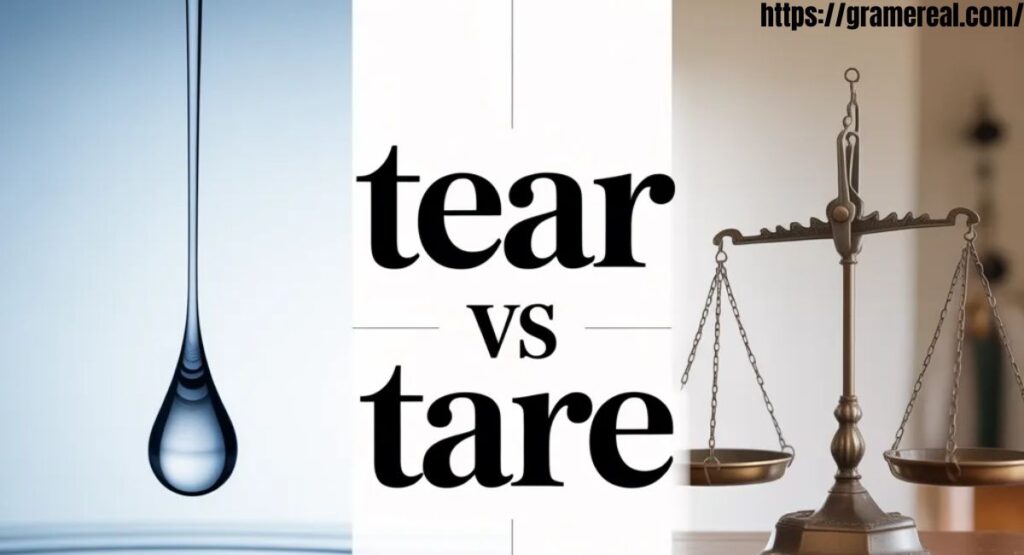
Tear vs tare Have you ever typed “tare the paper” or “tear the scale” and paused — something felt wrong, but you weren’t sure what? You’re not alone. Tear and tare are two of the most commonly confused words in English. They sound exactly the same, look almost identical, and yet they live in completely different worlds of meaning.
“Tear” shows up in emotional moments — a drop from the eye, a rip in your favorite jacket, a letter pulled apart in anger. “Tare,” on the other hand, quietly does its job in kitchens, warehouses, and science labs, helping people find the true weight of what’s inside a container.
One wrong word in a professional document can confuse your reader instantly. In a shipping report, writing “tear weight” instead of “tare weight” can cause real operational headaches. In a novel, writing “a tare fell from her eye” breaks the reader’s trust in your writing.
This guide covers everything — clear definitions, parts of speech, real-world examples, common mistakes, idioms, and memory tricks — so you can use both words with complete confidence from this point forward.
Quick Answer: Tear vs. Tare at a Glance
| Feature | Tear | Tare |
|---|---|---|
| Pronunciation | /tɪər/ (eye fluid) or /tɛr/ (rip) | /tɛr/ (rhymes with “bear”) |
| Part of Speech | Noun, Verb | Noun, Verb |
| Primary Meaning | A rip; eye fluid; to rip apart | Container weight; a weed |
| Common Context | Everyday language, emotions, damage | Weighing, shipping, cooking, labs |
| Origin | Old English teran (to split) | Old French tare (waste/deduction) |
Parts of Speech Analysis
Understanding the grammatical roles of “tear” and “tare” is the first step to using them correctly.
Tear functions as both a noun and a verb:
- As a noun: it refers to either a drop of salty liquid from the eye, or a hole created by ripping.
- As a verb: it means to pull something apart with force.
Tare also functions as both a noun and a verb:
- As a noun: it refers to the weight of an empty container, or a type of weed found in grain fields.
- As a verb: it means to zero out a scale by subtracting a container’s weight.
What “Tear” Means — A Simple Guide
Tear as a Noun (Two Meanings)
Meaning 1 Eye Fluid (/tɪər/, rhymes with “ear”): A tear is the clear, salty liquid produced by the eye’s lacrimal glands. It appears when we cry, feel strong emotions, or experience eye irritation.
A single tear rolled down his cheek when he heard the news.
Meaning 2 A Rip or Split (/tɛr/, Tear vs tare rhymes with “bear”): A tear is the hole or split left behind after something has been pulled apart by force.
There was a long tear along the spine of the old book.
Tear as a Verb
As a verb, “tear” means to pull something apart forcefully, often by stretching it beyond its limits. It is an irregular verb with the following conjugations:
| Tense | Form | Example |
|---|---|---|
| Present | tear | I tear the paper in half. |
| Past Simple | tore | She tore the letter open. |
| Past Participle | torn | He has torn his jacket on the fence. |
| Present Participle | tearing | She was tearing pages from the notebook. |
⚠️ Note: “Tare” was briefly used Tear vs tare as the past tense of “tear” in very old English but was replaced by “tore” around the 1600s. Do not use “tare” as a verb form of “tear” in modern writing.
In American English, “tear” can also be used informally as a noun to describe a rampage or burst of intense activity for example: “The team went on a tear in the fourth quarter.”
What “Tare” Means — A Simple Guide
“Tare” is a technical term you’ll rarely hear in casual conversation, but it carries real importance in business, science, and cooking.
Tare as a Noun (Two Meanings)
Meaning 1 Container Weight: Tare refers to the weight of an empty container, packaging, or vehicle. This weight is subtracted from the gross (total) weight to find the net weight the actual weight of the product inside.
The shipping invoice listed both the gross weight and the tare weight of each crate.
The Weight Formula:
Net Weight = Gross WeightTare Weight
Meaning 2 A Type of Weed: In older or biblical language, a tare is also an injurious weed (a type of tufted grass or vetch) that grows among grain crops. This usage is rare in modern everyday writing.
Tare as a Verb
“Tare” can function as a verb meaning to zero out or reset a scale so that only the contents not the container are measured.
Please tare the scale before adding the chemical sample.
This usage is common in:
- Kitchens: pressing the tare button on a digital scale to remove the bowl’s weight before measuring ingredients
- Laboratories: zeroing analytical balances before measuring reagents
- Shipping & warehouses: calculating the net weight of cargo
Contextual Examples with Parts of Speech and Verb Checks
| Sentence | Word Used | Part of Speech | Correct? |
|---|---|---|---|
| She began to tear the contract apart. | tear | Verb (to rip) | ✅ Yes |
| A tear slid down her cheek. | tear | Noun (eye fluid) | ✅ Yes |
| There was a tear in the upholstery. | tear | Noun (rip/hole) | ✅ Yes |
| Please tare the container before measuring. | tare | Verb (zero a scale) | ✅ Yes |
| The tare weight is listed on the label. | tare | Noun (container weight) | ✅ Yes |
| Don’t tear the scale before use. | tear | ❌ Wrong word | ✗ No |
| A tare fell from her eye. | tare | ❌ Wrong word | ✗ No |
Common Mistakes and How to Avoid Them
Because these words sound identical and share a similar spelling, Tear vs tare they are easy to confuse especially in writing. Spellcheck software won’t flag either word since both are valid English words.
Top 3 Mistakes Writers Make
Mistake 1: “Tear weight” instead of “tare weight”
- ❌ The tear weight of the empty container is 1.5 kg.
- ✅ The tare weight of the empty container is 1.5 kg.
2: “Tare the paper” instead of “tear the paper”
- ❌ Please tare the receipt in half.
- ✅ Please tear the receipt in half.
3: “A tare fell from her eye”
- ❌ A tare rolled down her cheek.
- ✅ A tear rolled down her cheek.
Memory Trick That Works
“E” for Emotion, “A” for Amount
- T-E-A-R → The E reminds you of Eyes and Emotion
- T-A-R-E → The A reminds you of Accounting, Amount, or Adjustment
Picture a tear rolling down a face versus a scale being reset those mental images cement the difference far better than any dictionary definition.
American vs. British English Differences
Here is some reassuring news: there is no difference between American and British English when it comes to “tear” and “tare.” Both words are spelled and used identically across all major English-speaking regions.
The pronunciation of “tear” (meaning eye fluid) may vary slightly by accent British speakers may elongate the vowel slightly but the meaning stays exactly the same worldwide.
Bottom line: The confusion with these words is never regional. It’s always about context and meaning.
Idiomatic Expressions and Phrases
“Tear” appears in many common idioms and phrasal verbs. “Tare” does not have idiomatic uses, as it remains a technical term.
Common “Tear” Idioms
| Expression | Meaning | Example |
|---|---|---|
| Tear up | Rip into pieces; or begin to cry | She tore up the old letter. / He started to tear up at the ceremony. |
| Tear down | Demolish or destroy | The city tore down the abandoned building. |
| Tear apart | Destroy emotionally or physically | The argument tore the family apart. |
| Tear into | Criticize harshly; attack aggressively | The editor tore into the rough draft. |
| On a tear | On a rampage; performing exceptionally well | The sales team was on a tear last quarter. |
| Crocodile tears | False or insincere crying | His apology was met with accusations of crocodile tears. |
| Tear your hair out | Feel extreme frustration | She was tearing her hair out over the deadline. |
Practical Tips for Writing and Editing
Whether you are writing a business report, an email, a novel, or a recipe blog, these tips will help you choose the right word every time.
- Ask yourself: Is the sentence emotional or mathematical? If the sentence has anything to do with feelings, physical damage, or ripping use tear. If it involves weight, measurement, scales, or containers use tare.
- Read the sentence aloud for context. Tear vs tare “Please tare the document” sounds odd the moment you say it. Your ear catches what your eye misses.
- Don’t trust autocorrect alone. Spellcheckers accept both words. You are the last line of defense.
- In professional or technical documents, double-check every instance of both words. In shipping manifests, lab reports, or food production records, the wrong word can cause real operational errors.
- When editing others’ writing, pay special attention to “tear weight” it is the single most common mix-up in professional contexts.
Rewriting — Improved Clarity, Grammar, and Style
Here are some example sentences rewritten for better clarity and correctness:
| Original (Unclear or Incorrect) | Improved Version |
|---|---|
| Don’t tear the scale before putting the box on it. | Please tare the scale before placing the box on it. |
| The tare in her dress was visible to everyone. | The tear in her dress was visible to everyone. |
| He teared the page out of the notebook. | He tore the page out of the notebook. |
| Subtract the tear from the gross to get net weight. | Subtract the tare from the gross weight to find the net weight. |
| She was crying, tears fell down. | Tears streamed down her face. |
Parts of Speech — Quick Reference Summary
| Word | Noun Form | Verb Form | Adjective? | Adverb? |
|---|---|---|---|---|
| Tear | a tear (rip or drop) | to tear (to rip) | tearful, torn | tearfully |
| Tare | the tare (container weight) | to tare (to zero a scale) | — | — |
Conclusion
“Tear” and “tare” are a classic example of how the English language loves to keep us on our toes. They sound alike, look similar, and can even share grammatical roles Tear vs tare yet their meanings have nothing in common. One belongs to the world of human emotion and physical damage; the other lives quietly in the realm of weight, measurement, and commerce.
The key is context. Ask yourself whether you are writing about something that rips or cries, or something that weighs. Once that question becomes a habit, the confusion disappears entirely.
Remember the golden rule: E for Emotion (tear), A for Amount (tare) and you will never mix them up again.
FAQs
What is the difference between tear and tare?
“Tear” refers to ripping something or the fluid from your eyes, while “tare” is the weight of an empty container subtracted to find the net weight.
Are tear and tare homophones?
Yes — when “tear” is used as a verb (to rip), both words are pronounced /tɛr/, rhyming with “bear” and “air.”
Can tare be used as a verb?
Yes. To “tare” a scale means to zero it out by removing the container’s weight before measuring contents.
What is tare weight in shipping?
Tare weight in shipping is the weight of the empty container, pallet, or vehicle, subtracted from the gross weight to calculate the actual net weight of cargo.
Is tear irregular?
Yes. The verb “tear” is irregular: present — tear, past simple — tore, past participle — torn.
Does British English use these words differently?
No. Both American and British English use “tear” and “tare” in exactly the same way, with no spelling or meaning differences.
What does “on a tear” mean?
In American English, “on a tear” is an idiom meaning performing exceptionally well, moving fast, or going on a rampage.
How do I remember the difference between tear and tare?
Use this mnemonic: E for Emotion (tear) and A for Amount (tare). If your sentence involves feelings or damage, use “tear.” If it involves weight or measurement, use “tare.”
What is a tare in biblical usage?
In biblical and agricultural language, a tare is a weed (a type of vetch or tufted grass) that grows among crops — notably referenced in the Parable of the Wheat and the Tares.
Will spellcheck catch tear vs. tare mistakes?
No. Since both are legitimate English words, most spellcheckers will not flag the error. Always proofread manually when precision matters.