
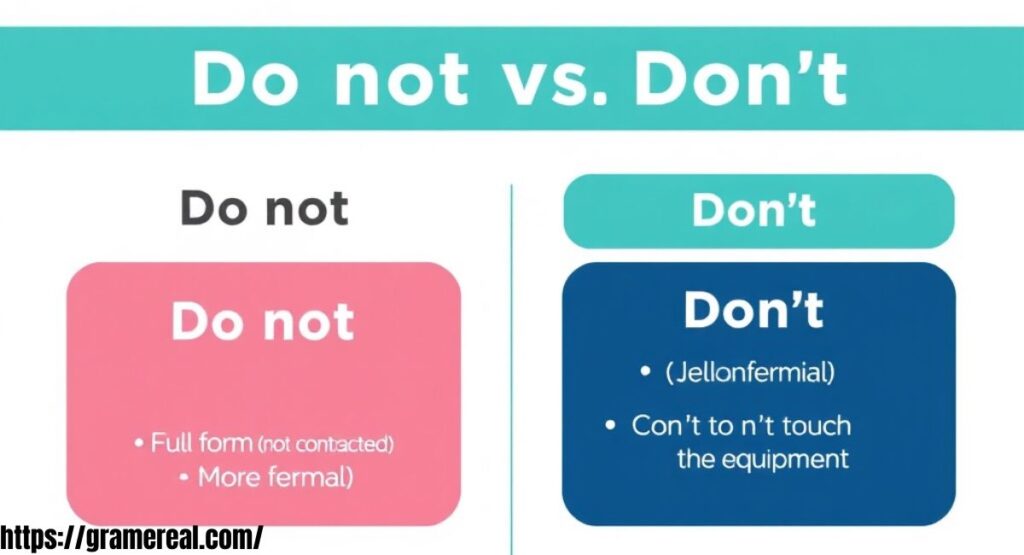
Do not vs don’t Have you ever stopped mid-sentence, unsure whether to write do not or don’t? You are not the only one. This tiny choice two separate words versus one short contraction can quietly change how your writing sounds to the reader. Use the wrong form in a formal report and it feels unprofessional. Use the wrong one in a casual email and it sounds stiff, even cold.
Here is the truth: both do not and don’t mean exactly the same thing. The real difference lies in tone, context, and formality. Knowing when to use each form is what separates a confident writer from one who second-guesses every sentence.
Do not vs don’t In this guide, you will get a full breakdown grammar rules, parts-of-speech analysis, pronunciation notes, common mistakes, American vs British differences, idiomatic expressions, and practical tips you can use right away. Whether you are writing an academic essay, a business email, or a casual text, this guide has you covered.
What Do “Do Not” and “Don’t” Mean?
At their core, both do not and don’t serve the same grammatical purpose they negate a verb in the present simple tense.
- Do not = the full, uncontracted negative auxiliary form
- Don’t = the contracted form (do + not joined with an apostrophe)
The meaning never changes. Only the tone, formality, and emphasis shift depending on which form you choose.
“Do not touch the equipment.” → Formal, authoritative, clear instruction
“Don’t touch the equipment.” → Natural, conversational, urgent reminder
Parts-of-Speech Analysis
Understanding the grammatical role of each word helps you use both forms correctly and confidently.
Breaking Down “Do Not”
| Word | Part of Speech | Function |
|---|---|---|
| Do | Auxiliary verb | Supports the main verb to form a negative |
| Not | Adverb | Negates the action of the main verb |
| (main verb) | Base-form verb | The action being negated |
Example: I do not understand the instructions.
- I → Personal pronoun (subject)
- do → Auxiliary verb (agrees with first-person singular)
- not → Adverb (negates “understand”)
- understand → Main verb, base form
- the instructions → Noun phrase (direct object)
Breaking Down “Don’t”
| Word | Part of Speech | Function |
|---|---|---|
| Don’tformality, | Contracted auxiliary + negative | Combined form of “do” + “not” |
| (main verb) | Base-form verb | The action being negated |
Example: I don’t understand the instructions.
- I → Personal pronoun (subject)
- don’t → Contracted auxiliary + negative adverb
- understand → Main verb, base form
- the instructions → Noun phrase (direct object)
Both sentences are grammatically identical only the register differs.
Form and Grammar Rules
Subject-Verb Agreement
This is where many learners make their biggest mistake. The auxiliary verb must match the subject:
| Subject | Full Form | Contracted Form |
|---|---|---|
| I | do not | don’t |
| You | do not | don’t |
| We | do not | don’t |
| They | do not | don’t |
| He | does not | doesn’t |
| She | does not | doesn’t |
| It | does not | doesn’t |
Critical rule: Never use don’t with a third-person singular subject (he, she, it). This is one of the most common errors in both spoken and written English.
- ❌ She don’t like the proposal.
- ✅ She doesn’t like the proposal. / She does not like the proposal.
The Base-Verb Rule
After do not or don’t, always use the base form of the main verb no -s, no -ing, no -ed endings.
- ❌ They don’t likes coffee.
- ✅ They don’t like coffee.
Imperative Sentences (Commands)
In negative commands, the subject “you” is implied and omitted. Both forms work, but they carry different weight:
- Do not open that file. → Stronger prohibition, often seen on signs or in formal instructions
- Don’t open that file. → Natural, everyday command
Pronunciation and Speech Notes
Spoken English almost always favors contractions. Saying do not in casual conversation can sound robotic, overly formal, or even aggressive, depending on context.
Stress and emphasis in speech:
When you want to emphasize a negative in speech, native speakers stress the word not or stretch the vowel in do:
- “I do NOT agree with that.” → Strong verbal emphasis (spoken)
- “Do NOT enter this room.” → Firm prohibition with vocal stress
The contraction don’t naturally carries a neutral, relaxed tone. Pronouncing it with sharp stress (DON’T) adds urgency without sounding as stiff as the full form.
Pronunciation tip: In fast, natural speech, don’t sounds like one smooth syllable: /doʊnt/. The full do not is two distinct words with a slight pause between them.
Punctuation and Spelling
The Apostrophe in “Don’t”
Do not vs don’t The apostrophe in don’t replaces the missing letter o from not. This is non-negotiable in standard English writing dont without an apostrophe is a spelling error.
- ✅ don’t (correct)
- ❌ dont (incorrect missing apostrophe)
Capitalization at the Start of a Sentence
Both forms can begin a sentence. Capitalize accordingly:
- Do not forget your ID.
- Don’t forget your ID.
Formal Writing Guidance
Do not vs don’t Most academic style guides including APA, MLA, and Chicago discourage contractions in formal papers. When in doubt, write do not to keep the tone professional and consistent.
Contextual Examples with Parts-of-Speech Labels
Example 1 — Casual Conversation
“I don’t think that’s a good idea.”
- I → Pronoun (subject)
- don’t → Contracted auxiliary + negative
- think → Main verb (base form)
- that’s a good idea → Noun clause (object)
Context note: Perfect for everyday speech, informal emails, or social media.
Example 2 — Formal Instruction
“Employees do not share confidential information outside the office.”
- Employees → Noun (plural subject)
- do → Auxiliary verb (agrees with plural subject)
- not → Adverb (negates the action)
- share → Main verb (base form)
- confidential information → Noun phrase (direct object)
Context note: Appropriate for company policy documents, legal text, and official notices.
Example 3 — Imperative (Command)
“Do not enter the restricted area without authorization.”
- (You) → Implied subject
- do not → Auxiliary + negative (imperative mood)
- enter → Main verb (base form)
- the restricted area → Noun phrase (direct object)
Context note: The full form on warning signs conveys authority and leaves no ambiguity.
Common Mistakes and How to Fix Them
Mistake 1: Using “don’t” with he/she/it
- ❌ He don’t want to attend the meeting.
- ✅ He doesn’t want to attend the meeting.
- ✅ He does not want to attend the meeting.
Fix: Whenever the subject is he, she, or it, switch to does not or doesn’t.
Mistake 2: Adding -s to the main verb
- ❌ They don’t needs help.
- ✅ They don’t need help.
Fix: The base verb never takes an -s after do not or don’t. The auxiliary already carries that grammatical load.
Mistake 3: Overusing “do not” in casual writing
- ❌ I do not think you should do not worry about it.
- ✅ I don’t think you should worry about it.
Fix: In informal emails, messages, and conversation, contractions are natural and expected. Overusing do not creates an unintentionally stiff tone.
Mistake 4: Using past tense incorrectly
- ❌ She didn’t saw the email.
- ✅ She didn’t see the email.
Fix: After didn’t (past negative), always use the base form of the verb — the auxiliary already signals past tense.
Mistake 5: Forgetting the apostrophe
- ❌ I dont know what happened.
- ✅ I don’t know what happened.
Fix: Always include the apostrophe. Dont is not a recognized English word.
American vs British English Notes
Both varieties of English use do not and don’t freely. However, some subtle differences exist:
| Feature | American English | British English |
|---|---|---|
| Contractions in informal speech | Very common | Very common |
| Contractions in formal writing | Discouraged | Discouraged |
| Semi-formal contexts | Don’t acceptable | Do not slightly preferred |
| Overall contraction frequency | Higher | Slightly lower in formal speech |
Do not vs don’t The core grammar rules subject-verb agreement, the base-verb rule, and tense are identical in both dialects. The distinction is a matter of style preference, not correctness.
Idiomatic Expressions and Common Phrases
Several common English idioms use don’t because they belong to the informal register:
| Expression | Meaning | Usage |
|---|---|---|
| Don’t mention it | You’re welcome (response to thanks) | Polite, informal |
| Don’t get me wrong | Don’t misinterpret what I’m saying | Conversational |
| Don’t hold your breath | Don’t expect it to happen soon | Casual warning |
| Don’t judge a book by its cover | Don’t form opinions based on appearances | Proverb |
| Don’t push your luck | Don’t risk losing what you already have | Informal caution |
Notice that formal equivalents using do not would sound unnatural in these expressions. “Do not mention it” is grammatically correct but rarely used idiomatically.
Practical Tips — When to Use Each Form
Use “do not” when:
- Writing academic papers, research reports, or essays
- Drafting legal documents or formal contracts
- Creating official signs, warnings, or public notices
- You want to add strong emphasis to a negative
- Writing professional business correspondence
Use “don’t” when:
- Speaking in everyday conversation
- Writing casual or friendly emails
- Posting on social media or writing a blog
- Communicating with colleagues in a relaxed setting
- Dialogue in fiction and creative writing
Quick mental test: Would you wear a suit saying this, or say it over coffee? Suit → do not. Coffee → don’t.
Rewriting for Clarity and Tone (Examples)
Do not vs don’t Sometimes a sentence needs to shift register. Here is how to move between forms effectively:
| Original (Casual) | Rewritten (Formal) |
|---|---|
| I don’t approve of this plan. | I do not approve of this plan. |
| Don’t forget to bring your ID. | Please do not forget to bring your ID. |
| They don’t accept late submissions. | Late submissions are not accepted. |
| Don’t be late. | Punctuality is expected. |
Notice that in formal rewrites, you can sometimes restructure the sentence entirely to avoid both forms a useful trick in academic or legal writing.
Longer Practice Examples (with Grammar Checks)
Practice 1 — Formal Email
“Please be advised that we do not process refunds after 30 days. If you do not receive a confirmation within 48 hours, do not hesitate to contact our support team.”
Grammar check: All uses of do not are correct and consistent with the formal email register. Subject-verb agreement is maintained. ✅
Practice 2 — Casual Text Message
“Hey! Don’t forget the meeting is at 3. I don’t have the address do you? Don’t worry if you’re a bit late.”
Grammar check: All contractions are appropriate for the casual register. Subject-verb agreement is correct (I don’t, not I doesn’t). ✅
Practice 3 — Public Notice
“Visitors do not feed the animals. Do not cross the safety barrier. Photography is permitted, but flash is not allowed inside the enclosure.”
Grammar check: Full forms are correct for official signage. Consistent formal register. ✅
Conclusion
Do not vs don’t The difference between do not and don’t comes down to one word: context. Their meaning is identical only the tone, register, and weight differ.Do not vs don’t Do not signals formality, authority, and emphasis. Don’t is the natural choice for everyday speech and casual writing.
Do not vs don’t Master two rules and you will get this right every time: first, match the auxiliary to the subject (do not/don’t for I/you/we/they; does not/doesn’t for he/she/it); second, always follow either form with the base form of the main verb. Apply these consistently, read your sentences aloud to check the tone, and choose the form that fits your audience.
FAQs
Is “don’t” incorrect in formal writing?
It is not incorrect, but it is considered too casual for academic papers, legal documents, and official reports use do not in those contexts.
Can I always replace “do not” with “don’t”?
In most cases, yes but in formal, emphatic, or legal contexts, do not is strongly preferred and carries more authority.
Why do native speakers rarely say “do not” in conversation?
Contractions are the natural rhythm of spoken English; don’t flows faster and sounds more genuine in everyday speech.
When should I use “doesn’t” instead of “don’t”?
Use doesn’t (does not) with third-person singular subjects: he, she, and it. Use don’t (do not) with I, you, we, and they.
Is “do not” rude or aggressive?
Not inherently, but it can sound strict or forceful depending on tone and context especially compared to the friendlier don’t.
Does the apostrophe in “don’t” matter?
Yes writing dont without the apostrophe is a spelling error. The apostrophe replaces the missing “o” from “not.”
Is there a difference between American and British English usage?
The core grammar rules are identical. British formal writing may slightly favor do not in semi-formal contexts, but both dialects follow the same grammatical principles.
Can “don’t” be used in imperative sentences?
Yes “Don’t touch that!” is perfectly correct. The full form “Do not touch that!” carries a stronger, more official tone.