
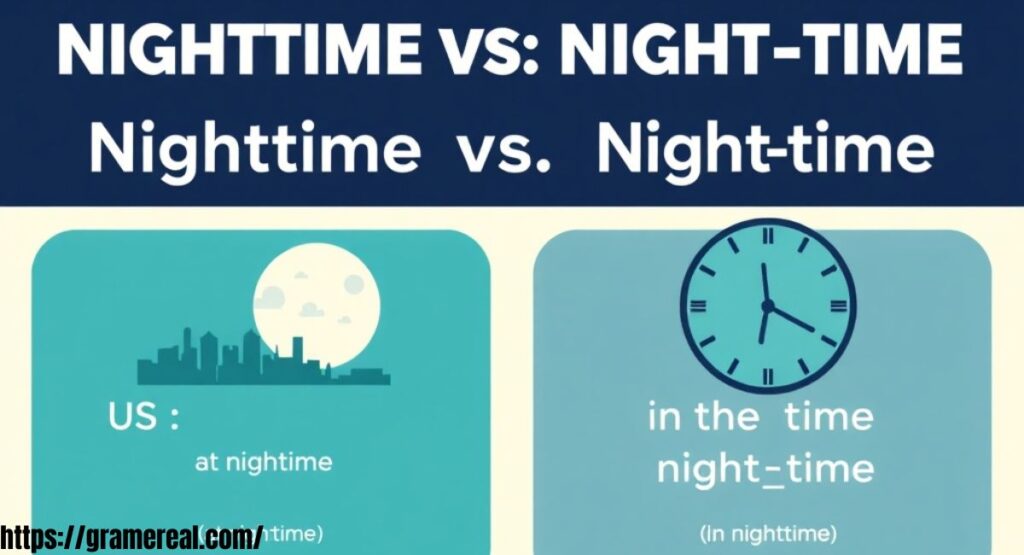
Nighttime and night-time both describe the same period of darkness the hours between sunset and sunrise when daylight has faded and the world grows still. The meaning of the word does not change with spelling; the difference is mainly regional and stylistic. Both forms are grammatically recognized, yet writers continue to misuse, mix, or misunderstand them every day.
Here is the truth most grammar guides bury in footnotes: the two-word form “night time” is never the correct spelling, yet it floods the internet. That single mistake quietly chips away at your writing’s credibility, whether you are crafting a blog post, a business report, or an academic essay.
The distinction is not one of right versus wrong, but of stylistic convention, regional preference, and grammatical function. Mastering it takes less than five minutes and the payoff is cleaner, more professional writing every time.
What Does “Nighttime vs Night-Time” Mean?
Both nighttime and night-time refer to the same thing: the period of darkness between sunset and sunrise. Neither spelling changes the meaning of the word. The confusion arises purely from spelling convention, not definition.
The word describes:
- The hours of darkness in a 24-hour cycle
- Activities, temperatures, or events that occur after dark
- A modifier describing something connected to the night (e.g., nighttime routine, night-time sky)
As a noun: “Nighttime is the best time for stargazing.” As a modifier (attributive noun): “The nighttime temperatures dropped below zero.”
Spelling History and Development
Understanding where these spellings came from helps make the right choice feel natural. <invoke name=”web_search”> English compound words typically follow a three-stage development path:
- Two separate words → night time (early usage)
- Hyphenated compound → night-time (transitional form)
- Closed compound → nighttime (modern standard)
This is the same path taken by words like daytime, lunchtime, mealtime, and bedtime all of which are now written as single closed compounds without debate.
In Middle English, “night” and “time” were used together but written separately. By the 18th and 19th centuries, writers began hyphenating the pair as night-time to signal a tighter conceptual link. By the mid-20th century, American publishing had fully adopted the closed compound nighttime as its standard. British English moved more slowly, and night-time remained common in UK texts much longer.
When to Use “Nighttime”
Use nighttime (one word, no hyphen) in the following situations:
- American English writing This is the recognized standard in the United States. Merriam-Webster lists nighttime as the primary entry and does not recognize night-time at all.
- Journalism The AP Stylebook uses nighttime consistently.
- Academic and professional writing The Chicago Manual of Style recommends nighttime for both noun and modifier uses.
- Digital and global content If you are writing for a broad or international audience, nighttime is the safest, most widely understood choice.
Examples:
- The nighttime air felt crisp and cool.
- Children often struggle with nighttime fears.
- Nighttime flights are quieter and less crowded.
- Security systems are designed for nighttime monitoring.
When to Use “Night-Time”
Use night-time (hyphenated) in these contexts:
- British English writing Oxford’s Lexico lists night-time as its preferred entry. While Cambridge Dictionary favors the closed form, many UK publications, school texts, and formal British documents still use the hyphenated version.
- Commonwealth countries Writers in Australia, Canada, India, and New Zealand may encounter night-time in style guides influenced by British standards.
- Following a specific house style If your publisher or employer requires the hyphenated form, follow their guide consistently.
Examples:
- The night-time temperatures were unusually mild for December.
- She loved the night-time silence of the countryside.
- Night-time driving requires extra caution.
Contextual Examples of Correct Usage
Seeing both forms in action makes the choice clearer:
| Context | American English | British English |
|---|---|---|
| Noun use | Nighttime brings stillness. | Night-time brings stillness. |
| Modifier use | A nighttime walk | A night-time walk |
| Weather writing | Nighttime lows of 5°C | Night-time lows of 5°C |
| Fiction writing | The nighttime forest was silent. | The night-time forest was silent. |
| Journalism | Nighttime curfew imposed | Night-time curfew imposed |
Both columns are grammatically correct. The right choice depends on your audience and the style guide you follow.
American vs British English
This is the heart of the nighttime vs night-time debate. Here is a clean summary:
| Feature | American English | British English |
|---|---|---|
| Preferred spelling | nighttime | night-time |
| Dictionary authority | Merriam-Webster | Oxford (Lexico) |
| Hyphen used? | No | Yes |
| Two-word form (“night time”) | Not accepted | Rarely accepted |
| Modern trend | Closed compound dominant | Slowly shifting to closed |
One important note: “night time” as two separate words is not correct in either dialect in formal writing. Neither Merriam-Webster nor Oxford accepts the open, two-word form as standard. Avoid it in professional, academic, or published content.
Common Mistakes with “Nighttime vs Night-Time”
Even careful writers make these errors. Knowing them in advance saves you from embarrassing edits.
❌ Mistake 1: Writing “night time” as two words in formal writing
Wrong: We went for a night time walk under the stars. Right: We went for a nighttime walk under the stars.
❌ Mistake 2: Using “night-time” in American English contexts
Wrong: The night-time temperature dropped to freezing. (in American writing) Right: The nighttime temperature dropped to freezing.
❌ Mistake 3: Mixing spellings within the same document
Wrong: The nighttime air was cool, but night-time activities were still popular. Right: The nighttime air was cool, but nighttime activities were still popular. (pick one and stay consistent)
❌ Mistake 4: Hyphenating after a verb
Wrong: The park closes at nighttime, so night-time visitors are turned away. Right: The park closes at nighttime, so nighttime visitors are turned away.
❌ Mistake 5: Applying the same hyphen rule to “daytime”
Some writers assume that if night-time is correct, day-time must be too. It is not. Daytime completed its evolution into a closed compound in both American and British English much earlier. Day-time looks archaic and incorrect in virtually all modern contexts.
Idiomatic and Natural Usage
Both forms appear in natural, idiomatic English. Here are some examples that show how the word lives and breathes in real writing:
- “Nighttime is when the city truly comes alive.”
- “She had developed a detailed nighttime routine that helped her sleep better.”
- “The night-time sky over rural Scotland was blanketed with stars.”
- “Children’s nighttime fears are common and usually outgrown by age eight.”
- “Nighttime drivers face unique hazards that daytime driving does not present.”
Related idioms that use nighttime as context:
- Burning the midnight oil working very late at night
- The dead of night the darkest, most silent hours
- Night owl a person who naturally stays up late
Practical Tips to Remember the Correct Form
Use these simple strategies to stop second-guessing yourself:
- Default to “nighttime” (one word) It works for American English, international audiences, journalism, and academic writing. When in doubt, this is your safest choice.
- Check your dictionary’s region If your spellchecker flags night-time, it is likely set to American English. Adjust the setting if you write for a British audience.
- Think of its family Daytime, lunchtime, bedtime, mealtime are all one word. Nighttime belongs to the same family.
- Never use “night time” in formal writing No major dictionary or style guide accepts the two-word open form in professional contexts.
- Pick one and be consistent Whether you choose nighttime or night-time, use the same spelling throughout your entire document.
Sentence Examples for Practice
Test your understanding with these practice sentences. The correct form is indicated for each.
- The air was cold but refreshing. → nighttime (AmE) / night-time (BrE)
- She developed a calming routine. → nighttime
- temperatures vary significantly in the desert. → nighttime / night-time
- We enjoyed a boat tour of the harbor. → nighttime
- The sounds of the forest were both eerie and beautiful. → nighttime / night-time
Why Using the Correct Form Matters
You might wonder whether this level of detail really matters. It does for several reasons:
- Credibility Inconsistent or incorrect spelling signals carelessness to editors, professors, and professional readers.
- Tone Using an outdated form like night time can make writing feel dated or informal, even when the intent is formal.
- SEO and publishing Digital content benefits from consistent, standard spelling. Search engines and readers process nighttime as a single semantic unit.
- Audience trust Writers who get small details right earn more trust on bigger ideas.
Reflection on Grammar Rules and Writing Techniques
The nighttime vs night-time question is a perfect example of how English grammar is not always a matter of absolute right and wrong it is often a matter of where, when, and for whom you are writing.
English compound words evolve naturally over time. Frequent pairings gradually fuse into single units because readers begin to perceive them as one concept, not two separate words placed side by side. This process is well-documented by linguists and explains why nighttime is simply following the same path as daytime, bedtime, and lifetime.
The practical lesson: follow your audience, follow your style guide, and stay consistent. Grammar rules exist to serve clarity and communication and in this case, both forms serve that purpose well within their respective dialects.
Conclusion
Nighttime or Night-Time: Common Mistakes and Correct Form is simpler than it looks. Use nighttime in American English. Use night-time in British English. Never write “night time” as two separate words in formal writing. The meaning stays the same across all spellings. Only the convention changes. Pick one form and stay consistent throughout your writing.
Understanding Nighttime or Night-Time: Common Mistakes and Correct Form makes you a stronger, more confident writer. Small spelling choices signal big things about your attention to detail. Major style guides, top dictionaries, and global publishers all agree on one thing consistency matters more than perfection. Follow your audience. Follow your style guide. Write with purpose. Get this right, and your writing immediately feels more polished and professional.
FAQs
Is “nighttime” one word or two?
Nighttime is correctly written as one word. The two-word form night time is not accepted in formal or professional writing by major dictionaries.
Is “night-time” correct?
Yes. Night-time is the standard spelling in British English and is accepted by Oxford’s Lexico, though nighttime is gaining ground even in the UK.
Which is correct in American English — “nighttime” or “night-time”?
In American English, nighttime (one word, no hyphen) is the only accepted standard. Merriam-Webster does not list night-time as a valid entry.
Can I use “nighttime” as an adjective?
Yes. Nighttime functions as both a noun (“I love the nighttime”) and an attributive modifier (“a nighttime walk”). No hyphen is needed in either role.
What does “nighttime” mean?
Nighttime refers to the period of darkness between sunset and sunrise the hours when night has fallen and daylight has not yet returned.
Why does British English still use “night-time”?
British English tends to preserve hyphenated compound forms longer than American English. Words like long-term, short-term, and part-time all retain hyphens in British style, and night-time follows that same pattern.
Is “night time” (two words) ever correct?
Almost never in formal writing. The two-word open form is considered archaic or poetic at best and incorrect at worst in modern standard English.
Does the spelling change the meaning?
No. Nighttime, night-time, and night time all refer to the same period of darkness. Only the spelling differs the meaning stays exactly the same.