Putted vs Put is one of the most common grammar confusions in the English language. It refers to the uncertainty many learners and speakers face when choosing between “putted” a word that seems like a logical past tense and “put,” which is the only correct form in standard English. Since “put” is an irregular verb, it stays the same across all tenses, making “putted” a grammatical error in everyday usage.
Putted vs Put: Common Usage Confusion Here is the truth that changes everything: one small word choice can silently damage your credibility in emails, essays, and conversations and most people never even realize they are making the mistake.
Putted vs Put: Common Usage Confusion Understanding the putted vs put distinction goes beyond memorizing a grammar rule. It reveals how irregular verbs work, why English does not always follow its own patterns, and how mastering these small but powerful exceptions builds stronger writing, sharper communication, and lasting confidence in your language skills.
Why “Put” Is Correct
Put is an irregular verb. Irregular verbs do not follow the standard rule of adding “-ed” to form the past tense. Instead, they follow their own patterns and sometimes, like “put,” they do not change at all.
The three principal forms of this verb are:
| Form | Word | Example |
|---|---|---|
| Base (Present) | put | I put the book on the desk. |
| Simple Past | put | She put the keys in her bag. |
| Past Participle | put | They have put everything away. |
Notice something? All three forms are identical. This is what makes “put” special and confusing. The verb stays the same no matter which tense you are using.
Other irregular verbs work the same way. Think of cut you would never say “cutted.” Think of shut nobody says “shutted.” Put follows exactly the same logic.
Why “Putted” Is Wrong
Putted vs Put: Common Usage Confusion When learners first encounter the past tense of “put,” many instinctively add “-ed” to create “putted.” This feels logical because regular verbs like walk → walked and talk → talked work this way. However, standard English grammar does not allow the form putted when referring to placing something somewhere.
While “putted” may seem like it should be the correct past tense form of “put,” it is not accepted in general English usage. The past tense of “put” is simply “put.”
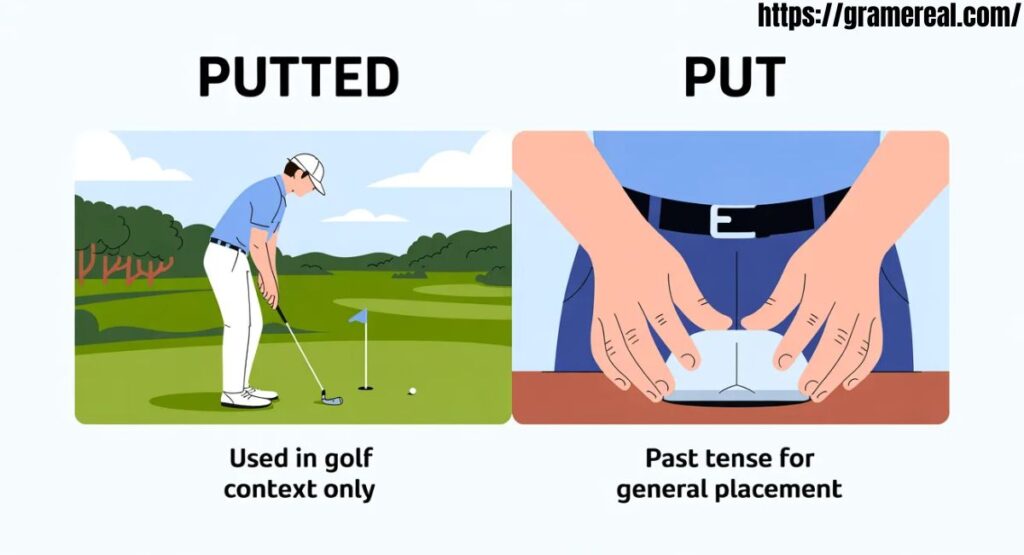
There is one narrow exception: golf. In golf terminology, “putted” is used to describe the action of gently striking a ball toward the hole using a putter. This is because the golf term comes from the noun putt, not from the verb put. They are different words entirely.
- ✅ She putted the ball into the hole. (golf context acceptable)
- ❌ She putted her phone on the table. (everyday context incorrect)
Outside of a golf course, using “putted” will be marked as an error by teachers and noticed as a mistake by readers.
Meaning of “Put” in Simple Words
Putted vs Put: Common Usage Confusion The verb put means to move something to a particular position or place. It expresses the action of placing, moving, or setting something somewhere.
Common meanings include:
- To place an object in a location (Put the bag on the floor.)
- To cause someone or something to be in a certain state (Don’t put me in a difficult position.)
- To express something in words (Let me put it simply.)
- To assign blame or responsibility (Don’t put this on me.)
Despite its short spelling, “put” carries a wide range of meanings making it one of the most versatile verbs in English.
Examples in Present Tense
In the present tense, “put” behaves like other verbs, but note the third-person singular form adds an “s.”
| Subject | Sentence |
|---|---|
| I | I put my keys near the door every morning. |
| You | You always put too much sugar in your tea. |
| He / She | She puts the dishes away after every meal. |
| We | We put in a lot of effort at work. |
| They | They put their phones on silent during class. |
Examples in Past Tense
This is where confusion usually strikes. Remember: the past tense of “put” is still put. Nothing changes.
| Situation | Correct Sentence | Incorrect Sentence |
|---|---|---|
| Yesterday | I put the report on your desk. | ~~I putted the report on your desk.~~ |
| Last night | She put the baby to sleep. | ~~She putted the baby to sleep.~~ |
| This morning | He put his jacket on the chair. | ~~He putted his jacket on the chair.~~ |
| Earlier today | We put all the files in the folder. | ~~We putted all the files in the folder.~~ |
Putted vs Put: Common Usage Confusion The sentences in the “incorrect” column might feel right if you are used to regular verbs but they are all grammatical errors.
Using “Put” in Questions
When forming questions using “put,” the structure follows standard English question patterns. The verb itself remains unchanged.
Yes/No Questions:
- Did you put the milk back in the fridge?
- Has she put the documents in the drawer?
- Will they put the chairs back in place?
- Where did you put my glasses?
- Why did he put the report on hold?
- When did they put the new policy into effect?
Notice that “put” stays the same in all of these. The helping verb (did, has, will) carries the tense “put” just provides the action.
Using “Put” in Negative Sentences
Forming negative sentences with “put” follows the same rule. You add the negative helper (did not / didn’t, has not / hasn’t), and “put” remains unchanged.
- I did not put the book there. (or: I didn’t put the book there.)
- She has not put the groceries away yet.
- They did not put enough time into the project.
- He hasn’t put the dishes in the sink.
Put as a Past Participle
The past participle of “put” is also put. It is used with helping verbs like have, has, had, is, was, been, and get to form perfect tenses or passive voice.
Perfect Tense Examples:
- I have put all the files in order.
- She has put a lot of thought into this decision.
- They had put the equipment away before it rained.
Passive Voice Examples:
- The books were put back on the shelf by the librarian.
- The plan was put into action last Monday.
- A notice has been put on the board.
The three forms of “put” present, past, and past participle are all simply “put.” This makes it one of the few verbs in English that never changes its spelling across all tenses.
Common Mistakes Students Make
Understanding where mistakes happen helps you avoid them. Here are the most frequent errors made with this verb:
1. Writing “putted” in general sentences This is by far the most common error. Students familiar with regular verbs automatically add “-ed.”
- ❌ I putted my phone on silent.
- ✅ I put my phone on silent.
2. Confusing “put” with similar-sounding verbs “Putt” (the golf term) and “put” sound almost the same. This leads people to borrow the past tense “putted” from golf and apply it incorrectly to everyday situations.
3. Using “have putted” in perfect tenses
- ❌ I have putted everything in its place.
- ✅ I have put everything in its place.
4. Applying regular verb logic to an irregular verb This is the root cause of all the above mistakes. “Put” is an irregular verb, meaning it does not follow the typical pattern of adding “-ed.” Instead, the past tense remains unchanged as “put.” Since most verbs follow the regular pattern, “put” stands out as an exception that requires direct memorization.
Easy Memory Trick
Here is a simple trick that works every time:
“You cut, you cut, you have cut no changes needed.” Now replace cut with put: “You put, you put, you have put.”
If you would not say “cutted” or “shutted,” do not say “putted” unless you are on a golf course.
Another way to remember: think of “put” as a word that refuses to grow up. It stays the same no matter how old (what tense) it gets.
Short Practice Story
Read the following short story and notice how “put” is used naturally across different tenses.
Every morning, Sana puts her notebook in her bag before leaving for school. Yesterday, she put her pencil case in the wrong pocket and spent ten minutes searching for it. By the time she found it, she had already put everything else neatly in place. She has put a sticky note on her bag now so she never forgets again.
Did you notice? “Put” appeared four times in four different tenses and it never changed its form once. That is how the verb works in real, natural English.
Why This Rule Is Important
Grammar is not just about passing exams. It is about how people perceive you in professional and academic settings.
Using the right form of verbs helps ensure clear communication. If you use “putted” in a professional email, your recipient may become confused or even question your grammar knowledge.
Beyond impressions, using correct verb forms makes your writing cleaner, more confident, and easier to read. Once you master small rules like this one, your overall fluency improves significantly.
This also opens the door to understanding other irregular verbs words like cut, shut, hit, set, spread, hurt which all follow a similar pattern of remaining unchanged in the past tense.
Final Reminder
Before you write your next sentence using “put,” remember these three key points:
- Put is an irregular verb it does not follow the “-ed” rule.
- The past tense of put is put not “putted.”
- “Putted” is only correct in golf never in everyday English.
Whether you are writing an essay, sending a work email, or speaking in class, always use put in the present, in the past, and with helping verbs. It is one of the simplest verbs in English once you stop fighting the urge to add “-ed.”
FAQs
Is “putted” ever correct in English?
Yes, but only in golf. “Putted” is the past tense of the golf term “putt,” which refers to hitting the ball toward the hole with a putter. In all other contexts, “putted” is incorrect.
What is the past tense of “put”?
The past tense of “put” is simply “put.” It does not change. Example: Yesterday, I put the letter in the mailbox.
Is “put” a regular or irregular verb?
“Put” is an irregular verb. Unlike regular verbs that add “-ed” in the past tense, “put” remains unchanged across all tenses.
What are the three forms of the verb “put”?
All three forms are identical: put – put – put (base form, simple past, past participle).
Can I say “I have putted it there”?
No. The correct form is “I have put it there.” “Putted” is not used in perfect tenses outside of golf.
Why do so many people use “putted” incorrectly?
Because most English verbs are regular and follow the “-ed” pattern. Learners apply this logic to “put” without realizing it is irregular. The similarity in sound between “put” and “putt” (the golf term) also adds to the confusion.
What are some other verbs like “put” that don’t change?
Other verbs that remain the same in past tense include cut, shut, hit, set, hurt, let, spread, and burst.
How can I practice using “put” correctly?
Write five sentences each day using “put” in different tenses present, past, and perfect. Reading English books and watching shows in English also helps you see the verb used naturally.