
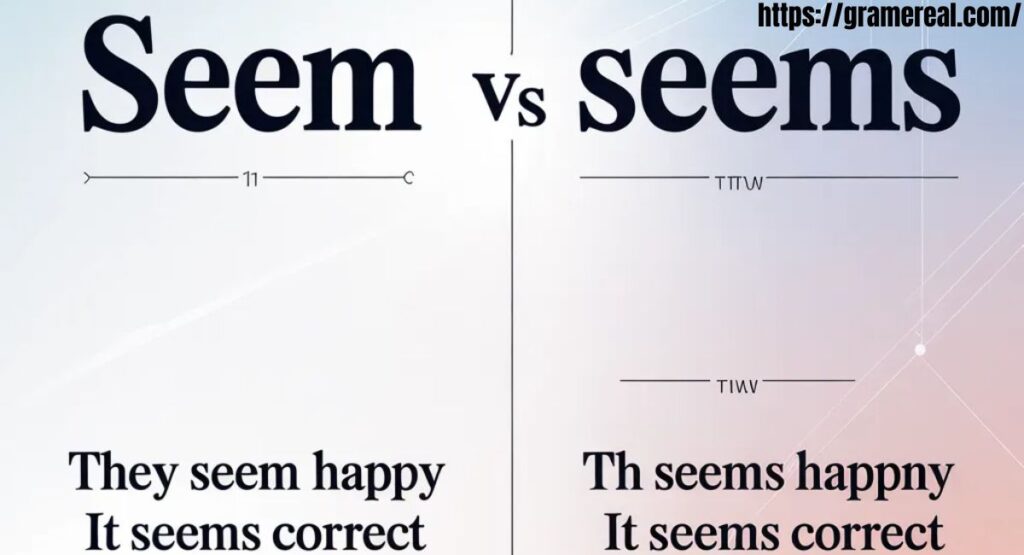
Seem vs seems are two present-tense forms of the same linking verb, and knowing how to use correctly each one comes down to a single grammar principle: subject-verb agreement. Seem pairs with plural subjects like they and we, while seems pairs with singular third-person subjects like he, she, and it. Both words express appearance, impression, or likelihood never a definite fact.
One small word. One tiny letter s. Yet that single difference can make your writing look polished and professional or instantly signal a grammar slip that undermines your credibility with every reader.
Mastering seem vs seems unlocks sharper, more confident writing across every context from casual texts to academic essays and professional emails. This guide walks you through subject-verb agreement, tricky sentence structures, common mistakes, and real-world examples, giving you everything needed to choose the right form every single time.
Understanding the Basic Difference Between Seem vs Seems
The difference between seem and seems is not about meaning both words carry the exact same definition. The difference is purely grammatical. It comes down to one foundational rule: subject-verb agreement.
In English, a verb must match its subject in number and person. Seem is a linking verb, and like all verbs, it changes form depending on who or what the subject is.
What Does “Seem” Mean?
“It seems difficult” means “It looks difficult” or “I think it is difficult.”
Seem is used to soften statements, express uncertainty, or describe perception rather than proven reality. That is why it appears so frequently in academic writing, professional emails, and everyday conversation.
What Does “Seems” Mean?
Seems carries the exact same meaning as seem. The only difference is that seems is the third-person singular present tense form of the verb. You use it when the subject is he, she, it, or any singular noun.
| Form | Meaning | Use With |
|---|---|---|
| Seem | appearance/impression | I, you, we, they + plural nouns |
| Seems | appearance/impression | He, she, it + singular nouns |
Subject-Verb Agreement With Seem vs Seems
Subject-verb agreement is the engine behind this entire rule. Every English verb must agree with its subject in person (first, second, or third) and number (singular or plural).
Here is how seem maps across all grammatical persons:
| Subject | Correct Form | Example |
|---|---|---|
| I | seem | I seem nervous today. |
| You | seem | You seem ready. |
| He / She / It | seems | She seems confident. |
| We | seem | We seem lost. |
| They | seem | They seem excited. |
| Singular noun | seems | The plan seems risky. |
| Plural noun | seem | The results seem accurate. |
The rule is consistent. Once you know your subject, the correct form becomes automatic.
Seem vs Seems in Present Tense
In the present tense, the distinction between seem and seems is active and important.
- ✅ They seem happy today.
- ✅ She seems tired after work.
- ❌ They seems happy today. (plural subject needs seem)
- ❌ She seem tired after work. (singular third-person needs seems)
The present tense is where writers most commonly make mistakes, particularly when a long phrase separates the subject from the verb.
Watch Out for Hidden Subjects
Sometimes a long phrase sits between the subject and the verb, making it easy to lose track of which noun is really in charge.
- ❌ The list of items seem confusing.
- ✅ The list of items seems confusing.
The real subject here is list, which is singular not items, which is plural. Always identify the core subject before choosing your verb form.
Seem vs Seems in Past and Future Tense
Good news: in the past and future tenses, the seem vs seems debate disappears entirely.
- Past tense: Both become seemed regardless of the subject.
- I seemed confused. / She seemed confused. / They seemed confused.
- Future tense: Both use will seem regardless of the subject.
- It will seem strange. / They will seem fine.
The singular vs plural distinction only applies in the present tense.
Seem vs Seems With Adjectives
Seem is a copular (linking) verb, which means it connects a subject to a describing word. That describing word is always an adjective, never an adverb.
- ✅ He seems calm. (adjective correct)
- ❌ He seems calmly. (adverb incorrect)
More examples:
| Subject | Verb | Adjective |
|---|---|---|
| She | seems | confident |
| The room | seems | quiet |
| They | seem | excited |
| The solution | seems | simple |
The adjective that follows does not change which form of the verb you use. The subject alone controls that.
Seem vs Seems With Infinitives
Both seem and seems are commonly followed by an infinitive (to + verb). The subject still drives the verb form.
- I seem to understand the problem.
- They seem to agree.
- He seems to know the answer.
- It seems to work well.
There are three infinitive patterns worth knowing:
- Simple infinitive describes a current impression: She seems to cry a lot.
- Continuous infinitive describes something happening right now: You seem to be working very hard.
- Perfect infinitive describes the impression of a past action: He seems to have forgotten.
Seem vs Seems in Questions
When forming questions, an auxiliary verb (do or does) is added. Here is the key rule: after does, always use the base form seem, never seems.
- ✅ Does she seem okay?
- ✅ Do they seem ready?
- ❌ Does she seems okay?
This trips up many learners because does already marks the third-person singular the main verb reverts to its base form.
Seem vs Seems in Negative Sentences
The same logic applies to negative sentences. Use do/does + not + seem (base form).
- ✅ He does not seem ready.
- ✅ They do not seem interested.
- ❌ He does not seems ready.
In informal writing, contractions are perfectly fine: He doesn’t seem ready. / They don’t seem interested.
Contextual Examples of Seem vs Seems
Seeing both forms used in realistic contexts helps them stick. Here are examples across different settings:
Everyday conversation:
- You seem upset. Is everything okay?
- They seem like a friendly group.
Academic writing:
- The data seem inconsistent with the hypothesis.
- The proposed solution seems effective based on the results.
Professional communication:
- The client seems satisfied with the proposal.
- The timelines seem manageable given our resources.
Formal structures:
- It seems that the meeting has been rescheduled.
- It seems as if the project will finish on time.
Common Mistakes With Seem vs Seems
Even experienced writers make these errors. Here are the most frequent ones and how to fix them:
| Incorrect | Correct | Reason |
|---|---|---|
| She seem tired. | She seems tired. | She is third-person singular |
| The results seems accurate. | The results seem accurate. | Results is plural |
| He do not seems ready. | He does not seem ready. | After does, use base form |
| Does it seems right? | Does it seem right? | After does, use base form |
| The team seem divided. | The team seems divided. | Team is a singular collective noun |
Seem vs Seems in Formal and Informal Writing
Both seem and seems work equally well in formal and informal contexts. There is no register difference between the two forms only the subject changes which one you use.
However, the broader structure around seem can shift by register:
- Informal: It seems like the plan failed.
- Formal: It seems that the plan failed.
In academic and professional writing, it seems that (with a that-clause) is generally preferred over it seems like. Both are grammatically correct, but the that construction sounds more precise in formal settings.
American vs British English Usage
This is one of the easiest points in the article: there is no difference. Both American and British English follow the same subject-verb agreement rules for seem and seems. The forms are identical across all English-speaking regions.
Idiomatic and Natural Expressions
Several everyday expressions use seem or seems naturally:
- It seems like a good idea. expressing a positive impression
- It seems as if it will rain. expressing a prediction based on observation
- It doesn’t seem right. expressing doubt or concern
- That seems fair. agreeing in conversation
These phrases still follow the same subject-verb rule. It is singular, so seems is always correct in these constructions.
Passive Voice With Seem and Seems
Seem and seems can appear alongside passive voice structures. In these cases, the subject receives the impression rather than performing an action.
- The task seems completed.
- The results seem confirmed by the data.
- The project seems well-organized.
The verb rule still applies: match seem or seems to the subject, regardless of what follows.
Grammar Rules Applied
Here is a clean summary of every rule covered:
- Singular subject (he/she/it/singular noun) → seems
- Plural or other subjects (I/you/we/they/plural noun) → seem
- Past tense → seemed (all subjects)
- Future tense → will seem (all subjects)
- After does/does not → seem (base form)
- Followed by adjective → adjective only, not adverb
- Followed by infinitive → to + base verb
- Formal writing → prefer “it seems that” over “it seems like”
Writing Techniques Used
Strong writers use seem and seems strategically:
- To soften claims in academic or analytical writing (“The data seems to suggest…”)
- To express uncertainty without making absolute statements (“It seems unlikely…”)
- To describe perception rather than hard facts (“She seems confident in the meeting.”)
- To invite conversation by framing observations gently (“You seem quiet today.”)
Practical Tips to Remember Seem vs Seems
- Identify the subject first always locate the subject of your sentence before choosing seem or seems.
- The he/she/it test if you can replace your subject with he, she, or it, use seems.
- Read it aloud your ear will often catch what your eye misses.
- Remember the does rule after does or does not, always revert to the base form seem.
- Watch for long phrases a prepositional phrase between subject and verb can disguise which noun is really in charge.
Rewritten and Polished Explanation (Clear and Simple)
Think of it this way:
If your subject is one person or thing (other than I or you), use seems. If your subject is more than one, or is I, you, we, or they, use seem.
That is the whole rule. Every other detail in this guide is just an application of that single principle.
Conclusion
The seem vs seems question has one clean answer: subject-verb agreement. Use seems when your subject is he, she, it, or any singular noun. Use seem with I, you, we, they, and plural nouns. In past tense, both become seemed. After auxiliary verbs like does, always use the base form seem.
Once you identify your subject, the correct form follows naturally. Practice with real sentences, read your writing aloud, and apply the he/she/it test whenever you are unsure. With these habits in place, you will use seem and seems correctly and confidently every time.
FAQs
Is “he seem happy” correct?
No. The correct form is “he seems happy” because he is a third-person singular subject.
Do past tense sentences use seem or seems?
Neither in past tense, both become seemed regardless of the subject.
Is there a meaning difference between seem and seems?
No. Both words carry the same meaning; only the grammatical subject determines which form to use.
Can I say “it seem like rain”?
No. It is singular, so the correct form is “it seems like rain.”
Do American and British English use these forms differently?
No. Both varieties follow the same grammar rule for seem and seems.
Can seem be used in questions?
Yes. For example: “Do they seem ready?” or “Does she seem okay?”
Is “seems to be” correct?
Yes. “Seems to be” is perfectly correct and common in both formal and informal writing.
Is “seem” used with does?
Yes and importantly, after does, you must use the base form seem, never seems.
What is the easiest way to remember the rule?
Apply the he/she/it test: if you can replace the subject with he, she, or it, use seems. Otherwise, use seem.
Can seem express uncertainty in academic writing?
Yes. Seem is widely used in academic writing precisely because it softens claims and expresses evidence-based impressions rather than absolute facts.