
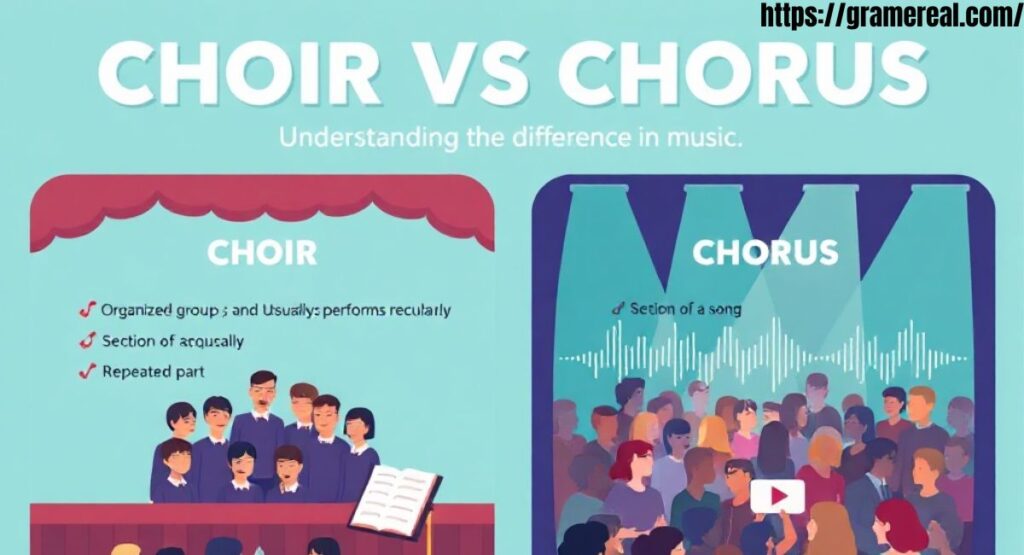
Choir vs Chorus: Understanding the Difference in Music Have you ever wondered whether to call a group of singers a choir or a chorus? You’re not alone. These two terms appear everywhere in churches, concert halls, Broadway stages, and school music programs and people use them interchangeably all the time. But they are not the same thing. Knowing the real difference helps you communicate more clearly about music, choose the right group to join, and even write and speak with greater precision.
Choir vs Chorus: Understanding the Difference in Music This guide breaks down the meaning of each term, highlights the key differences, clears up common mistakes, and gives you practical tips for choosing the right word every time.
What Is a Choir?
Choir vs Chorus: Understanding the Difference in Music A choir is an organized group of singers who perform together, usually under the direction of a conductor or choir director. Choirs are most strongly associated with:
- Religious settings churches, cathedrals, and places of worship
- Schools and universities as part of formal music education
- Classical and sacred music hymns, choral compositions, oratorios
A typical choir is divided into vocal sections based on voice range: soprano, alto, tenor, and bass (SATB). Members rehearse regularly and work toward a unified, blended sound. The emphasis is on harmony, precision, and musical discipline.
Choirs focus exclusively on vocal performance. You won’t find dancers or actors in a choir only singers. This makes the term fairly specific in its scope.
Example sentence: The church choir performed Handel’s Messiah during the Christmas service.
Types of Choirs
- Church choir performs sacred music during religious services
- School choir student singers trained as part of a music curriculum
- Chamber choir a small, select group of highly trained singers
- Community choir open to the public, often performs diverse repertoire
- A cappella choir performs without instrumental accompaniment
What Is a Chorus?
Choir vs Chorus: Understanding the Difference in Music A chorus is a broader, more flexible term. Like a choir, it can refer to a group of singers but it goes further. A chorus may also include dancers, actors, and other performers, making it common in theatrical and entertainment contexts.
The word “chorus” also has a second, completely separate meaning in music: the repeated section of a song the part you can’t get out of your head after listening. This is sometimes called the refrain.
Choruses are frequently associated with:
- Musical theater and Broadway productions
- Operas where the chorus supports the principal soloists
- Community and civic performances
- Pop and rock music referring to the repeated hook of a song
Example sentence: The chorus of the musical burst onto the stage, singing and dancing in perfect unison.
Two Meanings of “Chorus”
| Meaning | Description | Example |
|---|---|---|
| Group of performers | Singers (and sometimes dancers/actors) in a show | “The chorus in Hamilton was spectacular.” |
| Song section | The repeated, catchy part of a song | “I can’t stop humming the chorus of that song.” |
Key Differences Between Choir and Chorus
Here is a clear, side-by-side comparison of the two terms:
| Feature | Choir | Chorus |
|---|---|---|
| Performers | Singers only | Singers, dancers, actors |
| Setting | Religious, academic, classical | Theater, entertainment, community |
| Music style | Sacred, classical, formal | Secular, theatrical, broad range |
| Song section | Not used this way | Refers to the repeated refrain |
| Conductor | Usually has a choir director | May or may not have a conductor |
| Figurative use | Not common | “A chorus of criticism” |
| Associated phrase | “Preaching to the choir” | “The chorus of the song” |
The most important practical difference: if you’re talking about the repeated section of a song, only “chorus” works — never “choir.”
Contextual Examples
Choir vs Chorus: Understanding the Difference in Music Understanding these terms becomes much easier when you see them used in real-world contexts.
Choir in Context
- She joined the choir at her local Baptist church and rehearsed every Wednesday.
- The university choir toured Europe performing Bach cantatas.
- The children’s choir sang carols at the school winter concert.
Chorus in Context
- Every actor in the chorus had to audition for both singing and dancing.
- The chorus of “Bohemian Rhapsody” is one of the most recognized in rock history.
- The new policy faced a chorus of opposition from community leaders. (figurative use)
When Both Work
Sometimes both terms are acceptable. If a group of people are singing together at a public event, you can call them either a choir or a chorus context and tradition usually guide the choice.
Common Mistakes
Even experienced writers and music lovers mix these up. Here are the most frequent errors:
- Using “choir” to describe a song section Incorrect: “The choir of the song was catchy.” Use “chorus” instead.
- Assuming all choruses are choirs A theatrical chorus that includes dancers is not a choir.
- Using “choir” in figurative speech You can say “a chorus of complaints,” but not “a choir of complaints.”
- Treating the terms as always interchangeable They overlap, but they are not identical in every context.
American vs British English Differences
Choir vs Chorus: Understanding the Difference in Music There is a subtle difference in how these terms are used across varieties of English.
- In American English, school singing groups are more often called choruses (e.g., “the school chorus”), while church groups are called choirs.
- In British English, both school and church groups are more commonly referred to as choirs.
- The term chorale (pronounced kuh-RAL) appears in both varieties and typically refers to a choral composition or a formal choral society, borrowing from German musical tradition.
This explains why two people from different countries might describe the same group using different words and both be correct within their own dialect.
Idiomatic Expressions Involving Choir and Chorus
Expressions with “Choir”
- “Preaching to the choir“ Arguing for something to people who already agree with you. Example: “You don’t need to convince me to exercise more you’re preaching to the choir.”
Expressions with “Chorus”
- “A chorus of…” A large number of voices expressing the same opinion simultaneously. Example: “The announcement was met with a chorus of boos from the audience.”
- “Join the chorus” To add your voice to a group of people saying the same thing. Example: “After the report came out, more analysts joined the chorus calling for reform.”
Note that “choir” has far fewer idiomatic uses than “chorus.” When in doubt about figurative or idiomatic speech, “chorus” is nearly always the correct choice.
Practical Tips for Choosing the Right Word
Use this simple decision guide whenever you’re unsure:
- Are you referring to the repeated section of a song? → Always use chorus.
- Are the performers in a church or singing sacred/classical music? → Use choir.
- Are the performers in a musical, opera, or theater show? → Use chorus.
- Is it a school singing group? → In American English, use chorus; in British English, use choir.
- Are you using a figurative expression? → Use chorus (e.g., a chorus of criticism).
- Are the performers singing AND dancing? → Use chorus, not choir.
When in doubt in a modern, non-religious context chorus is the safer choice.
Conclusion
Both choir and chorus describe groups of singers, but they are not fully interchangeable. A choir focuses on vocal performance in religious, academic, or classical settings. A chorus is broader it may include dancers and actors, is common in theater and entertainment, and also names the repeated section of a song.
The key takeaway: context determines the correct term. Understanding these differences helps you speak and write more precisely about music, whether you’re a performer, student, writer, or simply a music lover. Next time you hear a group of voices fill a room, you’ll know exactly what to call them.
FAQs
Can “choir” and “chorus” be used interchangeably?
Sometimes, but not always. Both can refer to a group of singers, but “chorus” is the only correct term for the repeated section of a song or a group that includes dancers.
What is the difference between a choir and a chorale?
A chorale typically refers to a formal choral composition (often harmonized hymns) or a structured choral society, while a choir is the performing group itself.
Is a school singing group a choir or a chorus?
In American English, school groups are usually called a “chorus.” In British English, “choir” is more common for both school and church groups.
Can a chorus include non-singers?
Yes. In theatrical and opera productions, a chorus often includes dancers and actors alongside singers something a traditional choir does not do.
What does “preaching to the choir” mean?
It means making an argument to people who already agree with you, so your persuasion is wasted effort.
Which term is used in musical theater?
“Chorus” is the standard term in musical theater and opera. Chorus members may sing, dance, and act as part of the production’s ensemble.
Is “chorus” used in pop music?
Yes. In pop, rock, and most contemporary music, “chorus” refers to the repeated, often most memorable section of a song distinct from the verse and bridge.
What is an a cappella choir?
An a cappella choir is a vocal ensemble that performs without any instrumental accompaniment, relying entirely on the singers’ voices for harmony and melody.