Who else vs whom else If you have ever typed “who else was there?” and paused wondering if it should be “whom else,” you are not alone. Who else vs whom else This question trips up even confident English writers. The good news? Once you understand the simple subject-object rule, you will never hesitate again.
Who else vs whom else This guide covers everything from basic grammar rules to American vs British usage, common mistakes, idiomatic phrases, and a quick cheat sheet you can bookmark today.
What Do “Who” and “Whom” Actually Mean?
Who else vs whom else At their core, who and whom are both pronouns used to refer to people. The difference between them is grammatical function, not meaning.
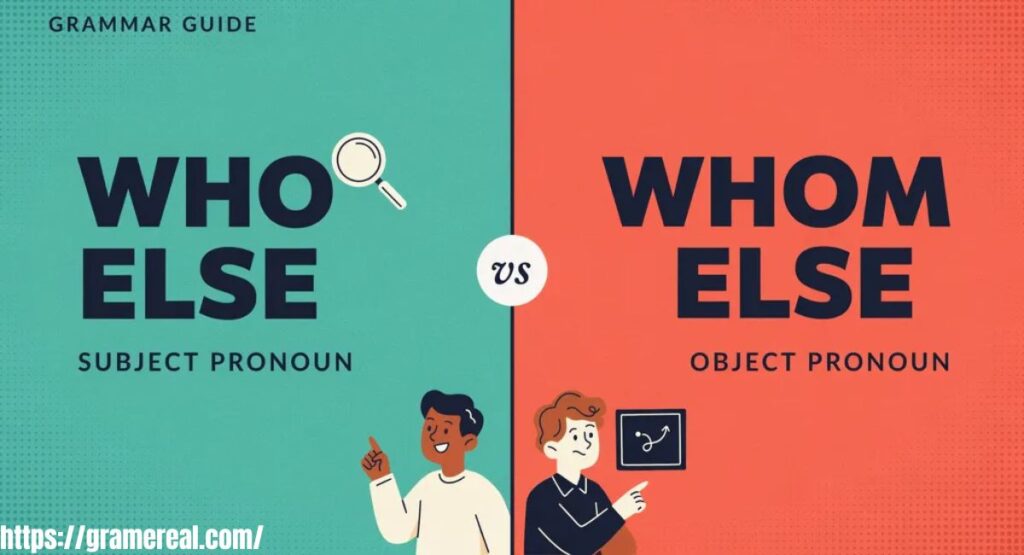
- Who = subject pronoun (like he, she, they)
- Whom = object pronoun (like him, her, them)
Think of it this way: if you can replace the word with he or she, use who. If you can replace it with him or her, use whom.
Who called? → He called. ✅ (subject) Whom did you call? → You called him. ✅ (object)
Parts of Speech: A Quick Analysis
| Pronoun | Grammatical Role | Case | Example |
|---|---|---|---|
| Who | Subject | Nominative | Who is coming to dinner? |
| Whom | Object | Objective | Whom should I invite? |
| Who else | Subject + addition | Nominative | Who else is joining us? |
| Whom else | Object + addition | Objective | Whom else did you invite? |
The word else simply adds the meaning of “in addition” or “besides.” It does not change the grammatical case of who or whom.
Why Do People Say “Who Else” More Often?
In everyday speech and informal writing, “who else” is used far more frequently than “whom else.” There are two reasons for this:
- “Whom” sounds formal. Most native speakers avoid it in casual conversation, even when it is technically correct.
- “Who else” covers both roles in informal speech. English has been gradually shifting away from the whom form for centuries, and spoken American English has nearly completed that shift.
Grammar experts and style guides (including The Chicago Manual of Style) acknowledge that “whom” is becoming rare in everyday speech, though it remains important in formal writing, academic papers, legal documents, and journalism.
The Rule in Simple Steps
Follow these three steps every time you are unsure:
1: Remove the word “else” temporarily.
2: Rephrase the sentence to answer it with he/him or she/her.
3: If the answer uses he/she → use who. If the answer uses him/her → use whom.
Quick Example
“(Who/Whom) else should I contact?”
- Rephrase: “Should I contact him?” → Yes → use whom
- Correct: “Whom else should I contact?”
“(Who/Whom) else is responsible?”
- Rephrase: “He is responsible.” → Yes → use who
- Correct: “Who else is responsible?”
Many Short Examples: Subject vs Object
Using “Who Else” (Subject Position)
- Who else is coming to the party?
- Who else knows about this plan?
- Who else was in the room?
- Who else can I trust?
- Who else has seen the report?
- Who else wants coffee?
- Who else agreed with her decision?
Using “Whom Else” (Object Position)
- Whom else did you invite?
- Whom else should we contact?
- Whom else did the manager blame?
- Whom else have you told?
- Whom else would you recommend?
- Whom else did she mention?
- Whom else can we trust besides him?
Grammar Note: Questions and Word Order
Word order in English questions can make the subject-object distinction tricky. When a question is formed, the object often moves to the front of the sentence, which is why whom sounds awkward — we are not used to seeing objects at the start.
Declarative (statement):
You invited [someone].
[Whom] did you invite?
Who else vs whom else Here, whom is the object of “invite,” but it is placed first in the question. This inversion confuses people, leading them to default to who in almost every situation.
Grammar tip: In indirect questions (embedded clauses), the word order does not invert, making the right choice clearer.
- Direct: Whom else did they select?
- Indirect: I don’t know who else they selected.
Notice that in indirect questions, who is often acceptable because it functions more naturally within the clause structure.
Common Mistakes and How to Fix Them
Mistake 1: Using “whom” as a subject
❌ Whom else is going? ✅ Who else is going? (The pronoun is the subject of “is going.”)
Mistake 2: Using “who” as an object
❌ Who else did you speak to? ✅ Whom else did you speak to? (formal/written) ✅ Who else did you speak to? (informal/spoken — widely accepted)
Mistake 3: Confusing preposition placement
❌ To who else should I send this? ✅ To whom else should I send this? (Prepositions always take whom, not who.)
Mistake 4: Overthinking in casual speech
In spoken English, insisting on “whom else” in casual conversation can actually sound unnatural. Save it for formal contexts.
American vs British English: Is There a Difference?
Yes but it is subtle.
| Feature | American English | British English |
|---|---|---|
| Everyday speech | “Who else” dominates | “Who else” dominates |
| Formal writing | “Whom” still recommended | “Whom” more strictly observed |
| Style guides | Chicago, AP: allow flexibility | Oxford, Guardian: lean toward formal “whom” |
| Trend | Rapid decline of “whom” | Slower decline of “whom” |
British formal writing tends to preserve whom more diligently than American writing does. However, in both dialects, conversational English has largely settled on who for most situations.
Idiomatic Uses and Fixed Phrases
Who else vs whom else Some expressions using who and whom have become fixed phrases they do not follow strict grammar rules but are accepted as standard idioms.
| Phrase | Notes |
|---|---|
| Who else but him? | Common rhetorical expression |
| To whom it may concern | Formal letter opening always whom |
| For whom the bell tolls | Literary/formal always whom |
| Who else would do that? | Rhetorical subject position, always who |
| With whom else did you go? | Formal preposition forces whom |
| Who else knows? | Casual everyday usage always who |
Rule of thumb: When a preposition (to, for, with, by, from) comes before the pronoun, always use whom.
Practical Tips: Your Quick Reference Guide
Use this checklist whenever you are writing something formal and are not sure which form to use.
“Who else” when:
- The pronoun is doing the action (subject)
- You can replace it with he or she
- You are writing or speaking casually
- The sentence is a simple question in informal context
“Whom else” when:
- The pronoun is receiving the action (object)
- You can replace it with him or her
- A preposition (to, for, by, with) precedes it
- You are writing formally — essays, emails to executives, academic work, legal documents
When in doubt in speech: Use who else. It is almost always understood and rarely sounds wrong in conversation.
Rewritten and Polished: Before and After Examples
Sometimes the clearest way to learn is to see clunky sentences cleaned up.
| Original (Unclear) | Corrected Version |
|---|---|
| Whom else is attending? | Who else is attending? |
| Who else did she blame? | Whom else did she blame? (formal) |
| To who else should I write? | To whom else should I write? |
| Who else do you trust besides him? | Whom else do you trust besides him? (formal) |
| Whom else knows the answer? | Who else knows the answer? |
Conclusion
In everyday speech, who else has become the safe default. In formal writing, precision matters — and knowing when to use whom else signals grammatical confidence and clarity.
Master this rule, and you will also sharpen your understanding of English pronouns overall, making your writing noticeably more polished.
FAQs
Is “who else” grammatically correct?
Yes. “Who else” is correct when the pronoun functions as the subject of the sentence for example, “Who else is coming?”
Is it ever wrong to say “who else” instead of “whom else”?
In informal speech, no. In formal writing, using who where whom is grammatically required is technically incorrect, though widely tolerated.
When should I use “whom else” in a sentence?
Use whom else when the pronoun is the object of a verb or preposition for example, “Whom else did you invite?” or “To whom else should I send this?”
Why does “whom” sound old-fashioned?
Because whom is gradually disappearing from spoken English. It survives mainly in formal writing and fixed expressions like “to whom it may concern.”
Can I use “who else” in professional emails?
Yes, in most professional emails who else is perfectly acceptable. Reserve whom else for highly formal documents, legal correspondence, or academic writing.
Does “else” change whether I use “who” or “whom”?
No. The word else does not affect grammatical case. The choice between who and whom depends entirely on whether the pronoun is a subject or an object.
Is “whom else” used in American English?
It is used, but rarely in speech. In formal American writing particularly in journalism, law, and academia whom else still appears regularly.
What is the easiest trick to remember the rule?
Substitute him or her into the sentence. If him/her fits, use whom. If he/she fits, use who.