I Sent vs I Have Sent vs I Had sent If you have ever paused mid-sentence wondering whether to write I sent, I have sent, or I had sent you are not alone.I Sent vs I Have Sent vs I Had sent These three phrases trip up even confident English speakers every day. They all involve the verb “send,” yet each one belongs to a different tense and carries a different meaning. Getting them right is not just about grammar it directly affects how clear, professional, and natural your writing sounds.
I Sent vs I Have Sent vs I Had sent This guide breaks down each form in plain language, shows you exactly when to use each one, and helps you avoid the most common mistakes writers make.
What Does “I Sent” Mean?
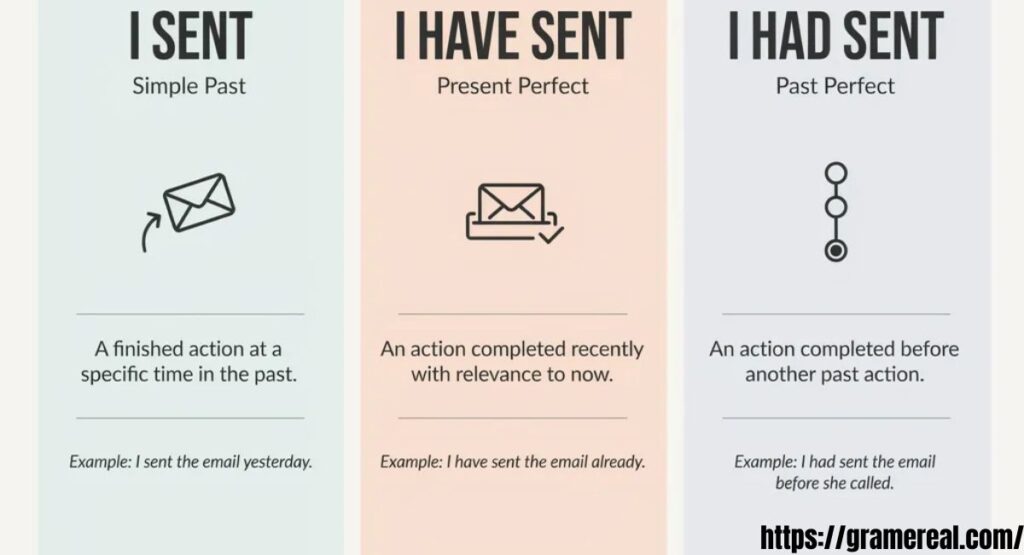
“I sent” is the simple past tense of the verb to send. It describes an action that happened at a specific point in the past and is now completely finished. There is no connection to what is happening right now the action is done and closed.
Structure: Subject + past verb → I sent
When to Use “I Sent”
Use I sent when:
- You mention a specific time in the past (yesterday, last week, at 3 PM)
- You are narrating past events in sequence
- You want to state a fact about something completed
- You are reminding someone of something you already did
Examples:
- I sent the invoice yesterday.
- I sent the proposal last Friday.
- I sent you the file at 3 PM.
- I sent the email before I left the office.
This tense is factual, clean, and neutral. It simply states what happened.
What Does “I Have Sent” Mean?
“I have sent” is the present perfect tense. It describes an action that happened in the past but remains relevant or connected to the present moment. The focus is less on when it happened and more on the fact that it has been done and matters right now.
Structure: Subject + have/has + past participle → I have sent
When to Use “I Have Sent”
Use I have sent when:
- You want to confirm that something is done and the result still matters now
- No specific time is mentioned
- You are updating someone in real time
- You want a slightly more formal or professional tone
Examples:
- I have sent the report for your review.
- I have sent all the required documents.
- I have sent you an invitation please check your inbox.
- I have sent the updated version with the corrections.
This tense is commonly used in professional emails when confirming an action that the other person needs to respond to now.
What Does “I Had Sent” Mean?
“I had sent” is the past perfect tense. It describes an action that was completed before another action in the past. Think of it as placing two past events in order I had sent is the earlier one.
Structure: Subject + had + past participle → I had sent
When to Use “I Had Sent”
Use I had sent when:
- You are comparing two past events and showing which came first
- You are explaining a sequence of events in the past
- You want to clarify a timeline in a formal context
Examples:
- I had sent the email before the meeting started.
- I had sent the file, but she had already found another version.
- I had sent the invitation, but no one responded.
- I had sent the initial draft before receiving the manager’s feedback.
Notice that I had sent almost always appears with another past event in the same sentence or nearby. Without that second event, this tense can feel out of place.
I Sent vs I Have Sent vs I Had Sent: Basic Comparison
| Phrase | Tense | When to Use | Time Reference |
|---|---|---|---|
| I sent | Simple Past | Completed action at a specific past time | Yesterday, last week, at 4 PM |
| I have sent | Present Perfect | Past action still relevant now | No specific time; just/recently |
| I had sent | Past Perfect | Action completed before another past event | Before something else happened |
Timeline Explanation (Very Simple)
Imagine time as a straight line:
- Past → Present → Future
Here is how each phrase sits on that line:
- I sent Points to a fixed spot in the past. (Done. Finished. No connection to now.)
- I have sent Starts in the past but stretches to the present. (Done, and it still matters.)
- I had sent Points to a past moment that happened before another past moment. (The earlier event in a two-event story.)
This mental picture alone will help you choose the right form in most situations.
Contextual Examples in Real Situations
1: Following Up on a Job Application
- ✅ I sent my application on Monday. (Simple past specific day)
- ✅ I have sent my application and am waiting for a response. (Present perfect still relevant now)
2: Explaining a Work Delay
- ✅ I had sent the draft before the deadline was moved. (Past perfect happened before another past event)
3: Confirming to a Client
- ✅ I have sent the contract to your email. (Present perfect the result matters right now)
4: Telling a Story
- ✅ I sent the message and waited for an hour. (Simple past storytelling mode)
Common Mistakes With These Tenses
Avoiding these errors will immediately improve your writing quality:
1: Using a time marker with present perfect
- ❌ I have sent it yesterday.
- ✅ I sent it yesterday. (Use simple past with specific times)
2: Using past perfect without a second event
- ❌ I had sent the email. (Hanging without context)
- ✅ I had sent the email before she called. (Now it makes sense)
3: Using simple past when confirming current relevance
- ❌ I sent the file. (Sounds abrupt when the recipient needs it now)
- ✅ I have sent the file for your review. (Warmer and more professional)
4: Writing “I had send” or “I have send”
- ❌ I had send / I have send
- ✅ Always use the past participle: sent
Sentence Structure and Clarity
Each tense follows a clear pattern:
| Tense | Formula | Example |
|---|---|---|
| Simple Past | Subject + sent | I sent the report. |
| Present Perfect | Subject + have/has + sent | I have sent the report. |
| Past Perfect | Subject + had + sent | I had sent the report before the call. |
Always use the past participle sent (never send) after have, has, or had.
American vs British English Usage
This is where things get slightly different depending on where you are.
In British English, the present perfect (I have sent) is strongly preferred when an action connects to the present — especially with words like just, already, and yet.
In American English, the simple past (I sent) is commonly used in these same situations. Both are grammatically acceptable in American usage.
British English: I have just sent the email. American English: I just sent the email.
Both are correct in their respective dialects. If you are writing for a global or formal audience, the present perfect is generally the safer and more universally accepted choice.
Formal vs Informal Writing
Your tense choice also affects the tone of your writing:
| Context | Preferred Form | Why |
|---|---|---|
| Professional email | I have sent | Sounds polished and relevant |
| Casual conversation | I sent | Direct and natural |
| Narrative/storytelling | I sent | Flows well in sequence |
| Explaining past order of events | I had sent | Clarifies sequence |
| Business dispute or report | I had sent | Formal and precise |
Idiomatic and Natural Usage
Native speakers don’t always follow textbook rules in everyday speech. Here are natural, real-world patterns:
- “I already sent it” Very common in spoken American English (simple past + already)
- “I’ve sent it over” Casual, informal British/American blend
- “It’s been sent” Passive alternative, often used to avoid specifying who sent it
- “I sent that ages ago” Conversational, emphasizes how long ago
Knowing these patterns helps you sound natural, not just grammatically correct.
Practical Tips to Avoid Confusion
- Check for a time marker. If your sentence includes yesterday, last week, at 4 PM, use simple past (I sent).
- Ask: does it matter right now? If yes, use present perfect (I have sent).
- Is there a second past event? If yes, use past perfect for the earlier one (I had sent).
- Never mix tense signals. Don’t write I have sent it yesterday pick one or the other.
- Read it aloud. If it sounds natural and clear, you’ve chosen correctly.
- When in doubt in formal writing, use present perfect. It works in both American and British contexts.
Grammar Rules Applied
Here is a quick grammar reference:
- Simple Past = Action completed at a definite past time. Verb form: sent
- Present Perfect = Past action with present relevance. Verb form: have/has + sent
- Past Perfect = Earlier of two past actions. Verb form: had + sent
Words that trigger each tense:
| Trigger Words | Tense to Use |
|---|---|
| Yesterday, last week, in 2020, at noon | Simple Past |
| Just, recently, already, yet, so far | Present Perfect |
| Before, by the time, already (in past sequence) | Past Perfect |
Writing Flow and Style
Good writing is not just about being grammatically correct it is about being clear and easy to follow. Here is how tense affects your reader’s experience:
- Consistent tense keeps readers anchored in time.
- Switching tense without reason creates confusion.
- Present perfect in emails signals completion and relevance it respects the reader’s time.
- Simple past in storytelling keeps the narrative moving forward naturally.
Mixing these tenses without purpose is one of the most common errors in professional writing.
Rewritten and Polished Explanation (Clear Summary)
Let’s put it all together simply:
- I sent Something happened in the past. Done. Finished. A specific time is usually mentioned or implied.
- I have sent Something happened in the past, and it is still relevant right now. No specific time needed.
- I had sent Something happened in the past, before something else also happened in the past. Two events, two time points.
If you remember only these three distinctions, you will be right almost every time.
Why This Practice Improves Writing
Mastering these three phrases does more than fix a grammar rule it sharpens your entire communication style. When your tenses are accurate:
- Readers understand your timeline immediately
- Your emails sound professional and confident
- Misunderstandings about deadlines and actions are reduced
- Your writing reflects attention to detail which matters in every field
Whether you are writing workplace emails, academic essays, or personal messages, verb tense precision is a silent indicator of your language skills.
Conclusion
I Sent vs I Have Sent vs I Had sent The difference between I sent, I have sent, and I had sent comes down to time, relevance, and sequence.simple past when an action is finished at a known past time. Use present perfect when a past action still connects to the present. Use past perfect when you need to show that one past action happened before another.
None of these is wrong in itself it simply depends on what you are trying to say. With a little practice and awareness, choosing the right form becomes second nature, and your writing becomes noticeably cleaner, clearer, and more professional.
FAQs
Is “I have sent” more formal than “I sent”?
Yes, slightly. “I have sent” often sounds more polished and professional, making it ideal for workplace emails and formal writing.
Can I use “I have sent” with the word “yesterday”?
No. “I have sent it yesterday” is grammatically incorrect. Use “I sent it yesterday” instead — always pair specific time references with simple past.
When should I use “I had sent” in an email?
Use it when explaining a sequence of past events, such as “I had sent the draft before the deadline changed.” It needs a second past event for context.
Is “I sent” correct in British English?
Yes, it is grammatically correct. However, British English often prefers “I have sent” when the action connects to the present, especially with words like just or already.
What is the past participle of “send”?
The past participle of “send” is sent. It is used after have, has, and had in perfect tenses. “I have send” or “I had send” are always incorrect.
Can “I sent” and “I have sent” ever mean the same thing?
In American English, yes they are sometimes interchangeable for recent actions. In formal or British English, they carry distinct meanings and should not be used interchangeably.
Why does tense matter so much in professional emails?
The right tense tells the reader whether an action is done, still relevant, or part of a past sequence reducing confusion and projecting professionalism.