
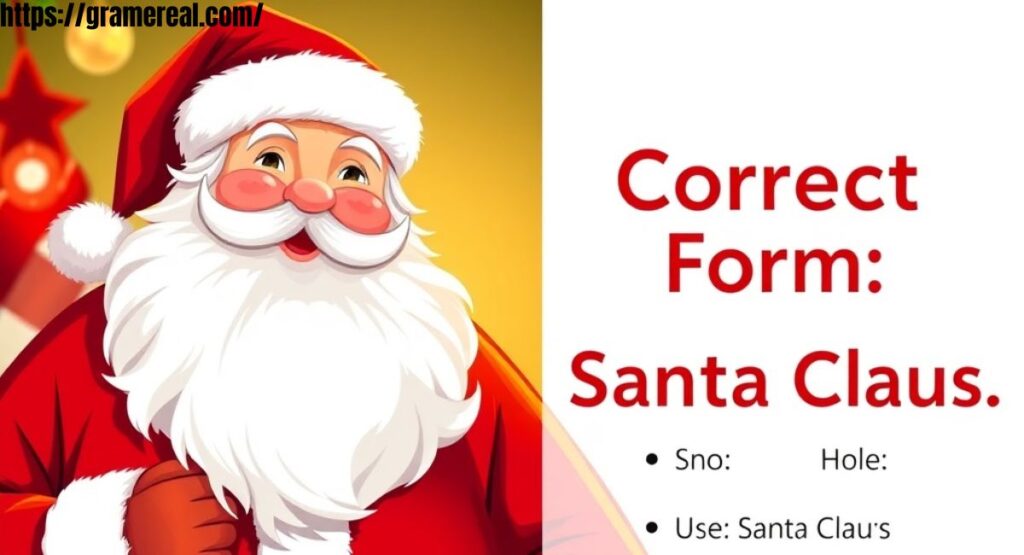
Santa Clause or Claus Picture this: you sit down to write a heartfelt Christmas card, and you pause is it Santa Claus or Santa Clause? You’re not alone. This is one of the most searched spelling questions every holiday season. The answer is simple: Santa Claus is always correct. Clause is a grammar and legal term it has nothing to do with the jolly man in the red suit. Santa Clause or Claus The mix-up started with a clever movie title in 1994 and has confused writers, students, and holiday shoppers ever since. This guide breaks it all down the correct spelling, the real history behind the name, and practical tips to get it right every time you write.
Origins of Santa Claus
To understand why the name is spelled Claus and not Clause, you have to go back to the 4th century.
The name Santa Claus evolved from the Dutch nickname Sinter Klaas, a shortened form of Sint Nikolaas (Dutch for St. Nicholas). Saint Nicholas was a fourth-century bishop of Myra, a man known for extraordinary generosity and gift-giving. His legend eventually spread across Europe, and the Dutch called him Sinterklaas while the German tradition eventually produced the name Santa Claus.
In 1804, New York Historical Society member John Pintard distributed woodcuts of St. Nicholas at the society’s annual meeting featuring now-familiar imagery like stockings filled with toys hung over a fireplace. In 1809, Washington Irving helped popularize the Sinter Klaas stories further.
The saint’s name gradually shifted to Santa Claus through a natural phonetic alteration from the German Sankt Niklaus. In other words, Claus is a proper name a surname rooted in European history not an English word invented for Christmas.
Santa Claus or Santa Clause: The Correct Form
The correct spelling is always Santa Claus.
Here is a simple breakdown:
| Term | Type | Meaning |
|---|---|---|
| Santa Claus | Proper noun | The legendary gift-giver; the holiday figure |
| Clause | Common noun | A unit in grammar or a section in a legal document |
| The Santa Clause | Movie title | 1994 Disney film starring Tim Allen |
Claus is a proper name just like Smith, Brown, or Johnson. Proper nouns are always capitalized and spelled consistently. Clause, by contrast, is rooted in grammar and law.
Think of it this way: you wouldn’t write “Michael Johnsun” because a movie happened to spell it differently. The same logic applies here.
Common Mistake: Clause vs. Claus
Why Do People Write “Santa Clause”?
The 1994 Disney movie The Santa Clause starring Tim Allen is largely responsible for the confusion. The movie portrays a regular man who enters into a contract a clause obliging him to become Santa’s replacement. It was a clever play on words, but it has led people to misspell Santa’s name for decades.
Many Americans especially kids who grew up in the 1990s mistakenly think Santa Clause is the correct spelling because of that film’s cultural reach.
Other contributing factors include:
- Autocorrect on phones and computers suggesting “Clause” over “Claus”
- Phonetic similarity both words sound identical when spoken aloud
- Low exposure to the correct written form in everyday life
What Does “Clause” Actually Mean?
Clause is a noun that refers to part of a legal document (you’ll find clauses in contracts and constitutions) or a grammatical unit a group of words that contains a subject and a verb but doesn’t form a complete sentence on its own. There are noun clauses, adjective clauses, and many other types.
Claus, on the other hand, has no standalone English definition. It is purely a proper name.
American vs. British English Differences
Interestingly, the Claus vs. Clause mix-up is not a global problem.
In American English, Claus is pronounced the same as Clause: /klɔːz/ (similar to “laws”). The confusion is unique to English-speaking countries, mainly the US, because of the identical pronunciation and the influence of Hollywood.
In the UK and other countries, the dominant name for the holiday figure is Father Christmas, which sidesteps the confusion entirely. Other regional names include:
- Kris Kringle (Germany, parts of the US)
- Saint Nicholas / Saint Nick (religious contexts)
- Père Noël (France)
- Babbo Natale (Italy)
- Sinterklaas (Netherlands)
None of these alternatives use the word clause, so the spelling confusion is largely an American, English-language phenomenon tied to pop culture.
Idiomatic Expressions and Popular Phrases
Santa Clause or Claus When Santa Claus appears in everyday phrases and expressions, the correct spelling always applies. Here are common examples:
- “Santa Claus is coming to town” classic Christmas carol
- “Believe in Santa Claus” expressing childhood wonder
- “The real Santa Claus” referring to the spirit of giving
- “Waiting for Santa Claus” anticipating holiday gifts
- “Dear Santa Claus” the opening of countless children’s letters
You won’t find any correct idioms or standard phrases using Santa Clause. All idiomatic expressions use Claus. If you see Clause in a phrase, it either refers to the movie or is a spelling error.
Practical Tips for Correct Usage
Here are simple, memorable strategies to get this right every time:
- Remember the origin. Claus comes from the Dutch Sinterklaas it is a name, not a grammar word.
- Use the name test. Would you write someone’s surname differently because of a movie title? No. Treat Claus like any other surname.
- Check context. Talking about Christmas, gifts, reindeer, or the North Pole? It’s always Claus.
- Distinguish by category. Claus = person’s name. Clause = grammar term or legal term.
- Run a quick search. If your spell-checker flags it, double-check by asking: am I talking about the holiday figure or a legal document?
- Proofread holiday content. Cards, emails, essays, and social media posts benefit from one quick check before publishing.
Fun Facts About Santa Claus
Beyond the spelling debate, the legend of Santa Claus holds some genuinely fascinating details:
- American writer Clement Clarke Moore, who wrote A Visit from St. Nicholas in 1823, and illustrator Thomas Nast helped shape Santa’s modern image. By the early 20th century, Coca-Cola advertising solidified the red suit, white beard, and cheerful persona we recognize today.
- Santa Claus, Indiana is a real US town that embraced the holiday theme. Karl Claus was a Russian chemist who discovered ruthenium in 1844, proving Claus has real-world roots beyond Christmas mythology.
- The name Claus is used across Germany, Denmark, and the Netherlands as a common given name and surname, demonstrating its deep roots in European history and culture.
- In 1841, many children traveled to Philadelphia just to see a life-size Santa model an early sign of how powerful the figure had become in American culture.
- The US Air Force has tracked Santa every Christmas Eve since 1955, a tradition that started after a child accidentally dialed a military defense number.
Examples of Correct and Incorrect Usage
✅ Correct Usage (Santa Claus)
- “My daughter wrote a letter to Santa Claus last night.”
- “The mall hired someone to play Santa Claus on weekends.”
- “Santa Claus is often depicted with a red suit and white beard.”
- “Children around the world believe in Santa Claus.”
❌ Incorrect Usage (Santa Clause)
- “My daughter wrote a letter to ~~Santa Clause~~ last night.”
- “The mall hired someone to play ~~Santa Clause~~ on weekends.”
- “~~Santa Clause~~ is often depicted with a red suit and white beard.”
Exception: The Santa Clause (1994) and its sequels are correctly titled with Clause because the title is an intentional pun not a spelling of the character’s name.
Grammar and Writing Tips
When writing about Santa Claus in any context, keep these grammar rules in mind:
- Capitalization: Always capitalize both words Santa Claus. The word clause (grammar/legal) stays lowercase unless it begins a sentence.
- Possessive form: Santa Claus’s (singular possessive) e.g., Santa Claus’s sleigh.
- Consistency: Pick one style and stick with it throughout your document.
- Sentence variety: Mix short and medium-length sentences when writing holiday content to keep it engaging and readable.
- Avoid passive voice where possible: “Santa Claus delivers gifts” is stronger than “Gifts are delivered by Santa Claus.”
Spelling isn’t just cosmetic. It affects clarity, credibility, and sometimes even meaning in written English. A misspelled proper noun signals carelessness to readers especially in professional or educational contexts.
Writing for Different Audiences
The correct spelling matters regardless of who you’re writing for:
Writing for Children
Use Santa Claus consistently. Young readers are in the process of building their vocabulary, and incorrect models create lasting confusion. Picture books, holiday worksheets, and classroom decorations should always reflect the correct spelling.
Writing for Adults (Professional or Academic)
In business emails, holiday newsletters, or academic papers, Santa Claus is the only acceptable spelling. Using Clause in a professional document undermines credibility.
Writing for Social Media
Hashtags and captions reach wide audiences. Using #SantaClaus (not #SantaClause) ensures your content is correctly indexed and avoids associating your post with the movie rather than the holiday figure.
Creative Writing and Fiction
If your story references the 1994 movie, The Santa Clause (with an e) is appropriate. For any other holiday context, Santa Claus is always correct.
Common Confusions and How to Avoid Them
| Confusion | Correct Answer | Memory Trick |
|---|---|---|
| Is it Claus or Clause? | Claus | Claus = name; Clause = grammar |
| Why does spell-check suggest Clause? | It’s a real English word; tools may not know the context | Always verify proper nouns manually |
| Is the movie spelled wrong? | No The Santa Clause is an intentional pun | The movie uses it as wordplay, not a spelling guide |
| Do British English rules differ? | Same spelling; they use Father Christmas more often | The spelling Claus is universal in English |
| Can I use Claus as a first name? | Yes it’s a real Germanic name | Klaus/Claus are both valid European names |
Conclusion
The correct spelling is Santa Claus full stop. The name traces back through centuries of history, from a 4th-century bishop in modern-day Turkey, through Dutch and German traditions, into 19th-century American culture. Claus is a proper surname with Germanic roots, not a variation of the English word clause.
The confusion persists mainly because of a 1994 Disney film and the fact that both words sound identical in spoken English. But in writing, the difference is clear and getting it right matters for clarity, credibility, and respect for the tradition behind the name.
FAQs
Is it Santa Claus or Santa Clause?
The correct spelling is Santa Claus. Santa Clause is a misspelling, except when referring to the 1994 Tim Allen movie The Santa Clause.
Why do people spell it “Santa Clause”?
The 1994 Disney movie The Santa Clause popularized the alternative spelling, and because both words sound identical when spoken, the mistake spread widely over the decades.
Where does the name “Claus” come from?
Claus is a shortened form of Nikolaas (Nicholas) in Dutch and Germanic languages. It evolved from Sinterklaas, the Dutch name for Saint Nicholas.
What does “clause” mean in grammar?
A clause is a group of words containing a subject and a verb; it may or may not form a complete sentence on its own. Examples include noun clauses and relative clauses.
Is the movie title “The Santa Clause” a spelling mistake?
No. The title is an intentional pun the word clause refers to the legal contract that drives the film’s plot, making it a deliberate play on words.
How do you pronounce “Claus”?
In American English, Claus is pronounced exactly like clause: /klɔːz/, rhyming with “laws” or “pause.”
Is Santa Claus a real name?
Claus is a real Germanic surname and first name, derived from Nikolaus. Historical figures named Claus include Karl Claus, the Russian chemist who discovered ruthenium.
What are other names for Santa Claus?
Other common names include Father Christmas (UK), Kris Kringle, Saint Nicholas, Saint Nick, Père Noël (France), and Babbo Natale (Italy).