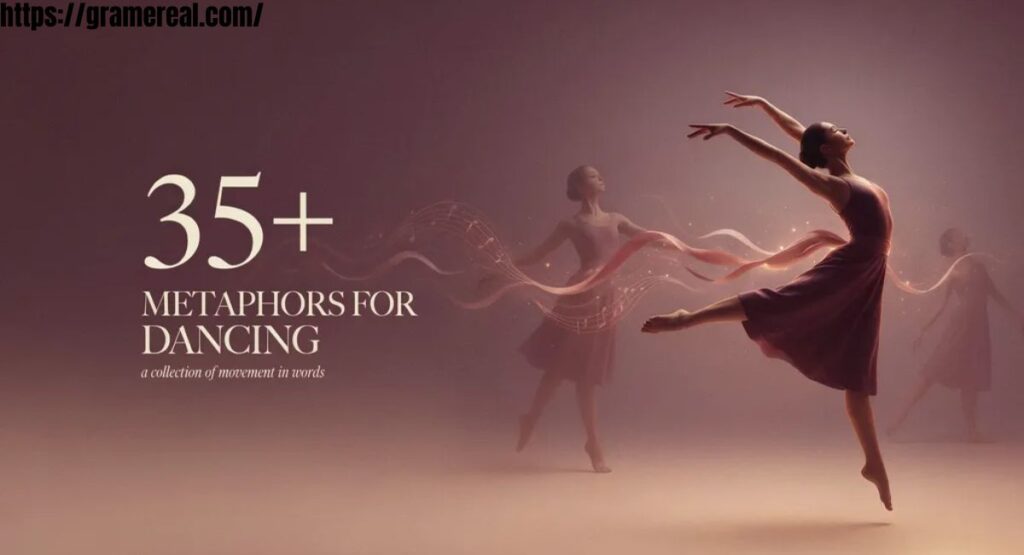
Dancing is more than movement it’s emotion made visible. But when words fall short, metaphors step in. Whether you’re a writer searching for the perfect phrase, a poet chasing rhythm, or simply someone who loves language, metaphors for dancing unlock a deeper layer of meaning. They transform physical motion into something felt in the soul.
In this article, you’ll discover 35+ vivid, creative, and emotionally resonant metaphors for dancing organized by theme, mood, and use case.
Why Metaphors for Dancing Feel So Powerful
Language and movement share a deep connection. When we describe dancing through metaphor, we’re not just painting a picture — we’re triggering emotional memory. A well-chosen metaphor makes the reader feel the beat drop, the spin, the stillness.
Metaphors work because they collapse distance. They say: this unfamiliar thing is like something you already know and love. Dance, as one of the oldest forms of human expression, gives metaphor writers endless raw material.
Dance as a Universal Human Language
Across cultures and centuries, dance has been described as the one language everyone speaks without translation. It predates written words. Long before alphabets existed, humans moved together around fires, in rituals, in joy, in grief.
When writers call dance “the mother tongue of the body” or “the speech of the soul,” they’re tapping into something archetypal. These metaphors resonate because they’re true on a level that goes deeper than dictionary definitions.
| Metaphor | Meaning |
|---|---|
| “Dance is the mother tongue of the body” | Movement is our first and most natural form of expression |
| “Dance is the speech of the soul” | Inner feelings become visible through physical motion |
| “Dance is a conversation without words” | Bodies communicate what language cannot |
| “Dance is the poetry of the foot” | Movement carries rhythm, beauty, and meaning |
How Dancing Becomes Poetry in Motion
The phrase poetry in motion is itself a metaphor and one of the most enduring ever applied to dance. It captures two things at once: the visual grace of a dancer’s body and the emotional arc of a poem moving through its stanzas.
Here are more metaphors in this family:
- “Dancing is painting with the body” each movement a brushstroke, each pose a color
- “A dancer is a sculptor of air” shaping the invisible space around them
- “Dancing is singing with the limbs” the body becomes the instrument
- “Every step is a word in a story only the body can tell”
The Many Faces of Dancing in Everyday Life
Dance doesn’t only happen on a stage. It shows up in how we move through life in gesture, rhythm, and the unconscious sway we make when a good song plays. Everyday language reflects this:
- We say negotiations are a dance between two parties.
- We say someone is dancing around a sensitive topic.
- We call a careful, strategic move a well-choreographed plan.
- A fast-paced workplace becomes a ballet of deadlines.
These aren’t accidents. They reveal how deeply movement metaphors are woven into how we think and speak.
Dancing as a Conversation With Music
One of the most beautiful ways to describe dancing is as a dialogue not between two people, but between a body and sound.
“Dancing is the body’s answer to music’s question.”
This metaphor works because it frames music as an invitation and movement as a response. It implies listening, interpretation, and creative reply all the things that make a great conversation great.
Other conversation-based metaphors include:
- “Dance is music made flesh” sound takes physical form in the dancer
- “The body and the beat are in constant negotiation”
- “Every dancer is a translator turning sound into sight”
Using This Metaphor in Romantic Writing
Dancing as a Conversation With Music
In romance writing, this metaphor creates intimacy without cliché. Two characters dancing aren’t just moving they’re talking, revealing, confessing. Their bodies say what their mouths won’t.
Example in use: “They moved together like a question and its answer incomplete alone, perfect together.”
Dancing as Fire in Motion
Fire and dance share an instinctive kinship. the Both flicker. Both reach upward. Both consume energy and transform it into something mesmerizing.
Metaphors for Dancing as Fire:
- “She danced like a flame wild, unpredictable, impossible to look away from”
- “His movements were embers catching wind, surging and settling in turns”
- “The dancer blazed across the stage, leaving light trails in her wake”
- “To watch her dance was to watch something burn beautifully”
- “The troupe was a bonfire each dancer a tongue of flame, together a conflagration”
When Fire Metaphors Work Best
| Context | Why Fire Works |
|---|---|
| Flamenco or Latin dance | Passionate, sharp, intense movements mirror flame behavior |
| Competitive dance writing | Fire implies heat, drive, and danger |
| Describing a solo performer | A lone flame is visually and emotionally powerful |
| Romantic or erotic writing | Fire connotes desire and consuming passion |
Dancing as Waves in the Ocean
Where fire metaphors suit passion and intensity, ocean and wave metaphors suit fluidity, surrender, and natural grace. They’re perfect for contemporary dance, ballet, and any style that emphasizes flow over sharpness.
- “She moved like a tide rhythmic, inevitable, ancient”
- “The dancers rolled across the stage like waves finding shore”
- “His body was water taking the shape of every emotion it held”
- “Dancing with her was like swimming in open water terrifying and free”
- “She didn’t perform; she flowed”
These metaphors evoke calm power. They suggest that the dancer isn’t forcing movement they’re becoming it.
Metaphors for Dancing in Joy
Joy demands its own vocabulary. These metaphors capture the lightness, effervescence, and almost involuntary quality of dancing when happiness overflows:
- “Dancing like no one is watching” pure, unselfconscious expression
- “She bubbled across the dance floor like champagne”
- “His feet couldn’t help themselves joy had taken over the controls”
- “Dancing like the music had lifted her off the ground”
- “They were sparks joy making them leap”
- “She turned herself into confetti and scattered across the room”
Metaphors for Dancing in Love
Love and dance have always been partners. These metaphors explore the tender, vulnerable, and electric dimensions of dancing when two people move as one:
- “Dancing together is the body’s way of saying: I trust you”
- “They danced like they were writing their story in the air”
- “His arms around her were a sentence she never wanted to end”
- “Dancing with him was coming home in a language she didn’t know she spoke”
- “They moved like gravity had decided they belonged together”
- “In that dance, she finally understood what hearts do when they stop hiding”
Metaphors for Dancing in Freedom
Some dances aren’t about joy or love they’re about liberation. The body breaking free. These metaphors carry that electric, unbounded quality:
- “Dancing is the soul escaping through the body’s door”
- “To dance is to shrug off gravity and everything it represents”
- “She didn’t dance to the music she danced away from everything that wasn’t music”
- “Movement was her jailbreak”
- “Every spin was a door slamming on what held her”
- “He danced like a bird who’d just remembered it had wings”
Dance as Storytelling
Great dance always tells a story, and great metaphors recognize this. These expressions frame dancing as narrative art:
- “A dance is a novel written in seconds”
- “The stage is a page; the dancer is the pen”
- “Each performance is a short story the body tells only once”
- “A ballet is a book you read with your eyes and feel with your chest”
- “She choreographed her grief into something the audience could witness”
Creative Practice for Readers
Ways to Use Dancing Metaphors Daily
You don’t need to be a novelist to use these metaphors. Here’s how to work them into everyday writing and speech:
- In journaling describe how you feel using movement: “Today I felt like a dancer who’d forgotten the steps.”
- In emails and speeches use dance metaphors to describe collaboration: “This project required all of us to stay in rhythm.”
- In social media captions pair a photo with a movement metaphor for added depth.
- In poetry build entire stanzas around one metaphor (fire, water, conversation).
- In storytelling use a character’s dance style as a window into their personality.
How to Make Dance Metaphors More Vivid
Strong metaphors are specific. Avoid generic phrases and instead:
- Name the style she moved like a flamenco dancer mid-stomp hits harder than she moved gracefully
- Use the senses include sound, breath, heat: “the floor shook under her joy”
- Ground it in emotion the best movement metaphors have a feeling underneath: “he danced like someone trying to outrun a memory”
- Subvert expectations “she danced like a house on fire not beautiful, but impossible to ignore”
A Creative Prompt
Try writing three sentences that describe the same dance three different ways:
- Using a fire metaphor
- Using an ocean metaphor
- Using a conversation metaphor
Notice how each one changes not just the image but the feeling of the dance entirely. That’s the power of metaphor in motion.
Why Metaphors for Dancing Inspire Us
Metaphors for dancing inspire us because they remind us that the body has wisdom the mind can’t always access. Dance is where we go when words aren’t enough and metaphors are the bridge that takes us back to language after we’ve been somewhere words can’t follow.
When a writer says “she danced like she was putting out a fire and starting one at the same time,” we don’t just see movement. We feel contradiction, passion, and the beautiful mess of being fully alive.
That’s what metaphors do. That’s what dancing does. Together, they do it twice as well.
Conclusion
From fire to ocean waves, from love to freedom, metaphors for dancing give language the ability to move. They help writers, poets, and everyday communicators capture something that is, by nature, beyond words.
The 35+ metaphors in this article are tools pick the ones that match your emotional intent, sharpen them with specific detail, and let them do what great metaphors always do: make the reader feel something they didn’t expect to feel.
FAQs
What is a metaphor for dancing?
A metaphor for dancing compares movement to something else like fire, water, or conversation to convey deeper emotional meaning without literal description.
What does “dancing is poetry in motion” mean?
It means dance, like poetry, carries rhythm, beauty, and layered meaning expressed through the body rather than words.
How do you describe dancing beautifully in writing?
Use sensory details and emotion-driven metaphors; say “she moved like the last note of a song, fading but unforgettable” rather than simply “she danced well.”
What are some metaphors for a dancer?
A dancer can be described as a flame, a wave, a storyteller, a sculptor of air, or a poet whose medium is the body rather than the page.
Why do writers use dance metaphors?
Because dance represents emotion, freedom, and human connection themes that resonate universally and give prose an immediate, felt quality.
Can dance metaphors be used in everyday speech?
Absolutely. Phrases like “dancing around the issue” or “a well-choreographed plan” show how naturally these metaphors fit into daily communication.
What is the best metaphor for joyful dancing?
“She turned herself into confetti and scattered across the room” is vivid and playful capturing the involuntary, effervescent quality of dancing in pure joy.
How do fire metaphors apply to dancing?
Fire metaphors highlight intensity, unpredictability, and consuming passion ideal for describing flamenco, competitive dance, or any performance with raw emotional heat.