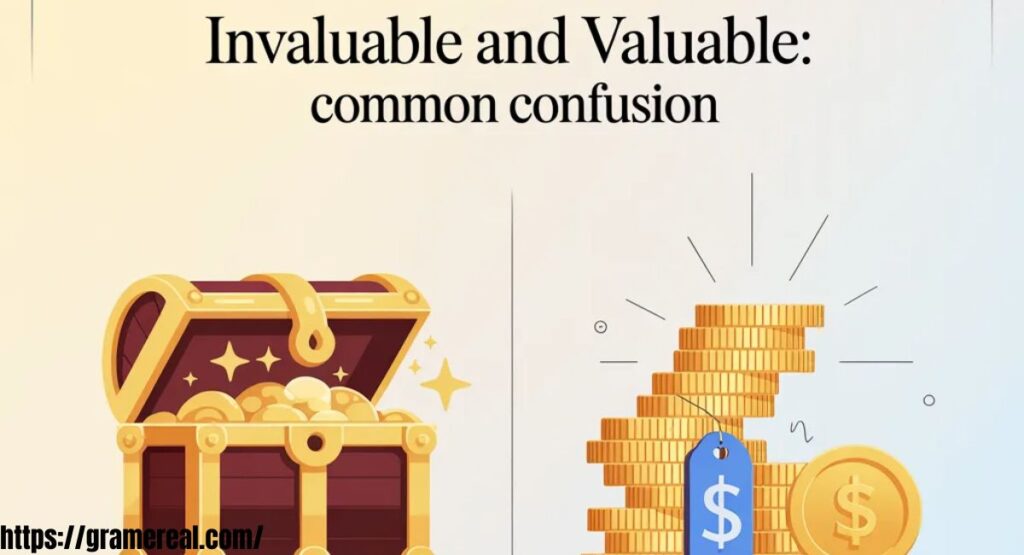
Invaluable and Valuable: Common Confusion refers to the widespread misunderstanding between two closely related English adjectives. Many writers assume these words are opposites because of the prefix in-, but they are not. Both words express worth and importance — the only difference lies in the degree of that worth.
Here is the truth that changes everything: removing a single three-letter prefix from invaluable does not give you its opposite it gives you a weaker version of the same idea. That small in- does not cancel value; it amplifies it beyond all measurement.
Understanding this distinction sharpens your writing instantly. When you call something valuable, you are saying it has great worth. When you call it invaluable, you are saying no price in the world could ever capture how important it truly is. Mastering this difference transforms the way you express meaning clearly, confidently, and precisely.
What Does “Valuable” Mean?
Valuable is an adjective that describes something with a significant monetary worth, admirable qualities, or practical usefulness. When you call something valuable, you are saying it has measurable worth a price tag, a benefit, or a clear advantage that can be estimated.
Common meanings of valuable:
- Worth a large sum of money
- Highly useful or beneficial
- Possessing admirable qualities
Examples in sentences:
- That antique watch is extremely valuable it sold for thousands at auction.
- She shared some very valuable advice about managing stress.
- He learned valuable skills during his internship.
In addition to being an adjective, valuable can occasionally function as a noun. People use the plural form “valuables” to refer to small, high-worth items like jewelry, passports, or cash.
What Does “Invaluable” Mean?
Invaluable is an adjective that describes something so important, useful, or precious that its value cannot be calculated or expressed in money. Think of it as a step beyond valuable something priceless in the truest sense of the word.
Key characteristics of invaluable:
- Beyond monetary measurement
- Irreplaceable or indispensable
- Extremely useful or essential
Examples in sentences:
- A mentor’s guidance is invaluable during the early stages of a career.
- The ancient manuscript is considered an invaluable piece of history.
- Your support during this project has been absolutely invaluable.
Note: Unlike valuable, the word invaluable is always an adjective it never functions as a noun.
Invaluable vs Valuable: The Core Difference
Here is a clear side-by-side comparison to make the distinction easy to grasp:
| Feature | Valuable | Invaluable |
|---|---|---|
| Basic meaning | Has measurable worth | Beyond measurable worth |
| Monetary link | Often tied to money or price | Transcends money entirely |
| Intensity | High worth | Extreme or immeasurable worth |
| Used as noun? | Yes (“valuables”) | No adjective only |
| Synonyms | Precious, prized, useful | Priceless, indispensable, essential |
| Example | A valuable gemstone | An invaluable friendship |
The key takeaway: both words are positive, but invaluable expresses a much stronger and deeper level of importance. If valuable is “worth a lot,” invaluable means “worth so much you can’t even put a number on it.”
Why “Invaluable” Does Not Mean “Not Valuable”
This is the heart of the confusion and it trips up even experienced writers.
In English, the prefix in- usually signals negation. Words like incorrect, inedible, and inefficient all mean the opposite of their root. So it feels natural to assume invaluable means “without value.”
But that assumption is wrong.
The reason comes down to etymology. Both valuable and invaluable trace their roots to the verb form of value, meaning “to calculate or assign monetary worth to something.” So invaluable does technically mean “not able to be valued” but not because the thing is worthless. Rather, it is because the thing’s worth is too great to calculate.
Think of it this way:
- A gold ring → Valuable (you can price it)
- A mother’s love → Invaluable (no price exists that captures its worth)
This is similar to the word priceless which also sounds negative on the surface but means the opposite. A priceless painting is not worthless; it is worth so much that no single price could do it justice.
Grammar Role of Invaluable and Valuable
Both invaluable and valuable are adjectives. That means they describe nouns and answer the question: What kind?
Grammatical positions:
Both words can appear before a noun (attributive position) or after a linking verb (predicative position).
- She gave me valuable feedback. (before noun)
- Her feedback was valuable. (after linking verb)
- He made an invaluable contribution. (before noun)
- His contribution was invaluable. (after linking verb)
Article usage tip:
Because invaluable begins with a vowel sound, always use “an” before it not “a.”
- ✅ an invaluable resource
- ❌ a invaluable resource
Contextual Examples of Invaluable vs Valuable
Seeing both words in real contexts helps lock in the difference.
In business writing:
- The report contains valuable data on consumer trends.
- Her expertise in data analysis has been invaluable to the team.
academic writing:
- Primary sources are valuable tools for historical research.
- The professor’s feedback was invaluable in shaping the final thesis.
personal life:
- He kept a valuable collection of stamps from the 1900s.
- The support of friends during difficult times is truly invaluable.
formal recognition:
- The company recognized her valuable contributions to the project.
- She was described as an invaluable member of the organization.
Invaluable vs Valuable in Everyday Language
In daily speech, valuable appears more frequently because it fits a wider range of situations things, advice, time, skills, and opportunities.
Invaluable is typically reserved for moments when you want to express deep appreciation or acknowledge something that simply cannot be replaced or priced.
Everyday expressions using valuable:
- “That was a valuable lesson.”
- “Time is valuable don’t waste it.”
- “This course gave me valuable experience.”
Everyday expressions using invaluable:
- “Your help was invaluable.”
- “This experience has been invaluable to my growth.”
- “She’s an invaluable part of the team.”
Common Mistakes With Invaluable vs Valuable
Even fluent English speakers make these errors. Here are the most frequent ones:
1: Thinking invaluable means “worthless”
- ❌ This old book is invaluable, so no one would buy it.
- ✅ This old book is invaluable because of its historical rarity.
2: Using valuable when invaluable is more appropriate
- Weak: Her mentorship was valuable during my first year.
- Stronger: Her mentorship was invaluable during my first year.
3: Combining both words together
- ❌ This is an invaluable valuable item.
- ✅ This is an invaluable item.
4: Using a instead of an before invaluable
- ❌ a invaluable experience
- ✅ an invaluable experience
Sentence Structure With Valuable
Valuable fits naturally before nouns and after linking verbs. It pairs easily with intensifiers like “very” or “extremely.”
Structural patterns:
- She received valuable guidance from her coach.
- The time we spent together was valuable.
- He provided very valuable input during the meeting.
- Learning a second language is a valuable skill in today’s world.
Sentence Structure With Invaluable
Invaluable carries more weight, so it tends to appear in sentences expressing strong appreciation, formal recognition, or deep importance.
Structural patterns:
- Your feedback has been invaluable to this process.
- The doctor’s early diagnosis proved invaluable.
- She made an invaluable impact on the company’s culture.
- Access to clean water is invaluable in developing regions.
Avoid pairing invaluable with weak intensifiers. Since it already conveys extreme worth, phrases like “very invaluable” or “quite invaluable” are redundant and sound unnatural.
Invaluable vs Valuable in Formal Writing
Both words are fully appropriate in formal, professional, or academic contexts. Choosing the right one comes down to the degree of worth you want to express.
Formal examples:
- The dataset provides valuable insights into regional economic patterns.
- Expert legal counsel is invaluable when navigating complex litigation.
- The audit identified several valuable opportunities for cost reduction.
- The partnership has proven invaluable to our international expansion strategy.
In formal writing, using invaluable where valuable is sufficient can feel overstated. Match the word to the true weight of what you are describing.
Invaluable vs Valuable in Informal Writing
Both words work in casual conversation and informal writing, though invaluable adds warmth and sincerity when expressing genuine gratitude.
Informal examples:
- Thanks for the valuable tips really helped me organize my study time.
- Honestly, your support has been invaluable. I couldn’t have done this without you.
- That was such a valuable conversation.
- Having you on the team is truly invaluable.
American vs British English Usage
There is no meaningful difference in how American and British English use these two words. Both varieties treat invaluable as meaning “extremely valuable” or “priceless,” and valuable as meaning “having measurable worth or great usefulness.” The spelling, grammar, and connotations remain the same on both sides of the Atlantic.
Idiomatic and Natural Expressions
Certain phrases with these words have become natural idioms in everyday English:
With valuable:
- a valuable lesson something learned through experience, often the hard way
- valuable time time that should not be wasted
- valuable asset a person or thing that contributes significantly
With invaluable:
- invaluable support help that made a crucial difference
- invaluable experience a formative experience that shaped your skills or perspective
- invaluable contribution an effort whose impact cannot be overstated
Choosing Between Invaluable vs Valuable
Ask yourself one simple question: Can the worth of this thing be measured?
- If yes → use valuable
- If no, or if the worth goes beyond any measurement → use invaluable
Decision guide:
| Situation | Best Word Choice |
|---|---|
| A diamond ring worth $10,000 | Valuable |
| A grandmother’s hand-written recipe | Invaluable |
| A well-researched business report | Valuable |
| A trusted mentor who shaped your career | Invaluable |
| Feedback that improved a project | Valuable |
| A friend who stood by you in a crisis | Invaluable |
Practical Tips to Remember the Difference
- Link “valuable” to a price tag. If you could theoretically sell it or assign it a dollar figure, it is valuable.
- Link “invaluable” to “priceless.” If no amount of money could capture its worth, it is invaluable.
- Think about degree. Valuable is high worth; invaluable is beyond worth.
- Test with replacement. Can you replace the word with “priceless”? If yes, use invaluable. If not, valuable is the better fit.
- Remember “an invaluable.“ The vowel sound at the start of invaluable always requires the article “an.”
Grammar Rules Applied
Both adjectives follow standard English adjective rules:
- They do not change form based on gender or number (a valuable tool / valuable tools / an invaluable tool / invaluable tools)
- They can be modified by adverbs (truly invaluable, extremely valuable)
- They can appear in comparative constructions, though invaluable does not technically have a comparative or superlative form since something either cannot be valued or it can
Sentence Flow and Clarity
Good writing depends on choosing the right word, not just the impressive one. Using invaluable for everything weakens its impact. Reserve it for the moments that truly deserve that elevated sense of importance and your writing will feel more precise, credible, and effective.
Why This Exercise Improves Writing
Understanding the distinction between invaluable and valuable trains your eye for word precision a hallmark of strong, professional writing. Every time you choose the right adjective, you communicate more clearly, build more credibility, and show your reader that you mean exactly what you say.
This kind of intentional word choice is what separates ordinary writing from writing that genuinely resonates.
Conclusion
Invaluable and Valuable: Common Confusion is easy to clear up once you understand one simple truth. Valuable means something has measurable worth. Invaluable means something is so important that no price can capture it. Both words are positive. Neither is the opposite of the other. The prefix in- does not cancel value it intensifies it beyond all measure.
Now you can use both words with full confidence. Remember this rule: if you can put a price on it, call it valuable. If no price in the world is enough, call it invaluable. Invaluable and Valuable: Common Confusion disappears the moment you connect each word to its true meaning. Choose the right word every time, and your writing becomes sharper, clearer, and far more powerful.
FAQs
Does “invaluable” mean “not valuable”?
No. Invaluable means extremely valuable something so important its worth cannot be measured in money or numbers.
Are “invaluable” and “valuable” synonyms?
They are not exact synonyms. Valuable means high worth; invaluable means beyond measurable worth a stronger, more emphatic degree.
Can I use “very invaluable”?
It is best to avoid it. Invaluable already carries the idea of extreme importance, making “very invaluable” redundant.
Is “invaluable” only used in formal writing?
No. It works in both formal and casual contexts, especially when expressing genuine gratitude or deep appreciation.
What is the article to use before “invaluable”?
Always use “an” — not “a” because invaluable begins with a vowel sound.
Is there a difference between American and British English usage?
No. Both varieties use invaluable and valuable the same way, with the same meanings and connotations.
What is a good synonym for “invaluable”?
Words like priceless, indispensable, irreplaceable, and essential all work as near-synonyms for invaluable.
Can a person be described as invaluable?
Absolutely. Calling someone invaluable means their contributions, skills, or presence are so important that they cannot be easily replaced or replicated.