
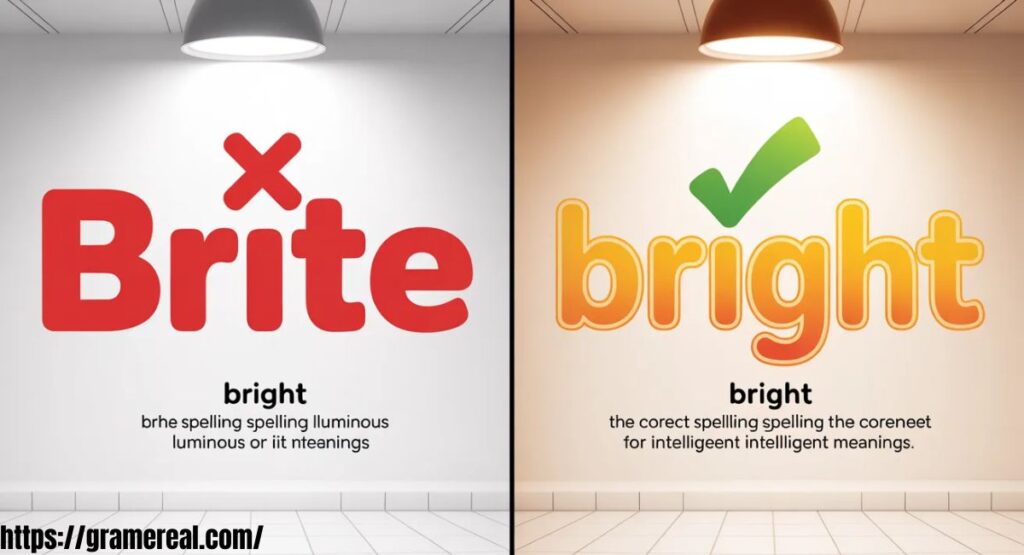
The basic meaning of brite vs bright comes down to one clear distinction: bright is the correct, standard English adjective used to describe light, intelligence, vivid color, and optimism, while brite is a nonstandard, stylized spelling that exists primarily in brand names and marketing not in formal writing.
Most people encounter “brite” long before they ever question it. Childhood toys, household product labels, and cartoon characters quietly trained millions of writers to accept a spelling that grammar books never will. That invisible influence is powerful and surprisingly hard to shake.
Knowing the basic meaning of brite vs bright goes beyond memorizing a spelling rule. It shapes how readers perceive your writing, how editors evaluate your credibility, and how confidently your message lands whether you’re writing a school essay, a professional email, or a published article.
Basic Meaning of Brite vs Bright
At the most fundamental level, the difference between brite and bright comes down to one thing: correctness in standard English.
- Bright is the official, dictionary-recognized adjective used in everyday writing, speech, and literature.
- Brite is a nonstandard, stylized spelling that appears mainly in brand names, logos, and marketing material.
Understanding this core distinction is the first step toward eliminating one of the most subtle spelling errors in English writing.
Understanding the Core Difference Between Brite vs Bright
| Feature | Bright | Brite |
|---|---|---|
| Standard English? | ✅ Yes | ❌ No |
| Dictionary recognized? | ✅ All major dictionaries | ❌ Rarely (or as informal) |
| Used in formal writing? | ✅ Always | ❌ Never |
| Used in branding/marketing? | Rarely | ✅ Common |
| Pronunciation | /braɪt/ | /braɪt/ |
| Origin | Old English beorht | 20th-century marketing |
Both words are pronounced identically /braɪt/ which is precisely what causes so much confusion among writers. On paper, however, only one of them belongs in professional, academic, or everyday writing.
What Does “Bright” Mean in English?
Bright is a highly versatile adjective with four primary meanings in modern English:
- Light intensity Describes something that emits or strongly reflects light. “The bright morning sun filled the room.”
- Vivid color Refers to bold, saturated, or vibrant hues. “She wore a bright red jacket to the interview.”
- Intelligence Describes a person who is mentally sharp, clever, or gifted. “He’s one of the brightest students in the class.”
- Optimism and hope Used figuratively to convey cheerfulness, positivity, or promise. “Despite the setbacks, the future looks bright.”
The word traces its roots back over 1,000 years to the Old English word beorht, meaning “shining” or “radiant.” From there, it passed through Proto-Germanic (berhtaz) and Proto-Indo-European (bhereg-, meaning “to shine or gleam”) before evolving into the modern spelling we use today. That long linguistic history explains why bright is so firmly anchored in standard English.
What Is “Brite” and Why It Causes Confusion?
Brite is a deliberately simplified, modern spelling of bright. It didn’t emerge from natural language evolution it was born in 20th-century advertising as a branding strategy. Marketers discovered that common words like “bright” couldn’t be easily trademarked, but a creative variation like “brite” could be. The simplified spelling also looked catchy, modern, and child-friendly.
The result? Entire generations grew up seeing products like:
- Lite-Brite the classic peg-and-light toy
- Scotch-Brite the household cleaning brand
- Rainbow Brite the beloved cartoon character
- BriteSmile the teeth-whitening brand
Constant exposure to these names made “brite” feel like a real word. For many people, especially those who grew up with these products, using “brite” in everyday writing feels perfectly natural even though it isn’t.
Is “Brite” Ever Correct?
Yes, but only in very specific situations. Here’s when “brite” is acceptable:
- When referencing a brand name by its official spelling (e.g., “I bought a Scotch-Brite sponge.”)
- When naming a new brand, product, or logo where stylized spelling is intentional
- In casual digital communication like texts or social media, where informal spellings are common
Outside of these three contexts, “brite” is considered incorrect. It should never appear in academic papers, professional reports, blog articles, business emails, or any formal communication. Editors will flag it. Grammar tools will mark it. Teachers will correct it.
Brite vs Bright in Everyday Writing
In everyday writing, the rule is simple: use bright, always. Consider these examples:
Correct usage of bright:
- The flashlight cast a bright beam across the trail.
- She has a bright mind and picks up new skills quickly.
- The team painted the office in bright, energizing colors.
- Their startup has a bright future in the tech sector.
Incorrect usage of brite (in general writing):
- ~~The flashlight cast a brite beam across the trail.~~
- ~~She has a brite future ahead of her.~~
The moment “brite” appears outside of a brand context, it reads as a spelling error even if the writer’s intent was perfectly clear.
Grammar Rules Behind Brite vs Bright
From a grammar standpoint, bright functions primarily as an adjective but can also appear as an adverb in informal usage:
- Adjective: “The bright student solved the problem instantly.”
- Adverb (informal): “The stars shone bright in the night sky.”
- Comparative form: brighter (“This lamp is brighter than the other.”)
- Superlative form: brightest (“She was the brightest person in the room.”)
“Brite” has no grammatical forms. It does not become “briter” or “britest.” It exists purely as a visual, stylistic spelling choice not a functioning English word with grammatical rules attached to it.
Common Mistakes People Make With Brite vs Bright
Here are the most frequent errors writers make:
- Using “brite” as a synonym for bright in sentences This is the most common mistake, often caused by brand exposure or autocorrect accepting it.
- Assuming both spellings are equally valid They are not. Only bright is standard.
- Mixing both spellings in the same document Using “bright” in one paragraph and “brite” in another creates inconsistency and undermines credibility.
- Trusting spellcheck blindly Some grammar tools accept “brite” because it appears in proper nouns and product names. This creates a false sense of security.
American vs British English Differences
Here’s one area where things are refreshingly simple: there is no difference between American and British English when it comes to brite vs bright.
Both dialects recognize bright as the correct and only standard spelling. Neither accepts “brite” in formal writing. Whether you’re submitting an essay at Oxford or filing a report in New York, the rule stays the same: use bright.
Pronunciation of Brite vs Bright
Both words are pronounced identically:
Pronunciation: /braɪt/ (rhymes with “fight,” “night,” and “write”)
- The “br” combination produces a crisp consonant blend.
- The “igh” produces a long /aɪ/ vowel sound (like the word “eye”).
- The final “t” is a clean, unaspirated stop.
Because the pronunciation is identical, the difference only matters in written form. Readers cannot hear a mistake but they can certainly see one.
Idiomatic Expressions Using “Bright”
The word bright appears in dozens of common idioms and fixed expressions in English. Notably, none of these idioms use “brite”:
- “Bright and early” Starting something very early in the morning (“She arrived bright and early for the meeting.”)
- “Bright idea” A clever or innovative thought (“That’s a bright idea — let’s go with it.”)
- “Look on the bright side” To focus on positive aspects of a situation
- “Bright future” Promising prospects ahead
- “Not the brightest bulb” A humorous way to describe someone as not very smart
- “Bright-eyed and bushy-tailed” Alert, eager, and full of energy
The presence of bright in so many established idioms further confirms its status as the standard, correct form.
Contextual Examples of Brite vs Bright
Here’s how each word correctly appears in context:
| Context | Correct Word | Example |
|---|---|---|
| Academic writing | Bright | “The bright student earned top marks.” |
| Professional email | Bright | “The company’s future looks bright.” |
| Product/brand name | Brite | “I use a Scotch-Brite sponge daily.” |
| Scientific writing | Bright | “The star appeared bright through the telescope.” |
| Creative branding | Brite | “We named the startup Brite Solutions.” |
| Casual conversation | Bright | “What a bright idea!” |
| Social media caption | Either | “Rise and shine — the future’s bright 🌟” |
Practical Tips to Remember the Difference
Struggling to keep these two straight? Try these memory strategies:
- “Bright contains ‘right'” The word bright contains the word right. If it’s the right word, use the one with “right” in it.
- The “gh” glow trick Think of the letters “gh” as representing the silent glow of real light. Actual brightness needs those letters.
- Ask the context question “Am I writing for school, work, or publishing?” If yes, use bright. “Am I naming a product or brand?” If yes, brite may be appropriate.
- Proofread before publishing Spellcheck won’t always catch “brite” because it exists in brand names. Manual proofreading is essential.
Teaching Brite vs Bright to Beginners
For teachers, tutors, and parents introducing this concept to young learners, a simple two-rule framework works best:
- Rule 1: If you want to describe light, color, intelligence, or hope → use bright.
- Rule 2: If you’re writing a name for a product, toy, or company → brite may be used creatively.
Using real-world examples from toys (Lite-Brite) and comparing them to sentences like “the sun is bright today” helps beginners immediately understand the context-based difference. Flashcard exercises, fill-in-the-blank activities, and comparison tables all reinforce the lesson effectively.
Why Writers Should Care About Brite vs Bright
For content writers, bloggers, and authors, word choice matters beyond just correctness it signals credibility. When readers encounter a nonstandard spelling like “brite” in a professional article, it introduces doubt about the writer’s expertise. Even a small error can reduce perceived quality, especially in long-form content.
Search engines also favor standard language. Articles written in proper, conventional English tend to rank better because they align with user search intent and demonstrate linguistic quality. Using “bright” correctly isn’t just about grammar — it’s a subtle SEO advantage too.
How Editors View Brite vs Bright
Professional editors have a clear, consistent stance: “brite” is removed from any non-branded context, without exception.
Major style guides including the Chicago Manual of Style and AP Stylebook recognize bright as the correct spelling. “Brite” is acceptable only when quoting or referencing a specific trademarked brand name. In any other sentence, an editor will flag it as a nonstandard spelling and correct it immediately.
If your writing gets reviewed by a copy editor before publication, don’t give them an easy reason to question your attention to detail.
Rewriting for Clarity and Style Improvement
Sometimes the best way to improve a sentence isn’t just fixing the spelling it’s improving the word choice around it. Here are some rewriting examples:
Before: “The brite colors on the packaging caught everyone’s eye.” After: “The vivid packaging colors immediately caught everyone’s attention.”
Before: “She has a brite smile that lights up the room.” After: “Her radiant smile instantly brightens any room she walks into.”
Replacing weak or incorrect word choices with precise, vivid alternatives makes writing sharper, more professional, and more engaging.
Reflection on Grammar Rules and Writing Techniques
The brite vs bright debate reveals something important about the English language: context shapes correctness. A spelling that works perfectly on a cereal box becomes an error in an essay. Language doesn’t exist in a vacuum the setting, audience, and purpose all determine what’s appropriate.
For anyone serious about writing well, paying attention to these subtle distinctions is part of developing genuine craft. It’s not pedantry; it’s professionalism. The writers and communicators who get these details right are the ones whose work earns trust and authority.
Conclusion
The verdict on brite vs bright is clear. Bright is the correct, standard English spelling with over a millennium of linguistic history behind it. It describes light, intelligence, color, and hope and belongs in every piece of formal or everyday writing you produce.
Brite, on the other hand, is a clever marketing invention. It lives in product names, logos, and creative branding — not in your essays, emails, or articles. Knowing when each belongs isn’t just a grammar rule; it’s a mark of a careful, credible writer.
Remember the golden rule: when in doubt, let your writing shine bright, not brite.
FAQs
Is “brite” a real word in the dictionary?
Most major dictionaries do not list “brite” as a standard word; it appears only in reference to product names or informal usage.
Can “brite” and “bright” be used interchangeably?
No — “bright” is the correct English spelling for general use, while “brite” is reserved for brand names and stylized contexts only.
Do American and British English differ on brite vs bright?
No. Both American and British English recognize only “bright” as the correct standard spelling.
What is the correct pronunciation of bright?
Both “bright” and “brite” are pronounced identically: /braɪt/, rhyming with “night” and “fight.”
Why do so many brands use “brite” instead of “bright”?
Brands use “brite” because it’s more memorable, visually distinctive, and easier to trademark than the common dictionary word “bright.”
How can I remember to use “bright” instead of “brite”?
Use the mnemonic: “Bright contains ‘right'” if you’re choosing the right spelling, pick the one that has “right” inside it.
Is using “brite” in a blog post a grammar mistake?
Yes, unless you’re specifically referencing a brand name editors and grammar tools will flag it as a nonstandard spelling in any other context.
What are some famous brand names that use “brite”?
Well-known examples include Lite-Brite, Scotch-Brite, Rainbow Brite, and BriteSmile.