
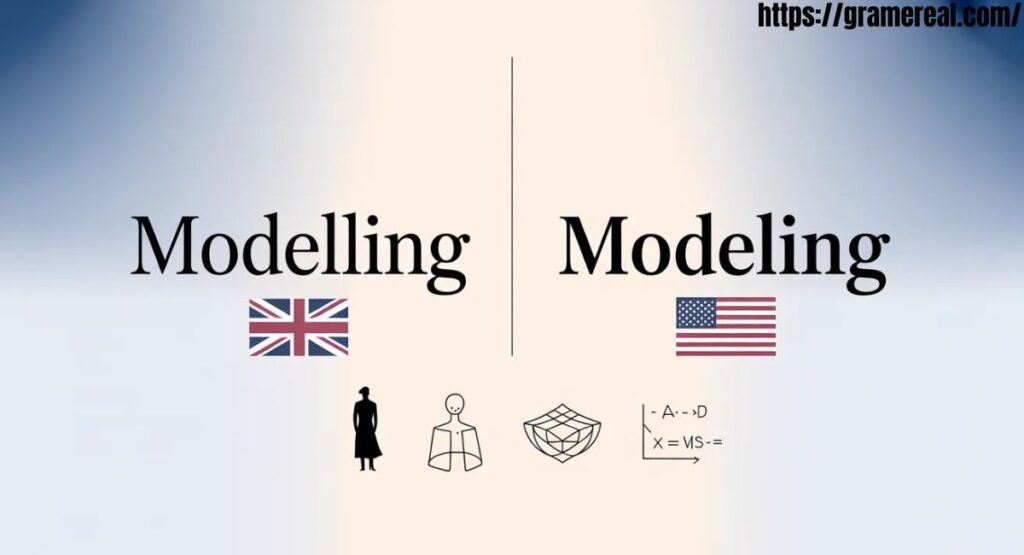
Modelling vs modeling refers to the regional spelling variation of the same English verb “model,” where British English uses the double-l form (modelling) and American English uses the single-l form (modeling). This difference follows established grammatical conventions unique to each dialect not errors, but two equally correct versions of the same word shaped by geography and tradition.
That one extra letter carries surprising weight. It can signal to an editor whether you understand your audience, determine whether a spellchecker flags your work, and even influence how professional your writing appears across borders. Mastering this distinction is a small change that makes a big impression.
Beyond fashion runways and scientific reports, this spelling divide appears in academic papers, business documents, digital content, and everyday communication worldwide. Understanding the rules behind modelling vs modeling helps writers, students, and professionals communicate with confidence, consistency, and cultural awareness wherever their audience may be.
What Does Modelling or Modeling Mean?
Both words are the present participle and gerund form of the verb “model.” The core meaning is identical regardless of spelling. “Modelling” and “modeling” can refer to:
- Creating a representation of something (a building, a system, a process)
- Displaying or wearing clothing as a professional model
- Shaping a material such as clay or wax
- Demonstrating behavior for others to imitate (as in a classroom setting)
- Simulating data in science, economics, or engineering
So the sentence “She has been modeling for five years” and “She has been modelling for five years” carry exactly the same meaning. The only thing that differs is the regional convention of the writer.
Why Are There Two Spellings?
The split between “modelling” and “modeling” is part of a broader pattern of spelling differences between British English and American English. The root verb “model” ends in a consonant (l) preceded by a vowel (e). When you add a vowel-starting suffix like -ing, a fundamental grammatical rule kicks in but British and American English apply it differently.
The Double-L Rule Explained
British English rule: When a verb ends in a single vowel followed by an “l,” double the “l” before adding a vowel suffix, regardless of syllable stress. This gives us modelling, travelling, labelling, and cancelling.
American English rule: Only double the final consonant if the last syllable is stressed. Since the stress in “model” falls on the first syllable (MOD-el), American English does not double the “l” producing modeling, traveling, labeling, and canceling.
This grammatical divergence is consistent across dozens of words. It is not an error; it is a well-established difference in two equally valid rule sets.
Modelling in British English
In British English, “modelling” with a double “l” is the standard and expected spelling. This applies across:
- Academic journals and dissertations published in the UK
- Government and public sector documents
- Newspapers such as The Guardian and The Times
- All Commonwealth countries including Australia, New Zealand, Canada, India, and South Africa
If you are writing for a British or Commonwealth audience, using “modeling” (single l) will appear as an error, even though it is technically a valid American spelling.
Common British English forms:
| Base Form | British English |
|---|---|
| model (verb) | modelling |
| past tense | modelled |
| person who models | modeller |
Modeling in American English
In American English, “modeling” with a single “l” is universally preferred. You will see this in:
- US academic publications and journals (APA, Chicago, MLA style guides)
- American newspapers and media outlets
- Corporate communications from US-based companies
- US government and scientific reports
Using “modelling” in American English content is not technically wrong, but it looks out of place and may distract readers or suggest unfamiliarity with local conventions.
Common American English forms:
| Base Form | American English |
|---|---|
| model (verb) | modeling |
| past tense | modeled |
| person who models | modeler |
Quick Comparison: Modelling vs Modeling at a Glance
| Feature | British English | American English |
|---|---|---|
| Spelling | modelling | modeling |
| Past tense | modelled | modeled |
| Agent noun | modeller | modeler |
| Region | UK, Australia, NZ, Canada | USA |
| Double-l rule | Always doubles | Only when syllable is stressed |
| Pronunciation | Identical | Identical |
| Meaning | Identical | Identical |
Modelling vs Modeling in Academic and Professional Writing
The stakes are higher in professional and academic writing, where inconsistency can undermine your credibility. Here are the key guidelines:
- Match your institution’s location. A paper submitted to a UK university should use “modelling.” One submitted to a US journal should use “modeling.”
- Follow the style guide. APA (American) uses “modeling.” Oxford style (British) uses “modelling.”
- Be consistent throughout. Switching between both spellings in one document is the only real mistake. Pick one and stick to it.
- Check the publisher’s requirements. Many international journals specify their preferred English variant in their author guidelines.
Common Mistakes with Modelling vs Modeling
Even experienced writers trip up here. Watch out for these:
- Mixing both spellings in the same document This is the most damaging error. A reader will assume it’s a typo or oversight.
- Applying American rules in British academic papers Examiners and editors notice this immediately.
- Ignoring the rule for related words If you choose “modelling,” you should also write “modelled,” “modeller,” “travelling,” and “labelling” for consistency.
- Assuming “modelling” is more formal Both spellings carry equal formality. Length does not equal sophistication.
- Over-correcting based on spellcheck Many spellcheckers default to American English. If you’re writing for a British audience, adjust your spellcheck settings.
Does the Meaning Change with Spelling?
No. The meaning is completely identical. Whether you write “modelling” or “modeling,” you are communicating the exact same concept. The spelling does not signal a different type of modelling, a different level of formality, or a different professional field. It signals only the regional variety of English being used.
Modelling vs Modeling in Fashion and Media
In the fashion world, both spellings are used freely depending on geography:
- A London-based fashion magazine will cover the modelling industry.
- A New York fashion brand will talk about modeling contracts.
- International platforms like Instagram and global brand websites sometimes use both, depending on the team’s location.
Neither version sounds more glamorous or professional than the other. Runway modelling and runway modeling refer to the same profession.
Modelling vs Modeling in Science and Technology
Scientific and technical writing uses “modelling” or “modeling” in contexts such as:
- Climate modelling/modeling Simulating atmospheric and weather systems
- Mathematical modelling/modeling Using equations to represent real-world phenomena
- 3D modelling/modeling Creating digital representations in software like AutoCAD or Blender
- Data modelling/modeling Structuring and organizing data in databases
- Predictive modelling/modeling Forecasting outcomes based on existing data
International scientific journals may accept either spelling. However, consistency within the paper is non-negotiable.
Idiomatic and Fixed Expressions
Some common phrases use “model” in ways where the regional spelling rule still applies:
| Expression | British English | American English |
|---|---|---|
| Role model (verb) | role modelling | role modeling |
| Scale model (verb) | scale modelling | scale modeling |
| Fashion model (verb) | fashion modelling | fashion modeling |
| Computer simulation | computer modelling | computer modeling |
How to Choose the Correct Spelling
Ask yourself three simple questions:
- Who is my audience? British/Commonwealth readers expect “modelling.” American readers expect “modeling.”
- What does my style guide say? APA = “modeling.” Oxford = “modelling.”
- What spelling have I used so far in this document? Whatever it is stick to it.
If you are writing for a global audience with no clear regional majority, either spelling is acceptable. Many international publications default to British English as a neutral standard, but American English is equally valid.
Modelling vs Modeling in Global Communication
In an increasingly connected world, writers often produce content for mixed audiences. Here are some practical tips:
- Websites with international traffic Consider your target market. If most users are American, use “modeling.” If UK or Commonwealth audiences dominate, use “modelling.”
- Social media Consistency matters less here, but picking one spelling per platform helps maintain a coherent brand voice.
- Email and business correspondence Mirror the spelling preference of the person you are writing to. It shows cultural awareness.
- Multilingual teams Agree on a house style at the start of a project to avoid mixed spellings across documents.
Historical Background of the Spelling Difference
The word “model” traces its roots to the Latin modulus, meaning “measure” or “standard.” It passed through Old French (modelle) before entering Middle English. By the 17th century, “model” was firmly established as both a noun and a verb in English.
The spelling divergence came later. In the 19th century, British and American literary traditions began to diverge noticeably. British authors maintained the doubled consonant rule broadly, while American writers influenced by spelling reform movements favored simplification. By the 20th century, both variants were cemented in their respective standard usage, and the split we see today was fully established.
Practical Examples in Full Sentences
- The architect spent weeks modelling the new building in software before construction began.
- She pursued a career in modelling after being scouted in Manchester.
- The researchers used climate modelling to forecast rising sea levels.
- The teacher modelled the correct technique for the students to follow.
American English (single l):
- The architect spent weeks modeling the new building in software before construction began.
- She pursued a career in modeling after being scouted in Chicago.
- The researchers used climate modeling to forecast rising sea levels.
- The teacher modeled the correct technique for the students to follow.
Teaching Modelling vs Modeling to Learners
For English language teachers and learners, this topic offers a great entry point into understanding the broader British vs American spelling system. A few teaching tips:
- Teach the pattern, not just the word. Once students understand the double-l rule, they can apply it to travelling/traveling, labelling/labeling, cancelling/canceling, and dozens more.
- Use regional context. Ask learners where their future career or studies will take them, then anchor spelling to that context.
- Avoid calling one “correct” and the other “wrong.” Both are correct. The goal is contextual accuracy.
- Practice with real texts. Show students British newspaper extracts and American news articles side by side to illustrate the difference naturally.
Conclusion
The modelling vs modeling debate has a simple answer: both are correct, and your choice depends entirely on your audience and regional context. British English uses the double “l” (modelling), while American English keeps it single (modeling). The pronunciation is identical, the meaning is identical, and neither version is superior to the other.
The one rule that matters most is consistency. Mix the two within a single piece of writing, and you’ll look careless. Choose one, apply it throughout, and your writing will always look polished and professional whether you’re modelling clay, modeling data, or writing about either.
FAQs
Is “modelling” or “modeling” correct?
Both are correct. “Modelling” is standard in British English, while “modeling” is preferred in American English.
Which spelling should I use in an academic paper?
It depends on your institution and journal. Use “modelling” for UK publications and “modeling” for US publications, and always follow the required style guide.
Is “modelling” more formal than “modeling”?
No. Both carry the same level of formality. The extra “l” is a regional spelling convention, not a marker of formality or sophistication.
Do “modelling” and “modeling” mean the same thing?
Yes, completely. The only difference between the two words is spelling. The meaning, pronunciation, and usage contexts are identical.
Which spelling does Google prefer for SEO?
Google treats both spellings as equally valid. Target the spelling your primary audience uses, and consider including both variants naturally in your content if your audience is international.
What about “modelled” and “modeled”?
The same rule applies. “Modelled” is British English; “modeled” is American English. Apply whichever matches the rest of your document.
Is “modeller” or “modeler” correct for the person who models?
“Modeller” is British English; “modeler” is American English. Both are grammatically correct in their respective contexts.
Can I use “modelling” in American documents?
Technically yes, but it will stand out. Most American readers and editors expect “modeling,” and using “modelling” may give the impression of an error.