
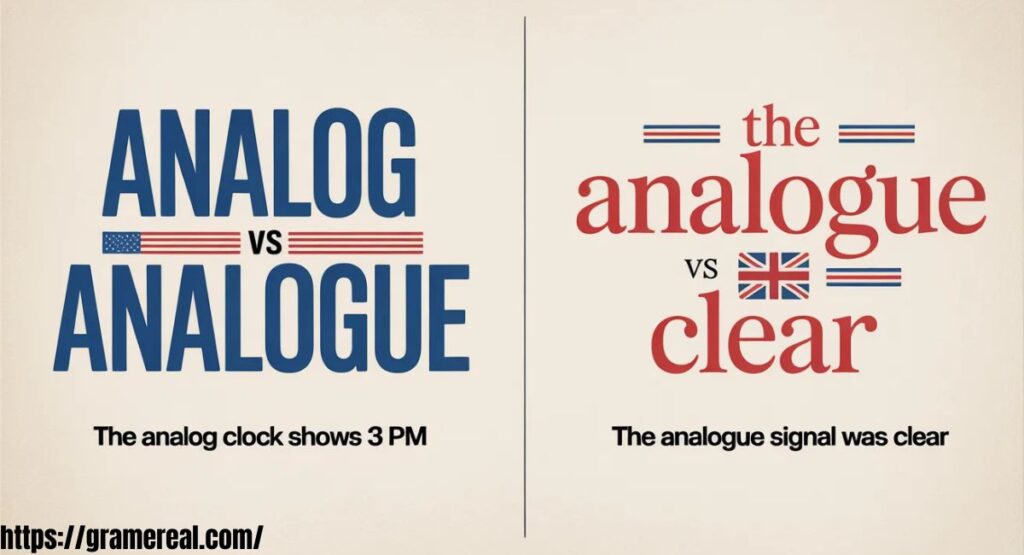
Analog vs Analogue two spellings of the same word one preferred in American English and the other in British English. Both describe systems where information flows continuously, like a clock with sweeping hands or a vinyl record with varying grooves, and both serve as nouns meaning something comparable to something else.
Here is the truth most grammar guides bury at the bottom: choosing the wrong spelling in a professional document does not just look careless it silently signals to editors, clients, and readers that you do not fully understand your audience.
Knowing when to write analog versus analogue is less about memorizing a rule and more about understanding who you are speaking to. Master this distinction, and your writing instantly feels more polished, authoritative, and regionally aware qualities that separate strong writers from forgettable ones.
What Does “Analog” Mean?
Analog is the preferred spelling in American English. It functions as both an adjective and a noun.
Analog vs Analogue: How to Use Them Correctly As an adjective, it describes systems or devices where information is represented by continuously variable physical quantities the opposite of digital. Think of a clock with moving hands, or a vinyl record with grooves that vary in depth.
As a noun, analog refers to something that resembles or corresponds to something else. This usage connects it to the word analogy both trace back to the Greek analogos, meaning “proportionate.”
Common examples of analog (adjective):
- Analog clock
- Analog signal
- Analog audio recording
- Analog circuit
Common examples of analog (noun):
- “The heart is a biological analog of a mechanical pump.”
What Does “Analogue” Mean?
Analogue is the standard spelling in British English and Commonwealth countries like Australia, Canada (partially), and New Zealand. It carries the exact same meaning as analog the spelling is the only difference.
In British publishing, analogue is used both in technical contexts (electronics, engineering) and in figurative or literary contexts where something is compared or likened to something else.
Common examples of analogue:
- Analogue television signal
- Analogue watch
- “The annual contest is an analogue to similar events in the US.”
Are Analog and Analogue the Same?
Analog vs Analogue: How to Use Them Correctly Yes — completely. Analog and analogue are two spellings of the same word. They share the same meaning, the same grammar roles (adjective or noun), and the same history. The only real difference is regional spelling convention.
| Feature | Analog | Analogue |
|---|---|---|
| Spelling region | American English | British/Commonwealth English |
| Part of speech | Adjective / Noun | Adjective / Noun |
| Meaning | Same | Same |
| Used in technology | Yes | Yes |
| Used figuratively | Yes | Yes |
Why Do Two Spellings Exist?
The split goes back to the 19th century and Noah Webster’s famous spelling reforms. Webster the American lexicographer behind Merriam-Webster deliberately simplified many British spellings to make American English more phonetic and easier to use. Words like colour became color, honour became honor, and catalogue became catalog. Following this same pattern, analogue was shortened to analog in American usage.
Analog vs Analogue: How to Use Them Correctly British English, by contrast, kept its French-influenced spellings and since analogue entered English directly from French around 1800, the British version retained the original “-ue” ending.
Both forms are historically valid. It’s not a question of right or wrong, but of audience and tradition.
Analog vs Analogue in Technology
In the world of technology, these words get heavy usage and here, analog tends to dominate globally, even in British-influenced environments.
What Is an Analog Signal?
An analog signal is a continuous, varying wave of information unlike digital signals, which exist in discrete on/off steps. Classic examples include:
- Analog clocks hands sweep continuously around the dial
- Vinyl records grooves vary continuously to encode sound
- Traditional thermometers the mercury rises and falls in a continuous range
- AM/FM radio waves continuous wave transmissions
Analogue in British Tech Writing
In UK-based technical manuals, academic papers, and engineering documentation, analogue is standard:
- “The lab tested analogue electronics.”
- “An analogue signal was detected at 60Hz.”
The meaning is identical only the spelling differs.
Contextual Examples in Daily Use
Here are both words used naturally in sentences so you can see them in action:
American English (analog):
- “She prefers the warm sound of analog recordings over digital.”
- “The analog meter gave a more intuitive reading.”
- “This device is a useful analog to the human nervous system.”
British English (analogue):
- “The museum displayed analogue photography equipment.”
- “He repaired analogue televisions for a living.”
- “The contest is an analogue to similar competitions held in Europe.”
Both sets of sentences are grammatically correct. The key is consistency within a single document.
Common Mistakes with Analog and Analogue
Mistake 1: Mixing Both Spellings in the Same Document
❌ “This analog device supports analogue signals.” ✅ “This analog device supports analog signals.” (American) ✅ “This analogue device supports analogue signals.” (British)
Pick one spelling and stick to it throughout your writing.
Mistake 2: Using the Wrong Form for Your Audience
If you’re writing a technical blog for a US audience, use analog. If you’re submitting an academic paper to a UK journal, use analogue. Ignoring your audience’s regional convention can make your writing feel foreign or careless.
Mistake 3: Confusing “Analog” with “Analogy”
These are related but different words. An analogy is a comparison or similarity between two things. An analog/analogue is the thing that is being compared. They share a Greek root but are not interchangeable.
Analog vs Analogue as a Noun
As nouns, both words mean “something that is comparable or functionally similar to something else.” This usage is slightly more common in formal or academic writing.
- “Water is a useful analog for understanding electrical current.” (American)
- “The mitochondrion has no exact analogue in human-made machines.” (British)
In this noun sense, analogue (with the “-ue”) is still common even in some American academic writing, particularly in biology and chemistry, where phrases like “chemical analogue” or “structural analogue” remain standard.
Analog and Analogue in Comparisons
Both words are frequently used when making comparisons across different fields:
| Field | Example |
|---|---|
| Biology | “The appendix has no clear analog in reptiles.” |
| Chemistry | “This compound is a structural analogue of aspirin.” |
| Music | “Analog recording captures warmth that digital misses.” |
| Philosophy | “Language is an analogue of thought.” |
American vs British English Differences
Here’s a quick-reference table showing how the two English traditions differ:
| Context | American English | British English |
|---|---|---|
| General adjective | analog | analogue |
| Technology / electronics | analog | analogue |
| Noun (comparison) | analog | analogue |
| Formal academic writing | analog | analogue |
| Commonwealth countries | analogue | |
| Global tech publications | analog (dominant) | analog (often used) |
Idiomatic and Natural Usage
In spoken English, both words sound identical the “-ue” is silent. This means the distinction is purely written. In casual conversation, nobody will notice the difference, but in published writing, it signals regional awareness.
Naturally occurring phrases:
- “Going analog” (American) / “Going analogue” (British) used to describe switching from digital to traditional methods
- “Analog photography” / “Analogue photography” film cameras as opposed to digital ones
- “Analog thinking” / “Analogue thinking” linear, step-by-step reasoning
Practical Tips to Remember the Difference
Here are three memory tricks that actually work:
- The UK trick: The word United Kingdom contains a “U”and so does analoue. If you’re writing for UK readers, include the “U.”
- The catalog pattern: Americans turned catalogue → catalog, dialogue → dialog, and analogue → analog. Follow the same pattern based on your audience.
- When in doubt, check your style guide: AP Style (American journalism) uses analog. Oxford style (British) uses analogue.
Sentence Examples for Practice
Try reading these aloud to internalize both spellings:
- The engineer replaced the analog sensor with a digital one. (US)
- She collected analogue watches from the 1970s. (UK)
- Music lovers argue that analog recordings have more depth. (US)
- The new drug is a synthetic analogue of a naturally occurring hormone. (UK science writing)
- He grew up reading analog science fiction magazines. (US)
- The city’s transport system has no analogue in the modern world. (UK formal)
Why This Difference Matters in Writing
You might wonder if they mean the same thing, why does it matter at all?
It matters for a few reasons:
- Professionalism: Using the wrong regional spelling in a formal document signals inattention to detail.
- Audience trust: British readers who see “analog” throughout a UK-facing document may find it jarring, and vice versa.
- Consistency: Mixed spellings within a single piece of writing look careless, regardless of region.
- SEO and publishing: Many editorial style guides have hard rules on regional spelling, and following them affects how your content is received by editors and search engines alike.
Reflection on Grammar Rules and Writing Techniques
The analog/analogue debate is a perfect case study in how English evolves separately across regions. Unlike most grammar “rules,” this one doesn’t have a right or wrong answer only a contextual answer. Good writers adapt their language to their audience. Knowing that catalog and catalogue follow the same pattern as analog and analogue helps you internalize the broader principle rather than memorizing case by case.
This kind of linguistic awareness understanding why a rule exists, not just what the rule is is what separates confident writers from uncertain ones.
Conclusion
Both analog and analogue are correct. They mean the same thing and function the same way in sentences. The choice comes down entirely to your audience: American readers expect analog, while British and Commonwealth readers expect analogue. In global technical writing, analog tends to dominate. In UK literature and formal academic writing, analogue remains standard.
FAQs
Is “analog” or “analogue” correct?
Both are correct analog is preferred in American English and analogue in British English.
Can I use “analogue” in the United States?
Yes, it’s understood, but analog is the expected spelling in American publications and can look unusual to US readers.
Which spelling is used in Canada?
Canada uses both, but analogue is more common in formal and academic writing due to British influence.
Is “analog” only used in technology?
No analog can also be a noun meaning something comparable to something else, used in science, philosophy, and everyday writing.
Are “analog” and “analogy” the same word?
No. An analogy is a comparison or similarity. An analog/analogue is the thing that is similar to something else. They share Greek roots but have distinct meanings.
Should I use “analogue” in chemistry?
Yes in chemistry and biology, analogue (or analog in US papers) is standard when referring to structural or chemical similarity, as in “a chemical analogue of dopamine.”
Does Google treat “analog” and “analogue” as the same keyword?
Not always. For SEO purposes, it’s best to use both forms naturally within your content if targeting both American and British audiences.