Trawling vs Trolling: A Complete Guide are two words that confuse even experienced writers and fishermen alike. Trawling refers to dragging a large net through water to catch fish on a commercial scale, while trolling means pulling a baited line or lure behind a moving boat or, in the digital world, deliberately provoking others online. This complete guide covers both terms in depth, from fishing techniques to grammar rules.
Trawling vs Trolling: A Complete Guide Here is the truth most people never realize: one wrong word can completely change your meaning. Call a commercial fisherman a “troller” or accuse someone online of “trawling” and you have already lost your credibility. The difference matters more than most people think.
Trawling vs Trolling: A Complete Guide From their medieval etymological roots to their modern-day usage in environmental debates and social media discussions, trawling and trolling carry distinct identities. Understanding when, why, and how to use each one correctly will sharpen your writing, strengthen your communication, and eliminate a surprisingly common mistake for good.
What Does “Trawling vs Trolling” Mean?
At the most basic level:
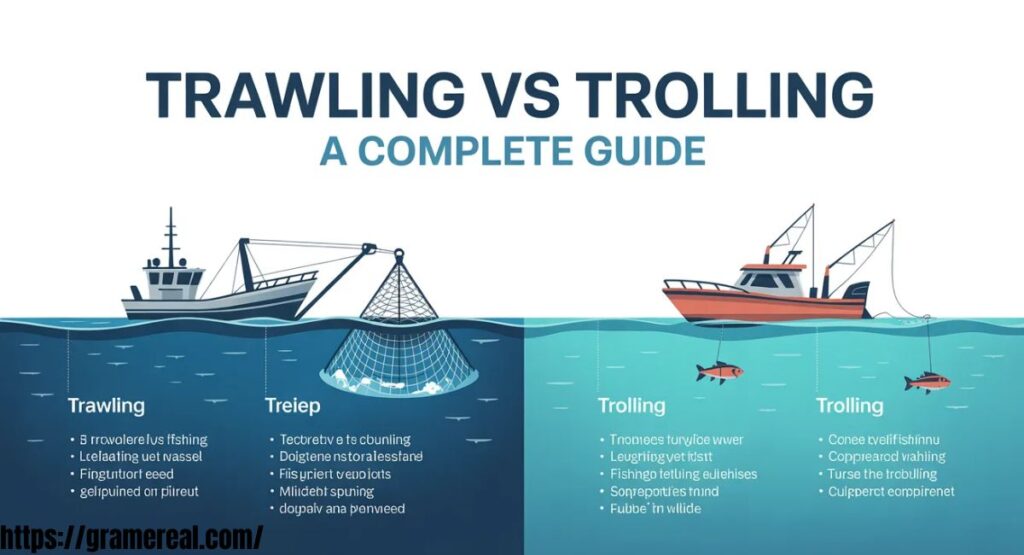
- Trawling = dragging a large net through water to catch fish (commercial, large-scale)
- Trolling = pulling a baited line or lure behind a moving boat (recreational or selective fishing) OR posting provocative content online to upset others
Think of it simply: trawling is about volume; trolling is about selectivity.
Both words are verbs. Both relate to dragging something through water. But they differ significantly in technique, scale, equipment, and modern usage.
Spelling and History
Where Did “Trawling” Come From?
The word trawl is believed to derive from a Middle Dutch word traghelen, meaning “to drag.” The noun entered English in the late 1400s and the verb form by the mid-1500s. From the start, it referred to a drag net pulled along the sea floor to scoop up marine life.
By the 20th century, the word had taken on a figurative meaning as well trawling through data, archives, job listings, or social media posts. The image is the same: casting a wide net and gathering everything in your path.
Where Did “Trolling” Come From?
Troll has a more tangled history. It traces back to the Old French word troller, a hunting term meaning “to wander in search of game.” By around 1600, it had taken on its fishing sense specifically, fishing by trailing a line behind a moving boat.
The internet sense of trolling emerged in the late 1980s and early 1990s on Usenet newsgroups, in phrases like “trolling for newbies.” The Oxford English Dictionary places its first known written attestation in 1992. The term likely merged the fishing image of dangling bait to lure a catch with the mythological Norse troll a mischievous, disruptive creature.
Key Spelling Difference
| Word | Root | Extra Letter | Memory Tip |
|---|---|---|---|
| Trawling | Trawl (net) | Think: Trawl = neT | |
| Trolling | Troll (lure/online) | Extra “l” | Lure starts with L trolling uses a lure |
When to Use “Trawling”
- Commercial net fishing large boats dragging enormous conical nets through the ocean
- Searching through large amounts of information data, archives, records, news articles
Trawling in Fishing Contexts
Trawling is the dominant method in commercial fisheries worldwide. A trawl net can span 50–100 feet wide and weigh several tons. The net’s open “mouth” scoops up everything in its path as the vessel moves forward. There are three main types:
- Bottom trawling nets dragged along the ocean floor, targeting species like cod and shrimp
- Pelagic (midwater) trawling nets pulled through the middle of the water column
- Skimmer trawling surface-level net fishing
Trawling is efficient but controversial. It is non-selective catching not just the target species but also bycatch including seabirds, rays, and juvenile fish. The ecological impact on ocean floor habitats is significant.
Trawling in Figurative Contexts
Trawling works well in everyday figurative English when the idea is searching widely or systematically:
- “She spent hours trawling the internet for cheap flights.”
- “Investigators were trawling through years of financial records.”
- “The editor trawled the archives for relevant photographs.”
This usage is especially common in British English, where trawl is the preferred figurative verb.
When to Use “Trolling”
Use trolling when you mean:
- Recreational fishing with a lure or baited line drawn behind a moving boat
- Deliberately posting provocative or disruptive content online to upset others
Trolling in Fishing Contexts
Unlike trawling, trolling is a precision fishing technique. Anglers attach baited lines or artificial lures to the back of a slowly moving boat, mimicking the natural movement of prey to attract specific species like salmon, tuna, or marlin. It is popular in both freshwater and saltwater fishing.
Because trolling targets individual fish with hooks, it produces very little bycatch. In most cases, non-target fish can be released alive — making it a far more sustainable method than trawling.
Trolling in Internet and Social Media Contexts
Today, most people encounter the word trolling in a digital context. An internet troll deliberately posts inflammatory, off-topic, or offensive messages to provoke an emotional reaction from others. The goal is disruption not genuine engagement.
This sense evolved from the fishing image of dangling bait and waiting for something to bite.
- “He was trolling the comment section just to start arguments.”
- “Don’t feed the trolls ignore them and they’ll move on.”
- “The social media platform suspended accounts caught trolling public figures.”
Contextual Examples of Correct Usage
| Sentence | Correct Word | Why |
|---|---|---|
| “The commercial fleet was for shrimp.” | Trawling | Large net, commercial operation |
| “She was through thousands of emails for clues.” | Trawling | Wide, systematic search |
| “He enjoyed for bass on the weekend.” | Trolling | Lure/line recreational fishing |
| “Stop and be respectful online.” | Trolling | Provoking others digitally |
| “The research team was databases for matching records.” | Trawling | Broad data search |
| “The boat was for salmon along the coast.” | Trolling | Moving boat, baited line |
Common Mistakes with “Trawling vs Trolling”
Mistake 1: Using “Trolling” for Net Fishing
❌ The fishermen were trolling with huge nets.
✅ The fishermen were trawling with huge nets.
Trolling never involves nets. If there’s a net, it’s trawling.
Mistake 2: Using “Trawling” for Online Provocation
❌ He was trawling the comments to make people angry.
✅ He was trolling the comments to make people angry.
Trawling has no established internet meaning. Online disruption is always trolling.
Mistake 3: Treating Them as Fully Interchangeable
While older dictionaries like the 1891 Century Dictionary noted some overlap in surface-fishing terminology, modern usage has clearly separated the two. Outside of very specific, archaic fishing descriptions, mixing them creates confusion.
American vs British English
There is no major spelling difference between American and British English for either word both regions write trawling and trolling identically.
However, usage patterns differ slightly:
- In British English, trawl is commonly used as a figurative verb: “trawling for votes,” “trawling the press.” This is well-established in UK media.
- In American English, troll is sometimes used figuratively as well: “trolling for clients,” “trolling for information.” This is less common but not incorrect in casual speech.
The internet meaning of trolling is universally understood in both varieties of English.
Idiomatic and Natural Usage
Here is how native speakers use these words in natural, idiomatic English:
Trawling:
- “The trawling boats returned with full nets.”
- “She spent the afternoon trawling job boards.”
- “Police were trawling CCTV footage for suspects.”
Trolling:
- “He’s just trolling don’t take the bait.”
- “They spent the morning trolling for pike on the river.”
- “The account was banned for repeat trolling.”
Notice how the context immediately makes the meaning clear. Trawling feels systematic and wide-ranging; trolling feels targeted — whether at a fish or a person.
Practical Tips to Remember the Correct Form
Here are three quick memory aids:
- Net = Trawl: If it involves a net, it is trawling. Think of the “w” in trawl as a net stretched wide.
- Lure = Trolling: Troll has an extra L and so does lure. Trolling uses a lure.
- Online = Trolling Only: The internet has trolls, not trawlers. If someone is being disruptive online, they are trolling, full stop.
Sentence Examples for Practice
Read each sentence and choose the correct word:
- “The vessel spent three days the North Sea for cod.” → Trawling
- “He was the forums, posting fake questions to get reactions.” → Trolling
- “She was through hundreds of résumés to find the right candidate.” → Trawling
- “We tried for bass near the inlet, using spinners.” → Trolling
- “Environmental groups oppose bottom because of damage to coral reefs.” → Trawling
- “The comedian admitted he was the interviewer with his answers.” → Trolling
Why Using the Correct Form Matters
Word choice matters for clarity, credibility, and communication. When you write for professional or public audiences, the wrong word can:
- Undermine trust readers notice errors, and they question the writer’s expertise
- Change the meaning entirely especially in legal, environmental, or digital policy contexts
- Confuse your audience particularly when switching between fishing and internet discussions
For example, a marine conservation article that says “we must reduce online trawling” would leave readers baffled. And a piece about social media that says “the troll was trawling for arguments” sounds clunky and imprecise.
Following Google’s E-E-A-T framework (Experience, Expertise, Authoritativeness, Trustworthiness), precise language is one of the clearest signals of genuine expertise.
Reflection on Grammar Rules and Writing Techniques
The trawling vs trolling confusion is a perfect example of how near-homophones words that sound alike but differ slightly trip up even fluent English speakers. The overlap in their fishing origins makes it worse.
The best writers do not rely on spell-checkers to catch these errors, because spell-checkers cannot detect contextual misuse. Both words are spelled correctly; only a human reader familiar with the meanings will flag the mistake.
Building vocabulary awareness understanding why words mean what they mean is the most reliable long-term fix. Etymology, context, and mnemonic tricks all help. And when in doubt, ask yourself: Is there a net involved? It’s trawling. Is there a lure or a provocateur? It’s trolling.
FAQs
What is the main difference between trawling and trolling?
Trawling uses large nets to catch fish in bulk; trolling uses baited lines or lures from a moving boat to target specific fish, or refers to disruptive online behavior.
Can trawling and trolling ever mean the same thing?
In rare, archaic fishing contexts (surface fishing with a trailing line), the words were once loosely interchangeable but modern usage treats them as distinct.
Is “trolling” only an internet term?
No. Trolling is a genuine and widely practiced fishing technique predating the internet by centuries; the online meaning is an extension of the fishing metaphor.
Which word do you use for searching the internet?
Use trawling for broad, systematic searches (trawling the web for data); use trolling only for deliberately provocative online behavior.
Is trawling bad for the environment?
Bottom trawling in particular is widely criticized for destroying seafloor habitats, producing high bycatch, and disrupting marine ecosystems. Many countries regulate or restrict it.
Does British English use these words differently?
Spelling and pronunciation are identical, but British English more commonly uses trawl as a figurative verb (e.g., trawling for ideas), while American English sometimes uses troll in similar figurative phrases.
How do I remember which word to use?
Think: nets = trawling; lures = trolling. And anything online + disruptive = trolling, always.