
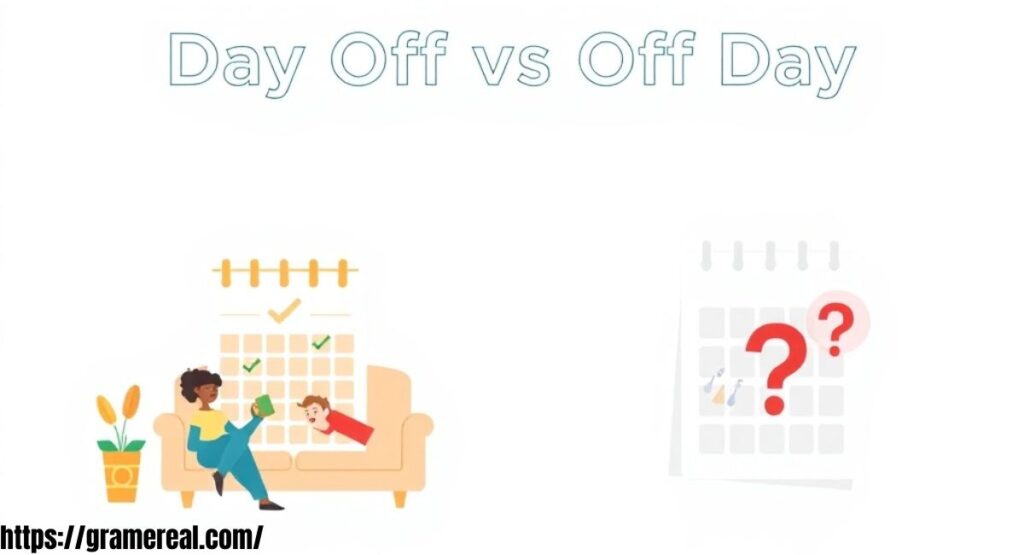
Day off vs off day Have you ever told a coworker, “I’m having an off day tomorrow” and watched them look confused? Or said “I took a day off” when you meant you just didn’t perform well? These two phrases trip up even fluent English speakers. Move a single word, and the meaning flips completely.
Day off vs off day This guide breaks down day off vs off day their meanings, grammar, parts of speech, real examples, and the most common mistakes to avoid.Day off vs off day By the end, you’ll never mix them up again.
Parts of Speech Analysis
Before diving into meaning, let’s examine what’s happening grammatically in each phrase.
| Phrase | Structure | “Off” Functions As | Meaning Conveyed |
|---|---|---|---|
| day off | Noun + Postpositive modifier | Adverb/adjective (postpositive) | A day free from work |
| off day | Adjective + Noun | Attributive adjective (prepositive) | A day of poor performance |
In “day off”, the word off comes after the noun day. It acts as a postpositive modifier the kind of structure you see in phrases like attorney general or court martial. It signals separation or absence from something (work, duty, routine).
In “off day”, off comes before the noun. It works as an ordinary attributive adjective, the same way bad works in bad day. It describes the quality of the day itself specifically, that something is wrong, substandard, or out of sync.
Word order is everything here. Same two words, completely opposite meanings.
Short Answer — Main Difference
- Day off = a planned, intentional break from work or responsibilities.
- Off day = an unplanned day when your mood, energy, or performance is below normal.
They are not interchangeable. The You take a day off. You have an off day. You never “take an off day from work,” and you never “have a day off at the office where you performed poorly.”
Detailed Meanings and When to Use Each
What Does “Day Off” Mean?
A day off is a scheduled rest day a day when you are not required to work, study, or fulfill your usual obligations. It’s intentional. You plan it, request it, or it falls naturally on a weekend or holiday.
Cambridge Dictionary defines a day off as “a day when you do not have to work or do something that you normally do.”
According to The Free Dictionary’s idioms section, the phrase dates to the late 1800s and is used in patterns like get a day off, have a day off, give someone a day off, and take a day off.
Use “day off” when:
- You’ve booked time away from the office
- You’re describing a holiday, rest day, or free day
- You’re talking about a scheduled break in a training or exercise routine
- You’re writing formally (HR letters, work emails, employment contracts)
Examples:
- She finally took a day off after working twelve days straight.
- Monday is my day off I don’t come in.
- I’d like to request a day off on Friday for a medical appointment.
What Does “Off Day” Mean?
An off day describes a day when you’re not performing at your usual level. It’s used informally to express frustration or disappointment not something planned, but rather an unexpected event where things just don’t go as expected.
The phrase likely emerged from early 20th-century sports slang. When an athlete underperformed, commentators called it “an off day.” It eventually entered everyday speech to describe any unproductive or emotionally tough day.
Use “off day” when:
- You’re tired, distracted, or mentally foggy at work
- An athlete or performer is not playing up to their usual standard
- You’re making more mistakes than usual despite being present
- You want to describe a rough day without calling it a total failure
Examples:
- The goalkeeper had an off day he let in three goals.
- Sorry for the typos. I’m having a bit of an off day.
- Even the best writers have off days.
Grammar Check — Structure and Parts of Speech
Let’s look at the grammar of each phrase in a complete sentence.
Sentence: “She took a day off to rest.”
| Word | Part of Speech | Notes |
|---|---|---|
| She | Pronoun | Subject |
| took | Verb (past tense) | Action verb; subject-verb agreement correct |
| a | Article (indefinite) | Modifies the noun phrase |
| day off | Noun phrase | Direct object of “took” |
| to rest | Infinitive phrase | Adverbial; explains purpose |
Sentence: “He had an off day at the presentation.”
| Word | Part of Speech | Notes |
|---|---|---|
| He | Pronoun | Subject |
| had | Verb (past tense) | Linking/action verb |
| an | Article (indefinite) | Used before vowel sound /ɒ/ |
| off | Adjective | Prepositive; modifies “day” |
| day | Noun | Head of noun phrase; direct object |
| at the presentation | Prepositional phrase | Adverbial modifier |
Article rule to remember: Always use an before off day because “off” begins with a vowel sound. ✅ an off day ❌ a off day.
Examples with Full Parts-of-Speech Labeling and Checks
Example 1 — “Day Off”
“I am taking a day off tomorrow to visit my parents.”
- I Pronoun (subject)
- am taking Verb phrase (present continuous; correct for planned future)
- a day off Noun phrase (direct object)
- tomorrow Adverb (time modifier)
- to visit Infinitive phrase (purpose)
- my parents Noun phrase (object of infinitive)
✅ Grammar check: Complete sentence. Subject-verb agreement correct. Article use correct.
Example 2 — “Off Day”
“Even experienced surgeons have off days.”
- Even Adverb (emphasizer)
- experienced Adjective (modifies “surgeons”)
- surgeons Noun (subject)
- have Verb (present simple; plural subject correct)
- off days Noun phrase (plural direct object; “off” as adjective)
✅ Grammar check: Complete sentence. Verb agrees with plural subject. Natural and idiomatic.
Common Mistakes and How to Fix Them
These errors show up regularly even among advanced English learners.
Mistake 1: Using “off day” to mean a free day
❌ “I’m having an off day tomorrow I won’t be at work.” ✅ “I’m taking a day off tomorrow I won’t be at work.”
Why: “Off day” does not mean absence from work. It describes poor performance while you are present.
Mistake 2: Using “day off” to describe poor performance
❌ “The team had a day off during the finals.” (when meaning they played badly) ✅ “The team had an off day during the finals.”
Why: “Day off” implies they didn’t play at all which changes the meaning entirely.
Mistake 3: Missing the article
❌ “She took day off.” ✅ “She took a day off.” or “She took the day off.”
Why: English requires an article before singular countable nouns. “Day off” is a countable noun phrase.
Mistake 4: Wrong article before “off day”
❌ “I’m having a off day.” ✅ “I’m having an off day.”
Why: “Off” begins with a vowel sound, so the article must be an, not a.
Mistake 5: Treating them as synonyms
❌ “Today is my off day, so I slept in and went to the beach.” ✅ “Today is my day off, so I slept in and went to the beach.”
Why: “Off day” refers to bad performance, not scheduled rest. Using it here sounds unnatural to native speakers.
American vs British English — Any Difference?
Both phrases are used and understood in American and British English without significant variation. However, there are a few subtle differences worth knowing.
American English strongly prefers “day off” in workplace contexts. You’ll see it in HR policies, employment contracts, and scheduling emails across the US.
British speakers may also say “day’s leave” as an alternative to “day off,” particularly in formal or professional contexts. The phrase “have a day off” is equally natural in British English.
“Off day” is used identically on both sides of the Atlantic a rough, underperforming day is an off day whether you’re in London or Los Angeles.
Idioms and Related Phrases
Once you understand these phrases, you’ll notice a whole family of related expressions:
- Take the day off to decide on the day itself not to work (informal)
- Day’s leave British formal alternative to “day off”
- Rest day close in meaning to “day off”; emphasizes physical or mental recovery
- Free day emphasizes liberty and absence of obligations
- Off one’s game similar to “off day”; used in sports and professional settings
- Not at one’s best polite way of saying someone is having an off day
- Under the weather used when an off day is caused by illness
Note: “Rest day” and “day off” are close but not identical. A rest day focuses on recovery; a day off simply means you’re not working you could spend it doing errands, traveling, or anything else.
Practical Tips — When to Use Which Phrase
Use this quick guide for everyday decisions:
“day off” when you want to communicate:
- Scheduled absence from work or school
- A holiday, weekend, or vacation day
- Time away from a regular routine (exercise, training, meetings)
- A request to your employer or teacher
“off day” when you want to communicate:
- Lower-than-normal energy or focus
- A series of uncharacteristic mistakes
- Poor athletic or professional performance
- Emotional difficulty without a specific cause
Quick memory trick: Think of day off as permissioned rest (you chose it) and off day as unplanned struggle (it happened to you).
Longer Examples in Context with Labels and Checks
Context 1 — Workplace Email
“Hi Sarah, I wanted to let you know I’ll be taking a day off on Thursday for a family matter. I’ve completed my pending tasks in advance. Please let me know if you need anything before then.”
Grammar notes:
- “Taking a day off” — present continuous for planned future ✅
- “A day off on Thursday” — countable noun phrase with correct article ✅
- Register: Professional and appropriate for a workplace email ✅
Context 2 — Sports Commentary
“Martinez had an off day at the net — she double-faulted four times and lost serve in the third set. It happens to the best players. She’ll come back stronger.”
Grammar notes:
- “Had an off day” past simple; correct for completed event ✅
- “An off day” vowel article rule applied correctly ✅
- Register: Neutral, sports-context appropriate ✅
Rewriting to Enhance Grammar, Clarity, and Style
Before (weak and unclear):
“Sorry I was bad today. I think I had a day off mentally or something.”
After (clear and natural):
“I apologize for today I was having an off day and wasn’t at my best. I’ll make sure it doesn’t affect tomorrow’s meeting.”
- Replaced the grammatically incorrect “had a day off mentally” with “having an off day” ✅
- Added accountability and forward-looking tone ✅
- More professional and idiomatic ✅
Before (clunky):
“She said she was taking an off day so she won’t come to the office.”
After:
“She mentioned she’s taking a day off, so she won’t be in the office today.”
What improved:
- Fixed “taking an off day” → “taking a day off” ✅
- Cleaner sentence structure ✅
- Natural phrasing a native speaker would use ✅
Conclusion
Day off vs off day The difference between day off and off day comes down to one thing: word order. Place off after day, and you have a planned rest from work.Day off vs off day Place off before day, and you have an unplanned, below-par performance.
Day off vs off day You take a day off. You have an off day. They are not interchangeable and now you have the grammar, examples, and memory tricks to use each one correctly, every time.
Day off vs off day Next time you book a break from work, say “I’m taking a day off.” And the next time nothing goes right despite your best effort, it’s simply an off day and everyone has them.
FAQs
Are “day off” and “off day” the same thing?
No. A day off means planned rest from work, while an off day means unplanned poor performance or low energy.
Can I say “I’m taking an off day from work”?
No this is a common mistake. The correct phrase is “I’m taking a day off from work.”
Which article do I use before “off day”?
Always use an not a because “off” starts with a vowel sound: “I’m having an off day.”
Is “off day” used in British English?
Yes, it’s used identically in both British and American English to describe a day of poor performance.
What’s the difference between “off day” and “bad day”?
An off day specifically refers to underperformance you showed up but weren’t at your best. A bad day is broader and can mean anything went wrong, regardless of performance.
Can “day off” be plural?
Yes. “She has two days off this week.” The plural is days off, not day offs.
Is “rest day” the same as “day off”?
They’re similar but not identical. A rest day emphasizes physical or mental recovery, while a day off simply means absence from obligations which you could spend traveling, running errands, or anything else.
What verbs go with “day off”?
Common verbs: take a day off, have a day off, get a day off, give someone a day off, request a day off.
What verbs go with “off day”?
Common verbs: have an off day, experience an off day. Note: you never take an off day.
Does word order always change meaning in English like this?
Yes, often. Word order in English is crucial. Moving an adjective or modifier shifts meaning “day off” vs “off day” is one of the clearest examples of this rule in everyday English.