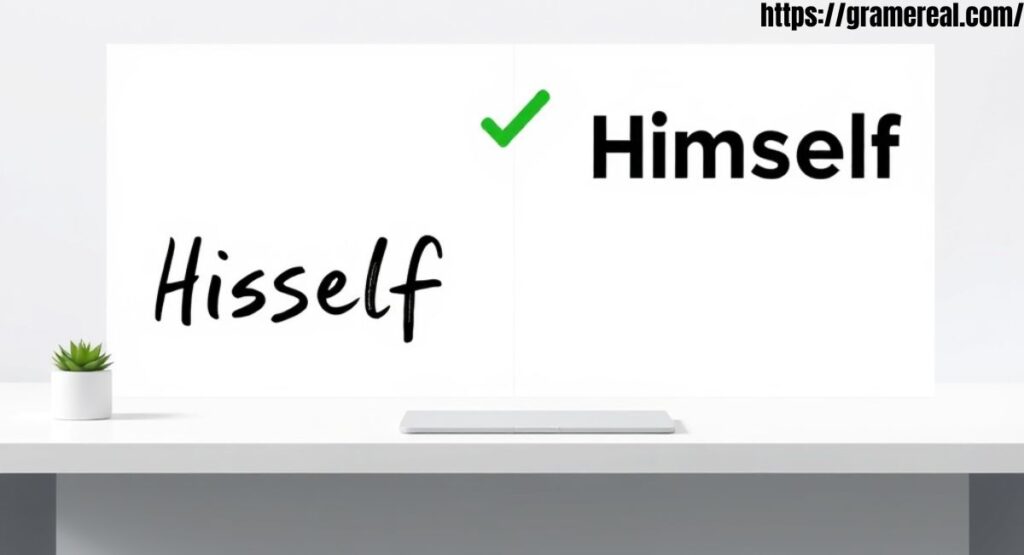
Hisself vs Himself Have you ever heard someone say “he did it all by hisself” and felt something was off but couldn’t quite explain why? You’re not alone. The hisself vs himself debate trips up native speakers, English learners, and even seasoned writers every day. Hisself vs Himself Understanding the difference between these two words is not just a grammar lesson it’s a key step toward writing with clarity, confidence, and credibility.
In this article, we’ll break down what each word means, where hisself comes from, how both American and British English treat it, and exactly how to use himself correctly every time.
What Is Himself?
Himself is the standard, grammatically correct reflexive pronoun for the third-person masculine singular. In plain terms, it refers back to a male subject already mentioned in the sentence.
How Himself Works
Hisself vs Himself A reflexive pronoun “reflects” the action back onto the subject. When a man does something to or for himself, himself is the word you need.
Examples:
- He hurt himself while playing football.
- The manager introduced himself to the new team.
- David locked himself out of his car.
In each sentence, himself and the subject (he, the manager, David) refer to the same person. That’s the defining rule: when the subject and object are the same male person, use himself.
Why Himself Is Correct
Hisself vs Himself The word himself is built on the objective pronoun him + self. Compare this pattern with other standard reflexive pronouns:
| Subject Pronoun | Reflexive Pronoun |
|---|---|
| I | myself |
| you | yourself |
| he | himself |
| she | herself |
| we | ourselves |
| they | themselves |
The pattern is consistent. Him is the objective form of he, so him + self = himself. It’s clean, logical, and universally accepted in both formal and informal writing.
What Is Hisself?
Hisself is a nonstandard, dialectal variant of himself. It is built differently using the possessive pronoun his instead of the objective pronoun him. So while himself follows the correct grammatical pattern (objective + self), hisself breaks it by using (possessive + self).
This is why grammar authorities from Merriam-Webster to the Oxford English Dictionary do not recognize hisself as correct in Standard English. You will not find it accepted in academic writing, professional communication, formal speech, or most published content.
Do not use:
He fixed the car hisself.The boy hurt hisself.
Use instead:
- He fixed the car himself.
- The boy hurt himself.
The History of Hisself
Hisself is not a modern invention born from careless speaking. It actually has deep historical roots in Middle English, roughly spanning the 14th to 16th centuries. During that era, spelling and grammar had not yet been standardized, and writers freely used variations like hisself alongside himself.
Over time, as formal English grammar became codified, himself emerged as the clear standard. Hisself, however, didn’t disappear it survived in spoken dialects, particularly in regions where communities were geographically isolated.
Hisself in Appalachian and Southern American English
One of the most well-documented examples is Appalachian English, spoken across parts of West Virginia, Tennessee, Virginia, Kentucky, and the Carolinas. Linguistic research shows this dialect preserves many features from early Scots-Irish and British English settlers who populated the region from around the 1730s through the 1830s. Because mountain communities remained relatively isolated, older speech patterns lingered long after they vanished from mainstream usage.
Linguists at the University of South Carolina’s Appalachian English archive have documented real usage such as: “The little boy stayed there all night by hisself.” This reflects a genuine and historically rich speech tradition not ignorance. Still, hisself remains nonstandard by every modern grammar measure.
Common Mistakes with Hisself and Himself
Here are the most frequent errors writers and speakers make and how to fix them:
| Incorrect (Nonstandard) | Correct (Standard English) |
|---|---|
| He did it all by hisself. | He did it all by himself. |
| The boy fixed the bike hisself. | The boy fixed the bike himself. |
| He introduced hisself to the crowd. | He introduced himself to the crowd. |
| He blamed it on hisself. | He blamed it on himself. |
Common Traps to Watch Out For
- Spellcheckers often won’t flag hisself in casual editors. Don’t rely on autocorrect alone.
- Hearing hisself in speech can make it feel natural. Spoken language and written grammar are not always the same.
- Analogical reasoning can mislead: because we say herself (her + self), some speakers assume hisself (his + self) should work too. But the rule requires the objective pronoun, not the possessive.
Hisself vs Himself in American vs British English
One common question is whether hisself is acceptable in American English while himself is the British standard or vice versa. The answer is clear:
Both American English and British English treat himself as the only standard form.
There is no variety of formal, modern English American or British — where hisself is the accepted norm. It remains regional, dialectal, and informal on both sides of the Atlantic. You may encounter it in Southern American speech or in older literary texts, but it carries no formal status anywhere.
| Feature | Himself | Hisself |
|---|---|---|
| Grammar Level | Standard English | Nonstandard / Dialectal |
| Formation | Objective (him) + self | Possessive (his) + self |
| American English | ✅ Correct | ❌ Nonstandard |
| British English | ✅ Correct | ❌ Nonstandard |
| Formal Writing | ✅ Always acceptable | ❌ Avoid |
| Creative Dialogue | ✅ Standard voice | ✅ Acceptable for dialect effect |
Idiomatic Expressions with Himself
Himself appears in several well-known English expressions. Knowing them strengthens both your vocabulary and your writing fluency.
- “By himself” Alone, without help. (He built the entire shed by himself.)
- “Be himself” To act naturally or authentically. (He finally felt comfortable enough to be himself.)
- “Come to himself” To regain consciousness or composure. (After the shock, he slowly came to himself.)
- “Full of himself” Arrogant or self-important. (Everyone avoided him because he was so full of himself.)
- “Beside himself” Overwhelmed with emotion. (He was beside himself with joy when he heard the news.)
Notice that all these idioms use himself never hisself. These phrases are embedded in Standard English and should always follow the correct form.
Practical Tips to Remember the Difference
Here’s a simple, memorable framework to make sure you never confuse the two again:
- Think of the pronoun pattern. All standard reflexive pronouns use either the objective (him, her, them) or the first-person form (my, our) + self. His is possessive it doesn’t fit the pattern.
- Say the sentence with him first. If you can say “He told him” (two different people), then the reflexive is himself (one person). This reinforces that him not his is the base.
- Trust the table. If you’re unsure, refer to the standard reflexive pronoun chart above. Each pronoun has one accepted reflexive form. For he, it is always himself.
- Use dialect deliberately. If you’re writing fiction or dialogue and want to portray a character from a specific regional background, hisself can be a legitimate stylistic tool. Outside that context, always use himself.
Examples in Sentences
Here are clear, real-world examples showing himself used correctly across different contexts:
Reflexive use (action reflects back on subject):
- He taught himself to play the guitar.
- The CEO blamed himself for the failed launch.
Emphatic use (for emphasis, not strictly reflexive):
- The president himself attended the memorial.
- He said so himself — no one else.
Idiomatic use:
- After a long recovery, he finally felt like himself again.
- He sat by himself in the corner, lost in thought.
Incorrect — avoid these:
He cooked dinner hisself.→ He cooked dinner himself.The child dressed hisself.→ The child dressed himself.
How This Improves Your Writing
Using himself correctly every single time does more than just follow grammar rules. It signals something important to your reader:
- Credibility: Correct grammar builds trust. When readers spot hisself in a formal piece, it raises doubts about the writer’s expertise.
- Clarity: Standard pronouns are universally understood. Dialectal forms may confuse readers unfamiliar with regional speech.
- Professionalism: Whether you’re writing a business email, an academic essay, or a published article, correct usage shows you’ve mastered the language.
- SEO and readability: For content writers, grammatically correct text scores better with readability tools and is less likely to be flagged for quality issues.
In short, the hisself vs himself distinction is a small choice with a large impact on how your writing is perceived.
Conclusion
The bottom line is simple: always use himself. It is the only standard, grammatically correct reflexive pronoun for a masculine singular subject in English in America, in Britain, and everywhere else formal English is used.
Hisself has a legitimate historical background and still lives in certain regional dialects, but it has no place in professional, academic, or formal writing. Reserve it only for creative writing where authentic dialect characterization is the goal.
Understanding this one distinction himself follows the objective pronoun pattern, hisself incorrectly uses the possessive gives you a tool you can apply confidently for life. Get this right, and you’re one step closer to writing that is cleaner, sharper, and more trusted by every reader who encounters it.
Frequently Asked Questions (FAQs)
Is hisself a real word?
Hisself exists as a dialectal and historical form, but it is not recognized as correct in Standard English by any major grammar authority.
Can I use hisself in creative writing?
Yes in dialogue or character voice to reflect a specific regional dialect. Outside that context, always use himself.
Why do people say hisself if it’s wrong?
Because spoken language often follows different rules than written grammar. Regional speech patterns and habit lead many speakers to say hisself naturally.
Is hisself used in British English?
No. Both British and American Standard English use himself exclusively as the correct reflexive pronoun.
What’s the difference between reflexive and emphatic pronouns?
A reflexive pronoun reflects the action back on the subject (He hurt himself). An emphatic pronoun stresses the subject (He did it himself). Both use himself never hisself.
Will spellcheck catch hisself?
Not always. Many basic spellcheckers skip it in informal contexts. Always proofread manually for pronoun accuracy.
Does using hisself make someone sound uneducated?
In formal writing, yes it signals unfamiliarity with standard grammar. In regional speech, it’s simply a dialect feature. Context matters.
When did himself become standard?
Himself became the accepted standard during the Early Modern English period (roughly 15th–17th century), as grammatical norms were codified and printing standardized the language.