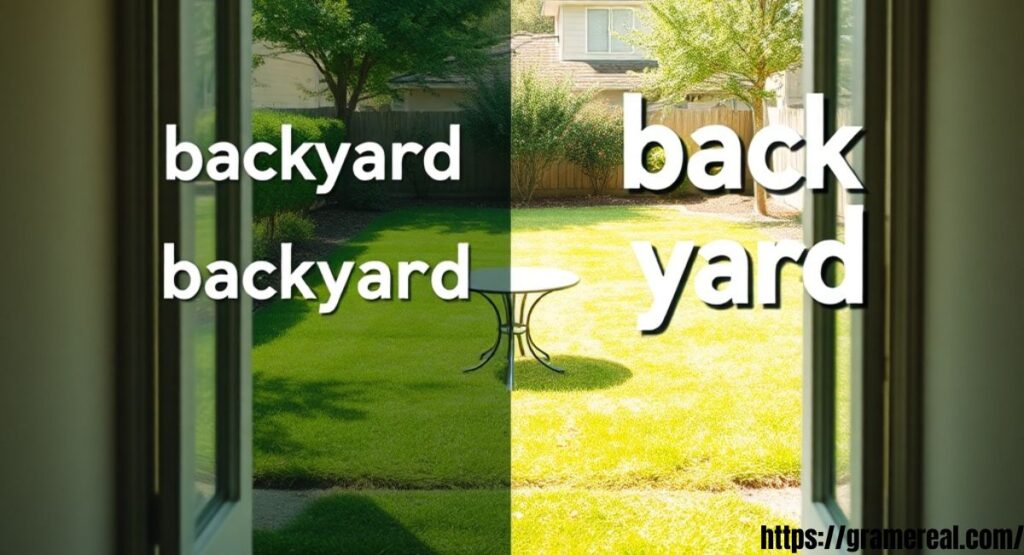
You’re writing an email about your weekend plans, and suddenly you stop is it “backyard barbecue” or “back yard barbecue”? This tiny spelling decision trips up even experienced writers. The good news? There’s a clear answer, and once you understand it, you’ll never second-guess yourself again.
What Does “Backyard” Mean?
Backyard (one word) is the standard modern spelling used in both American English and most international publications. It functions as:
- A noun: referring to the area of land behind a house or building
- An adjective: modifying another noun to describe something connected to that outdoor space
“We spent the whole afternoon relaxing in the backyard.” “She planned a backyard wedding for next spring.”
As a compound word, backyard carries a sense of familiarity and ownership it’s the personal outdoor space attached to your home. Think of it as one unified concept, not just two separate descriptive words placed side by side.
What Does “Back Yard” Mean?
Back yard (two words) carries the same basic meaning the land behind a house or structure but it works differently in grammar. When written as two words, back acts as an adjective that modifies the noun yard, literally describing a yard that is located at the back.
“The deliveries were left in the back yard of the warehouse.” “A fence separated the back yard from the alley.”
This two-word form is less common today and is mostly found in older texts, British publications, or very specific formal writing contexts. It can also appear when a writer wants to emphasize the physical, literal location rather than the personal, residential concept.
Core Difference Between Backyard and Back Yard
| Feature | Backyard (one word) | Back Yard (two words) |
|---|---|---|
| Part of speech | Noun or adjective | Noun phrase only |
| Modern usage | Preferred, dominant | Less common, older feel |
| As an adjective | ✅ Yes “backyard party” | ❌ No |
| American English | Standard form | Rarely used |
| British English | Understood; less common | Appears in formal texts |
| Style guides | AP, Chicago prefer this | Acceptable but secondary |
The simplest way to think about it: backyard is the evolved compound that belongs in modern writing. Back yard is the older, more literal construction that still has a place but a narrow one.
Grammar Rules and Usage
Understanding the grammar behind these two forms makes the choice much easier.
Backyard as a Noun
When you’re talking about the space itself where kids play, where you host cookouts, where your garden grows use the one-word form.
- “The dog ran straight to the backyard.”
- “Our backyard needs mowing this weekend.”
Backyard as an Adjective
Only the one-word form works as a modifier before another noun. This is a key rule that many writers miss.
- ✅ “They threw a backyard cookout for the whole neighborhood.”
- ❌ “They threw a back yard cookout.” (grammatically awkward)
Back Yard as a Noun Phrase
The two-word version functions purely as a noun phrase in limited contexts, usually in formal, older, or British writing.
- “The back yard of the property was overgrown.”
Rule of thumb: If you’re unsure, use backyard. It’s correct in virtually every context.
Contextual Examples in Everyday Situations
Seeing both forms in realistic situations makes the difference much clearer.
- “The family installed a fire pit in their backyard last fall.”
- “A storage shed in the back yard kept tools out of the rain.”
Real estate listings:
- “This property includes a spacious backyard with a covered patio.”
- “The back yard of the commercial property is used for parking.”
Casual conversation and social media:
- “Come over we’re having a backyard movie night!”
- “The kids spent all afternoon in the backyard.”
Formal or technical writing:
- “The survey maps indicate that the back yard measures 40 by 60 feet.”
Notice how backyard feels natural and fluid in most everyday writing, while back yard sounds more formal and deliberate sometimes even stiff.
Common Mistakes with Backyard or Back Yard
Even careful writers fall into these traps. Here are the most frequent errors and how to fix them:
1. Inconsistency within the same piece Switching between “backyard” and “back yard” in one article, email, or listing confuses readers and looks unprofessional.
- ❌ “The backyard is beautiful. The back yard fence needs painting.”
- ✅ “The backyard is beautiful. The backyard fence needs painting.”
2. Using “back yard” as an adjective Only “backyard” works before a noun as a modifier.
- ❌ “We attended a back yard wedding.”
- ✅ “We attended a backyard wedding.”
3. Treating “backyard” as a verb Neither form can function as a verb. This one sounds obvious, but it happens.
- ❌ “Let’s backyard this weekend.”
- ✅ “Let’s spend time in the backyard this weekend.”
4. Hyphenating unnecessarily “Back-yard” with a hyphen is largely outdated. Avoid it unless quoting an older source or following a very specific house style.
American vs British English Differences
Geography plays a real role in how these words are used. Here’s what you need to know:
American English
In the United States, backyard is the overwhelming standard. Style authorities are clear on this:
- AP Stylebook: Use “backyard” as one word
- Chicago Manual of Style: Prefers the one-word compound in most contexts
- Google Ngram data: “Backyard” is used more than five times as often as “back yard” in American publications
British English
In the UK, the phrase “back garden” is actually the most common equivalent of the American “backyard.” When British writers do use the yard-related term, they are more likely to write it as two words back yard particularly in formal or journalistic contexts.
Quick guide by audience:
- Writing for American readers → use backyard
- Writing for British readers → use back garden or back yard
- Writing for a global audience → backyard is the safest, most widely understood choice
Backyard as an Adjective
One of the most practical grammar points in this debate: only “backyard” (one word) works as an adjective. This is consistent across style guides and usage data.
When “backyard” comes before a noun to describe it, it’s functioning as a compound adjective:
| Phrase | Correct? |
|---|---|
| backyard barbecue | ✅ |
| backyard garden | ✅ |
| backyard party | ✅ |
| back yard barbecue | ❌ |
| back yard garden | ❌ |
This adjectival use is extremely common in everyday life event invitations, lifestyle articles, recipe blogs, real estate copy and always takes the one-word form.
Practical Tips to Remember the Correct Form
You don’t need to memorize grammar rules to get this right every time. These simple strategies work:
- Think of it as one space Your backyard is one unified place, not two separate concepts. One space, one word.
- Ask: “Could I replace it with a single concept?” If “backyard” describes an idea (a cookout, a garden, a party), use one word.
- Default to backyard In 95% of writing situations, the one-word compound is correct and natural.
- Check your style guide If you’re writing for a publication, follow their house style. Most major guides prefer one word.
- Stay consistent Whatever form you choose, use it throughout the entire piece.
Examples in Short Sentences
Here are quick, clear examples to reinforce the rules:
- “The kids built a fort in the backyard.” ✅ (noun)
- “We hosted a backyard movie night.” ✅ (adjective)
- “The back yard of the old factory was fenced off.” ✅ (formal noun phrase)
- “She planted roses along the backyard fence.” ✅ (adjective)
- “He loves sitting in the backyard after dinner.” ✅ (noun)
- “Back yard furniture sale” ❌ → should be “Backyard furniture sale”
Why This Difference Matters in Writing
You might wonder: does this really matter? In casual texting or spoken conversation, not much. But in professional writing blog posts, real estate listings, academic work, published articles it matters for three reasons:
1. Credibility: Small spelling inconsistencies signal carelessness to editors, readers, and clients. A polished writer uses the standard form.
2. SEO performance: Online, readers and search engines both process compound words differently. “Backyard barbecue ideas” performs better in search than “back yard barbecue ideas” because it matches how people actually search.
3. Readability: The one-word compound reads more smoothly and feels more natural, especially in headlines and calls to action.
Reflection on Grammar Rules and Writing Techniques
The journey of “back yard” becoming “backyard” reflects how English actually works. Over time, two-word phrases that become part of everyday vocabulary tend to merge into compound words. We saw it with “book store” becoming “bookstore,” “web site” becoming “website,” and “base ball” becoming “baseball.”
Knowing when and why a compound forms helps writers stay ahead of language shifts. Rather than memorizing every exception, the smarter approach is to trust modern style guides, use current dictionaries, and stay consistent within each piece of writing.
Grammar isn’t a rigid set of rules carved in stone it’s a living system that reflects how people actually communicate. And right now, in 2025, “backyard” is how the English-speaking world communicates this idea.
Conclusion
So backyard or back yard? In almost every situation, the answer is backyard (one word). It’s the form preferred by major style guides, used far more frequently in modern print and digital media, and the only version that works as an adjective. The two-word form, back yard, is grammatically acceptable as a noun phrase but it sounds older, feels more formal, and is rarely the best choice for contemporary writing.
The golden rule: When in doubt, write it as one word. Your readers, your editors, and your search rankings will thank you.
FAQs
Is “backyard” one word or two words?
“Backyard” is one word in modern American English and is the preferred spelling in most writing contexts.
Can “back yard” be used as an adjective?
No. Only “backyard” (one word) works as an adjective before a noun, such as “backyard barbecue” or “backyard garden.”
Is “back yard” ever correct?
Yes, “back yard” is grammatically correct as a two-word noun phrase, particularly in formal, older, or British writing contexts.
What do style guides say about backyard vs back yard?
The AP Stylebook and Chicago Manual of Style both prefer the one-word form “backyard” in most contexts.
How do British English speakers say “backyard”?
British English speakers most commonly use “back garden” instead of “backyard.” When they do use the yard-related term, “back yard” as two words appears more often.
Does spelling “backyard” vs “back yard” affect SEO?
Yes. “Backyard” as one word aligns more closely with common search queries and is the standard form expected by most readers and search engines.
Is “back-yard” with a hyphen correct?
The hyphenated form “back-yard” is largely outdated and should be avoided in modern writing unless required by a specific house style.
What is the plural of backyard?
The plural is “backyards” for example, “The backyards of these homes are beautifully landscaped.”