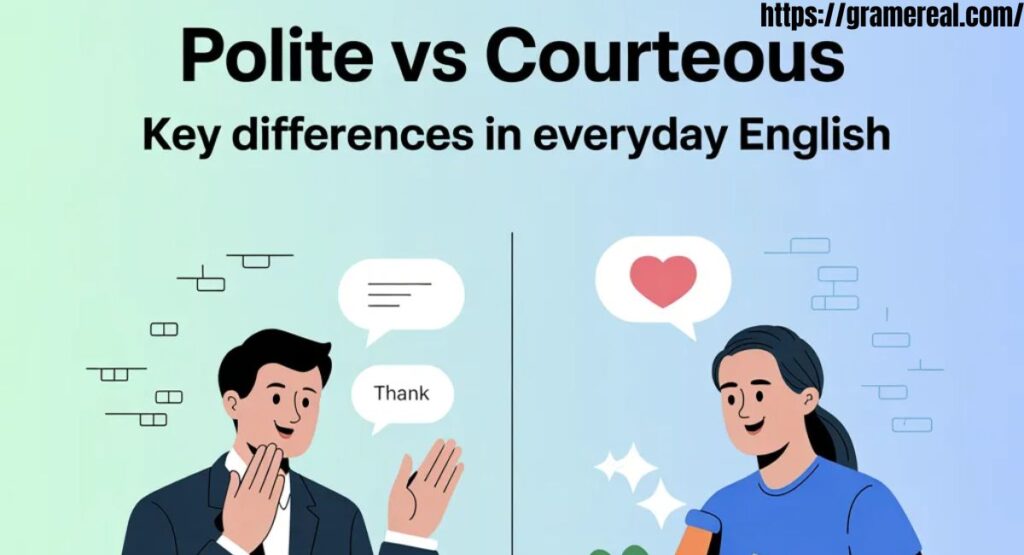
Have you ever wondered whether “polite” and “courteous” mean exactly the same thing or whether one goes a little further than the other? You are not alone. Native speakers use both words every day, yet many people swap them without realising there is a meaningful difference. Understanding polite vs courteous helps you choose the right word, sound more natural in conversation, and leave a better impression whether you are writing an email, speaking at work, or meeting someone new.
Basic Meaning of Polite vs Courteous
Both words are compliments. Both describe socially acceptable behaviour. But they operate at slightly different levels.
- Polite means following expected social rules saying “please,” “thank you,” and “excuse me,” avoiding offensive language, and behaving in a way that does not upset others.
- Courteous means going a step beyond the rules. It involves actively showing warmth, anticipating someone’s needs, and treating others with genuine respect and consideration.
Think of it this way: politeness keeps interactions smooth. Courtesy makes interactions memorable.
Core Difference Between Polite vs Courteous
| Feature | Polite | Courteous |
|---|---|---|
| Core focus | Following social rules | Showing active consideration |
| Emotional warmth | Neutral or minimal | Warm and sincere |
| Behaviour type | Reactive (avoids offence) | Proactive (offers help) |
| Strength of meaning | Baseline standard | Elevated standard |
| Common context | Everyday situations | Formal and high-care situations |
| Noun form | Politeness | Courtesy |
| Adverb form | Politely | Courteously |
Grammar Category and Word Form
Both words belong to the same grammar category: adjectives. They describe people, behaviour, responses, and communication styles.
Word Forms
- Polite → adjective
- Adverb: politely
- Noun: politeness
- Comparative: more polite / politer
- Superlative: most polite / politest
- Courteous → adjective
- Adverb: courteously
- Noun: courtesy
- Comparative: more courteous
- Superlative: most courteous
Note that “courtesy” can also be used as a modifier noun (e.g., a courtesy call, a courtesy shuttle). This is a separate meaning from the adjective “courteous.”
Using Polite in Simple Sentences
- She gave a polite smile when he walked past.
- Please write a polite response to the complaint.
- He was polite enough to wait his turn.
- The staff were politely professional throughout the meeting.
- A polite refusal is still a refusal.
Using Courteous in Simple Sentences
- The hotel receptionist was remarkably courteous, anticipating every need.
- He held the door open a small but courteous gesture.
- She responded courteously even when the customer was rude.
- The driver was courteous to pedestrians at every crossing.
- Writing a courteous email takes only a few extra seconds.
Polite vs Courteous in Real Situations
Waiting in Line
- Polite: You wait your turn without pushing or complaining.
- Courteous: You notice someone elderly struggling and offer them your place.
At a Restaurant
- Polite: You say “please” when ordering and “thank you” when served.
- Courteous: You address the server by name, acknowledge their effort, and leave a thoughtful tip.
At Work
- Polite: You reply to emails within a reasonable time without using rude language.
- Courteous: You follow up, check in, and acknowledge someone’s effort in your reply.
Emotional Tone of Polite vs Courteous
This is where the two words truly separate.
Politeness can be emotionally neutral. You can be polite while feeling indifferent. A polite nod, a polite pause, a polite refusal none of these require genuine warmth. They simply require the absence of rudeness.
Courtesy, however, carries an emotional charge. It implies that you have thought about the other person their comfort, their dignity, their needs. A courteous person does not just follow the rules; they bring kindness into the room.
As Merriam-Webster notes, courteous “implies more actively considerate or dignified politeness” a standard exceeded, not just met.
Polite vs Courteous in Professional Settings
In the workplace, both qualities matter, but they serve different functions.
Polite behaviour at work includes:
- Replying to emails without unnecessary delay
- Knocking before entering a colleague’s office
- Not interrupting during meetings
- Using respectful language in written communication
Courteous behaviour at work includes:
- Acknowledging a colleague’s effort publicly
- Offering help before being asked
- Writing a warm, personalised message rather than a template reply
- Following up after a difficult meeting to ensure clarity
In customer service especially, courtesy builds loyalty while politeness alone can feel robotic. A customer may accept a polite response but they remember a courteous one.
Polite vs Courteous in Social Life
In everyday social settings, the difference becomes even clearer through small actions.
| Social Situation | Polite Response | Courteous Response |
|---|---|---|
| Friend is late | You wait without complaining | You message to check if everything is okay |
| Someone drops something | You step aside | You pick it up and hand it back |
| Guest arrives | You greet them at the door | You offer a drink before they sit down |
| Someone looks lost | You don’t interfere | You approach and offer directions |
Polite vs Courteous in Writing
In written English emails, letters, and formal documents the two words signal different levels of tone.
Polite writing example:
Dear Mr. Smith, please find the report attached. Thank you.
Courteous writing example:
Dear Mr. Smith, I hope you’re doing well. I’ve attached the report and highlighted the key points for your convenience. Please don’t hesitate to reach out if you have any questions.
The courteous version goes beyond the minimum. It anticipates, personalises, and adds warmth without being unprofessional.
Common Mistakes With Polite vs Courteous
Many English learners (and native speakers) make these errors:
- Using them as exact synonyms in all contexts. They overlap, but courteous always implies more effort and warmth.
- Forgetting the noun forms. The noun for polite is politeness, not politesy. The noun for courteous is courtesy, not courteousness (though courteousness exists, courtesy is far more natural).
- Confusing “courtesy” as a noun with the adjective. A courtesy call (a noun modifier) is different from a courteous call (an adjective describing the call).
- Assuming polite means warm. Someone can be polite and cold at the same time. Courtesy implies warmth.
American vs British English Usage
Both words are used in American and British English without major confusion. However, there are small tendencies worth noting.
- “Polite” is truly universal and appears in all registers formal, informal, spoken, and written in both varieties.
- “Courteous” appears slightly more in British formal writing and traditional contexts. Phrases like “courteous behaviour is expected” feel at home in British institutional language.
- Americans tend to use “polite” more casually and reserve “courteous” for professional or elevated contexts.
- The British phrase “Would you be so polite as to…” is more formal than the American equivalent “Would you please…”
Neither version is incorrect. The core meanings remain the same across both dialects.
Polite vs Courteous in Daily Speech
In everyday spoken English, polite appears far more often than courteous. This is simply because polite is shorter, more versatile, and fits casual conversation naturally.
- “She was really polite about it.” ✅ (very natural)
- “She was really courteous about it.” ✅ (natural, slightly more formal)
You might choose courteous to add weight or sincerity to signal that someone went beyond the expected minimum.
Idiomatic and Natural Expressions
With “Polite”
- A polite fiction a harmless untruth told to avoid awkwardness
- Polite society people considered socially respectable
- A polite refusal a gentle, non-offensive no
With “Courteous”
- Unfailingly courteous always showing consideration, without exception
- Courteous to a fault almost too considerate
- Courteous conduct formal phrase used in professional or legal contexts
Sentence Structure and Grammar Use
Both adjectives follow standard English placement rules:
Attributive position (before the noun):
- A polite response is always appreciated.
- She has a courteous manner.
Predicative position (after a linking verb):
- He was polite throughout the interview.
- The staff remained courteous under pressure.
With adverbs:
- She spoke politely but firmly.
- He responded courteously despite the provocation.
Passive Voice Examples
- Polite: A polite tone was maintained throughout the discussion.
- Courteous: Courteous attention was shown to every guest who arrived.
- Mixed: Visitors were greeted politely at the entrance and treated courteously throughout their stay.
Polite vs Courteous for Describing People
When describing someone’s character, the choice of word sends a distinct message.
- “He is polite” tells us he follows social norms and won’t embarrass you.
- “He is courteous” tells us he genuinely cares about others and goes out of his way to show it.
A polite person avoids friction. A courteous person creates warmth.
Polite vs Courteous in Customer Relations
Customer-facing roles demand both qualities but they operate at different levels.
Polite service means responding to every query without being rude, using appropriate language, and following the expected script.
Courteous service means anticipating what a customer needs before they ask, personalising the interaction, and making them feel genuinely valued rather than just processed.
Research in customer experience consistently shows that courtesy drives loyalty in a way that mere politeness cannot. Customers forgive mistakes from courteous staff far more readily than from polite-but-cold interactions.
Polite vs Courteous in Conflict Situations
In difficult conversations, choosing the right word and the right behaviour matters most.
- You don’t raise your voice.
- You use measured language.
- You avoid personal attacks.
Being courteous in conflict:
- You acknowledge the other person’s feelings.
- You propose a concrete next step.
- You follow up to ensure resolution.
A polite response de-escalates tension. A courteous response builds the bridge to resolution.
Choosing Between Polite vs Courteous
Use this quick decision guide:
- Choose polite when the context is everyday, informal, or requires a baseline of good manners.
- Choose courteous when you want to signal warmth, active consideration, and a standard clearly above the minimum.
- Use both when you want to emphasise that someone consistently demonstrates both rule-following and genuine care.
“He was always polite, but what made him memorable was how courteous he was he never just met the standard; he always exceeded it.”
Practical Tips for Easy Learning
- Remember the etymology: Courteous contains the word “court.” Behaviour fit for a royal court is elevated, deliberate, and warm that is courtesy.
- The substitution test: Try replacing courteous with “actively considerate.” If it fits, courteous is correct. If “not offensive” is enough, use polite.
- Noun practice: Repeat politeness (for polite) and courtesy (for courteous). Write both in a sentence daily.
- Notice real usage: Pay attention to how customer service representatives, professionals, and public figures use these words.
Practice Sentences
Try completing these sentences correctly:
- The receptionist was when she greeted the visitors. (polite / courteous)
- He gave a nod and moved on without speaking. (polite / courteous)
- Her email was not just professional it was genuinely. (polite / courteous)
- costs nothing, but it builds everything. (Politeness / Courtesy)
- The driver waited at the crossing while the elderly man crossed. (politely / courteously)
Suggested answers: 1. courteous 2. polite 3. courteous 4. Courtesy 5. courteously
Grammar Rules Applied in This Topic
- Both polite and courteous are gradable adjectives you can say “very polite” or “extremely courteous.”
- They follow the same comparative and superlative patterns, though polite can use either form (politer / more polite), while courteous uses only more/most courteous.
- Their adverb forms (politely, courteously) follow the standard -ly rule.
- Noun forms follow different patterns: politeness adds -ness, while courtesy is an irregular derivative from Old French.
Cultural Aspect of Polite vs Courteous
Culture shapes what both words mean in practice. Politeness is largely rule-based, meaning it varies significantly across cultures. What counts as polite in Japan (bowing, formal language) differs from what counts as polite in the United States (a firm handshake, direct eye contact).
Courtesy, however, tends to be more universal it is rooted in genuine care for others, which transcends cultural scripts. A courteous gesture reads as warm and considerate across most cultural contexts, even when the specific form it takes differs.
This is why learners of English as a second language often find courteous easier to demonstrate through action than polite, which requires knowledge of local etiquette rules.
Review of Polite vs Courteous
| Aspect | Polite | Courteous |
|---|---|---|
| Definition | Follows social manners | Goes beyond manners with warmth |
| Depth | Surface behaviour | Deeper consideration |
| Emotional tone | Neutral | Warm and sincere |
| Grammar | Adjective, adverb: politely, noun: politeness | Adjective, adverb: courteously, noun: courtesy |
| Best context | Everyday, casual | Formal, high-care, professional |
| Strength | Baseline | Elevated |
Conclusion
Polite and courteous are close relatives in the English language overlapping, often interchangeable, but never identical. Politeness is the floor: it is what good manners require. Courtesy is the ceiling: it is what genuine respect inspires.
In professional writing, customer relations, social situations, and everyday speech, knowing the difference helps you communicate with greater precision and impact. Polite gets you through the door. Courteous shows you thought about who was standing on the other side.
Use polite when the baseline is enough. Use courteous when you want to say that someone truly went the extra mile.
FAQs
Is “polite” the same as “courteous”?
They are very similar but not identical polite means following social rules, while courteous means actively showing warmth and consideration beyond those rules.
Can a person be polite but not courteous?
Yes someone can use all the right words and phrases (polite) without genuinely considering another person’s needs or feelings (courteous).
Which word is more formal — polite or courteous?
Courteous generally feels slightly more formal and elevated, making it more common in professional documents, customer service standards, and formal correspondence.
What is the noun form of “courteous”?
The noun form is courtesy for example, “She showed great courtesy to every visitor.”
What is the noun form of “polite”?
The noun form is politeness for example, “Politeness is a sign of respect.”
Can “courtesy” mean something different from “courteous”?
Yes courtesy can also work as a modifier meaning something provided free of charge, such as a courtesy car or courtesy call. This is unrelated to the adjective courteous.
Which word should I use in a professional email?
Use courteous when you want to describe genuinely warm, considerate communication. Use polite for general professionalism without a specific emotional tone.
Are “politely” and “courteously” interchangeable as adverbs?
In many sentences, yes but courteously always implies a warmer, more active quality, while politely simply implies adherence to expected social norms.