
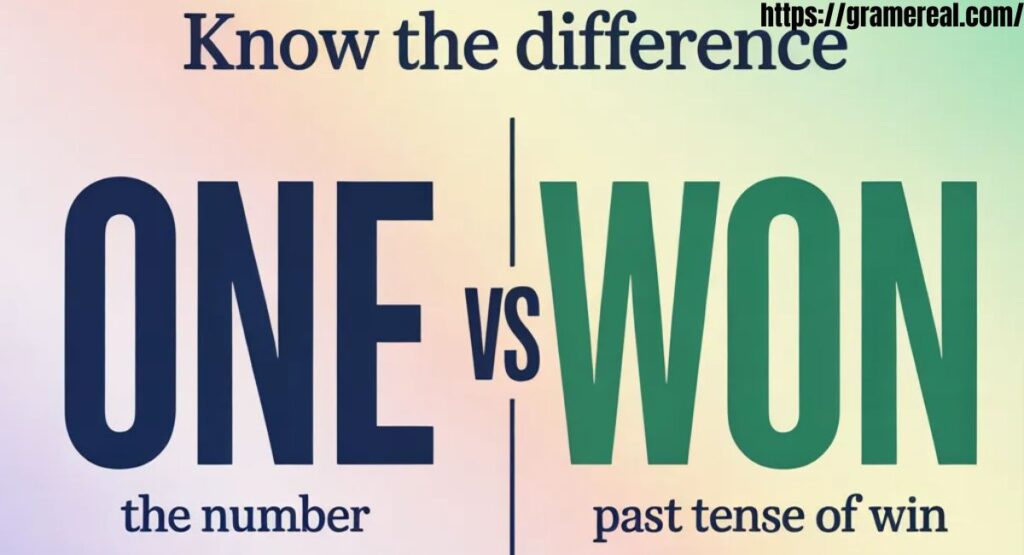
One vs Won are homophones words that sound identical when spoken but carry completely different meanings, spellings, and grammatical roles. One is a numeral and pronoun representing a single unit or person, while won is the past tense of the verb win, used to describe a completed victory or achievement.
One vs Won A single wrong word can silently destroy the credibility of your writing. You may know exactly what you mean but if your reader sees “she one the race,” trust evaporates instantly. That invisible gap between sounding right and being right is where good writers separate themselves from great ones.
Mastering one vs won is not just a grammar lesson it is a communication skill. These two words appear constantly in academic writing, professional emails, and everyday conversation. Understanding when and how to use each one correctly will sharpen your writing, eliminate embarrassing errors, and make every sentence you craft land with precision and confidence.
The Basic Difference Between One and Won
Both one and won are pronounced the same wa /wʌn/. That single shared sound is the root of all the confusion. However, their meanings, grammatical roles, and contexts are entirely different.
In short: One is about a number or quantity. Won is about victory. Once you anchor that idea in your mind, everything else falls into place.
| Feature | ONE | WON |
|---|---|---|
| Part of Speech | Number / Pronoun / Adjective | Verb (past tense) |
| Core Meaning | The number 1; a single unit | Achieved victory; past tense of “win” |
| Origin | Old English ān (unity) | Old English winnan (to strive) |
| Example | “I have one dog.” | “She won the match.” |
| Can it count things? | Yes | No |
| Related to winning? | No | Yes |
Meaning of One
One
Pronunciation: /wʌn/
The number 1. Also used as a pronoun to refer to any person in general, or as an adjective meaning “a single.”
“One apple a day keeps the doctor away.”
Won
Pronunciation: /wʌn/
The past tense of “win.” It means to have achieved victory, success, or a prize in a competition or challenge.
“Our team won the championship last night.”
Uses of One
The word one is incredibly versatile. It works as a numeral, a pronoun, and an adjective depending on the sentence. Here are its three main uses:
- As a numeral: It represents the number 1 “I ate one sandwich.”
- As a pronoun: It replaces a noun in a general or formal sense “One must always be honest.”
- As an adjective: It describes a single thing “She is the one person I trust.”
- In expressions: “One by one,” “one at a time,” “all in one,” “one of a kind.”
- In counting: “Step one, step two, step three.”
Meaning of Won
Won is the simple past tense of the verb win. Whenever you are talking about something that already happened a race, a game, a competition, an argument, a prize and the outcome was victory, you use won.
- “The athlete won three gold medals at the tournament.”
- “Our school team won the science quiz last Friday.”
- “She won everyone’s heart with her kindness.”
- “He won the argument with solid evidence.”
Easy Comparison Examples
One vs Won The fastest way to understand the difference is to see both words side by side in similar sentences. Study these pairs carefully:
ONEI need one more chance to prove myself.
WONShe won her chance by working hard every day.
ONEThere is only one ticket left for the show.
WONHe won a ticket in the lucky draw yesterday.
ONEOne player made all the difference in the game.
WONThat player won the game with a single goal in extra time.
Grammar Difference
Understanding the grammar behind these two words removes all doubt about which one to use.
How “One” Works Grammatically
One vs Won One belongs to multiple word classes. As a numeral, it quantifies things (“one book”). As a pronoun, it refers to people in general, often in formal writing (“One should respect others”). A an adjective, it modifies nouns (“the one solution”). It never describes an action.
How “Won” Works Grammatically
Won is strictly a verb specifically, the past tense of win. It describes a completed action. In a sentence, it always functions as the main verb or part of a verb phrase. You can always test it by asking: “Is someone winning something here?” If yes, and it already happened, use won.
| Test Question | Use ONE if… | Use WON if… |
|---|---|---|
| Can you replace it with “a single”? | Yes → “a single apple” works | No → “a single the game” doesn’t work |
| Can you replace it with “was victorious”? | No | Yes → “was victorious in the race” |
| Does the sentence involve counting? | Yes | No |
| Does the sentence involve winning? | No | Yes |
Sentence Structure Help
Here is a simple structural rule that works every single time:
Spotting “One” in a Sentence
Look for one before a noun or at the start of a sentence as a pronoun. It usually answers the question “how many?” or refers to a person in a broad, general sense.
- “One moment, please.” → refers to a single moment
- “One should never give up.” → refers to people in general
- “Pick one from the list.” → a single item
Spotting “Won” in a Sentence
Look for won after a subject (person or team) and before an object (a prize, a game, a title). It follows the same position as any past-tense verb.
- “She won the trophy.” → subject + won + object
- “The team won by two points.” → subject + won + detail
- “He won easily.” → subject + won + adverb
More Practice Sentences
One vs Won Practice is the fastest path to confidence. Read these sentences slowly and notice how each word fits naturally:
Practice with “One”
- She is the one teacher who changed my life.
- Please give me one more minute to finish.
- One cannot succeed without consistent effort.
- There is one rule you must never break.
- We are one team with a common goal.
Practice with “Won”
- Our country won the World Cup for the first time in history.
- The young scientist won a national award for her research.
- Despite the odds, he won the debate competition.
- The underdogs won the final match in thrilling fashion.
- She won the hearts of the audience with her performance.
Short Practice Story
Read this short story. Notice how both words are used correctly in context:
There was one boy in the village who dreamed of becoming a chess champion. Every day, he practiced for one hour without fail. One year later, he entered the district competition.
In the final round, only one move stood between him and victory. He studied the board for one long minute then made his move.
One vs Won He won. The crowd erupted. He had won the championship that one dream had always been about. It was the greatest moment of his life all from one boy, one dream, and the determination that finally won.
Why Students Confuse One and Won
This is one of the most common homophone errors in both school exams and everyday writing. Here’s why it happens so often:
- Identical pronunciation: Both words sound exactly like /wʌn/. Your ears give you zero clues.
- No visual similarity: Unlike other homophones that share some letters, one and won look nothing alike so you can’t rely on visual patterns.
- Autocorrect won’t help: Spell-checkers recognize both as valid words, so they won’t flag “I one the game” as an error.
- Writing speed: When typing quickly, the brain often picks the more familiar spelling without thinking about meaning.
- ESL challenges: For non-native English speakers, remembering that a number and a verb can sound the same is particularly tricky.
Easy Memory Trick
The Two-Second Test
Next time you’re unsure which word to use, ask yourself one simple question:
“Am I talking about winning, or counting?”
Winning → WON | Counting → ONE
Memory hook #1: WON starts with W just like WIN. Victory = WON.
Memory hook #2: ONE = a single thing. Think of the number 1 standing alone.
Replacement test: Can you say “a single” in its place? → Use ONE. Can you say “was victorious”? → Use WON.
Common Errors in Exams
These are the most frequent mistakes students make in grammar tests and written assignments. Knowing them ahead of time is your best defence.
❌ Wrong
“She one the spelling bee competition.”
✓ Correct
“She won the spelling bee competition.”
❌ Wrong
“There is only won way to solve this problem.”
✓ Correct
“There is only one way to solve this problem.”
❌ Wrong
“Won must always be kind to others.”
✓ Correct
“One must always be kind to others.”
Quick Summary
ONE
- The number 1
- Refers to a single unit or item
- Works as a pronoun (“One should…”)
- Used in counting and measuring
- Not connected to victory or winning
- Can follow “only” or “just”
WON
- Past tense of “win”
- Describes a completed victory
- Always functions as a verb
- Used in sports, games, competitions
- Always linked to achievement or success
- Can follow “has” or “have” (perfect tense)
Conclusion
The difference between one and won is not complicated once you know what each word actually does. One counts, identifies, and generalizes. Won celebrates a victory that already happened. They live in completely different parts of a sentence, doing completely different jobs.
The key is to pause for just one second before writing and ask: “Is this about a number or a win?” That small habit will save you from one of the most common grammar mistakes in the English language. With the examples, memory tricks, and practice in this guide, you are well-equipped to use both words correctly every time.
FAQs
Q1. Are “one” and “won” homophones?
Yes, they are homophones both pronounced /wʌn/ but they have completely different meanings and spellings.
Q2. What part of speech is “one”?
“One” can be a numeral, a pronoun, or an adjective depending on the sentence context.
Q3. What part of speech is “won”?
“Won” is a verb specifically the simple past tense and past participle of the verb “win.”
Q4. Can “won” be used as a noun or adjective?
No. “Won” is strictly a verb form and cannot be used as a noun or adjective in standard English.
Q5. How can I quickly remember which word to use?
Simple trick: WON = W for Win (victory); ONE = a single item (counting). Ask yourself winning or counting?
Q6. Will spell-check catch mistakes with “one” and “won”?
No. Since both are real words, spell-checkers won’t flag wrong usage you must check the meaning yourself.
Q7. Is “one” ever used informally?
Yes, “one” as a pronoun (“One should be careful”) is considered formal; in casual speech, people typically say “you” instead.
Q8. Can “won” be used in perfect tenses?
Yes “She has won three awards” (present perfect) and “They had won before” (past perfect) are both correct