Stink vs Stank vs Stunk Have you ever said “the trash has stank for days” and felt something was off? You were right it should be “has stunk.” These three words stink, stank, and stunk confuse English learners and even native speakers. They all come from the same verb, but each belongs in a different tense. Get one wrong and your sentence sounds awkward, no matter how well everything else is written.
This guide breaks down the correct use of stink vs stank vs stunk in clear, simple language. You’ll find real examples, comparison tables, common mistakes to avoid, and practical tips to remember the rules for good.
Understanding the Basic Difference Between Stink vs Stank vs Stunk
All three words are forms of the irregular verb “to stink,” which means to produce a strong, unpleasant smell or, figuratively, to be very bad or unpleasant.
Because stink is an irregular verb, it doesn’t follow the usual rule of adding -ed to form the past tense. You won’t say “stinked” that’s never correct. Instead, the verb changes its vowel sound depending on the tense.
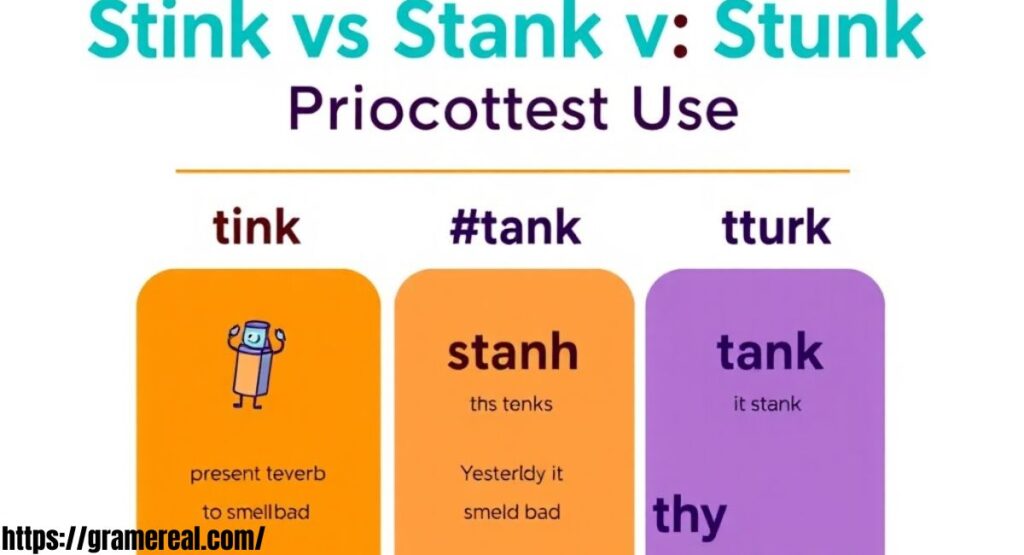
Here’s the pattern at a glance:
| Form | Tense | Example |
|---|---|---|
| Stink | Present tense | Your socks stink after the game. |
| Stank | Simple past tense | The locker room stank last night. |
| Stunk | Past participle | The fridge has stunk for weeks. |
This vowel-shift pattern — i → a → u — also appears in other familiar irregular verbs: sing → sang → sung, drink → drank → drunk, and sink → sank → sunk. Recognizing this pattern is one of the fastest ways to stop mixing up these forms.
What Does “Stink” Mean?
Stink is the base form of the verb. Use it when talking about something that smells bad right now or as a general, ongoing truth.
- The garbage stinks if you leave it too long.
- Those old shoes really stink.
- That idea stinks, and everyone knows it.
It also works in the future tense with will: “This milk will stink by tomorrow.”
When the subject is third-person singular (he, she, it), add -s: “She stinks at cooking” or “It stinks in here.”
What Does “Stank” Mean?
Stank is the simple past tense of stink. Use it to describe something that smelled bad at a specific point in the past no helper verb needed.
- The fish market stank on a hot summer afternoon.
- His gym bag stank after two weeks in the car.
- That movie stank we left before it ended.
Stank is the go-to form for narrating past events in everyday, conversational English. It’s also used figuratively: if something disappointed you in the past, it stank.
What Does “Stunk” Mean?
Stunk is the past participle of stink. It always needs a helping verb have, has, or had to work in a sentence.
- The basement has stunk since the flooding.
- My jacket had stunk for days after the campfire.
- The team’s performance has stunk all season.
Without a helping verb, stunk is incorrect: ❌ “The room stunk yesterday” → ✅ “The room stank yesterday.”
Simple Timeline for Stink vs Stank vs Stunk
Think of these three forms as markers on a timeline:
PAST ←————————————————————————→ PRESENT / FUTURE
  had stunk   stank   has stunk   stinks / will stink
(past perfect) (simple past) (present perfect) (present/future)
- Stink = happening now or generally true
- Stank = happened and ended in the past
- Stunk = happened in the past but connected to now (or in a sequence), always with have/has/had
Stink vs Stank vs Stunk in Sentences
Stink in Sentences
- The dumpster behind the restaurant stinks every morning.
- Dishonest business practices stink, no matter the industry.
- It will stink in here if you don’t open a window.
Stank in Sentences
- The locker room stank after the championship game.
- Her breath stank of garlic during the entire meeting.
- The whole situation stank nobody felt good about the decision.
Stunk in Sentences
- The refrigerator has stunk since we forgot the leftovers.
- His attitude had stunk for months before he finally quit.
- The kitchen has stunk ever since that cooking disaster.
Common Mistakes With Stink vs Stank vs Stunk
Even confident writers slip up here. These are the errors that come up most often:
| ❌ Incorrect | ✅ Correct | Why |
|---|---|---|
| The room has stank for hours. | The room has stunk for hours. | Use stunk with has/have/had |
| It stunk yesterday. | It stank yesterday. | Simple past needs stank, not stunk |
| The trash stinked all week. | The trash stank all week. | Stinked is never correct |
| The place had stank for days. | The place had stunk for days. | Had requires the past participle stunk |
The most common mistake is using stunk without a helper verb in simple past sentences. Remember: if there’s no have, has, or had in the sentence, use stank.
Stink vs Stank vs Stunk in Questions
Forming questions with these verbs follows the same tense logic:
- Does this water stink to you? (present tense)
- Did the gym stink after the tournament? (past note: with did, use the base form stink)
- Has the drain stunk since the repair? (present perfect)
- Had the area stunk before the cleanup? (past perfect)
When using did in a question, always revert to the base form not stank or stunk: ✅ “Did it stink?” not ❌ “Did it stank?”
Negative Sentences With Stink vs Stank vs Stunk
- The flowers don’t stink — they smell wonderful. (present)
- The room didn’t stink before the guests left. (past base form with did)
- The car hasn’t stunk since we had it cleaned. (present perfect)
- The basement hadn’t stunk until the pipe burst. (past perfect)
The rule with did/didn’t is the same for negatives: always use the base form stink.
Active and Passive Voice Examples
Active voice is more direct and common in everyday writing:
- The wet dog stank up the entire car.
- The spilled chemicals have stunk up the laboratory.
Passive voice uses stunk in a different construction:
- The hallway was stunk up by the overflowing trash cans.
- The building had been stunk up by a gas leak.
In passive constructions, stunk works as part of the verb phrase with a form of to be.
Stink vs Stank vs Stunk in Everyday Conversation
In casual speech, these words show up constantly both literally and figuratively:
- “Ugh, this place stinks.” (literal complaint)
- “That deal stank from the start.” (figurative disappointment)
- “Their customer service has stunk for years.” (ongoing criticism)
Figurative uses are especially popular in American English for expressing frustration, failure, or poor quality. Saying a movie stinks or a plan stank communicates instant, blunt disapproval without extra explanation.
American vs British English Usage
Both American and British English use stink, stank, and stunk the same way grammatically. However, there are subtle differences in tone and frequency:
| Feature | American English | British English |
|---|---|---|
| Figurative use | Very common (“That stinks!”) | Less frequent in formal speech |
| Past tense preference | Stank strongly preferred | Stank also preferred |
| Informal speech | Stunk sometimes used alone for past | Stank more consistent |
In very informal American English, you might hear “it stunk” used as a simple past technically incorrect, but widely understood in casual conversation.
Idiomatic and Natural Expressions
The verb stink appears in several idiomatic phrases worth knowing:
- “Stink up the place” to make an area smell bad, or to perform very poorly: “That speech stunk up the room.”
- “Raise a stink” to protest loudly or cause a fuss: “She raised a stink about the unfair policy.”
- “Stinks to high heaven” something is very suspicious or corrupt: “This whole arrangement stinks to high heaven.”
These idioms don’t always follow strict tense rules in casual use, but in writing, apply the same present/past/participle logic.
Stink vs Stank vs Stunk in Formal and Informal Writing
Informal Writing
- Blog posts, text messages, and social media lean on stink and stank naturally.
- “The event totally stank nobody organized anything.”
Formal Writing
- In academic or professional writing, these words are less common. When used, precision matters.
- “The facility had stunk of chemicals prior to the inspection, suggesting ventilation failures.”
- In truly formal contexts, consider replacing with emitted a strong odor or was unpleasant.
Grammar Rules Applied
Here’s a clean summary of the grammar rules behind all three forms:
- Stink = present tense / base form. No helper verb. Works with will for future.
- Stank = simple past. No helper verb. Describes a completed action in the past.
- Stunk = past participle. Always needs have, has, or had. Forms perfect tenses.
- With did / didn’t / does / doesn’t, always use the base form: stink.
- Stinked is never correct in Standard English.
Writing Techniques Used
Good writers use these forms naturally by:
- Reading the sentence for a helper verb first if you see has, have, or had, use stunk
- Checking the time reference is it now? (stink) Was it a finished past event? (stank) Is it ongoing from the past? (stunk)
- Saying it aloud “The fridge has stank” sounds wrong to a trained ear; “has stunk” sounds right
Practical Tips to Remember Stink vs Stank vs Stunk
Here are three simple memory shortcuts:
- The vowel ladder: I → A → U Stink (i), Stank (a), Stunk (u) just climb the vowel ladder in order.
- The helper verb test See have, has, or had? Use stunk. No helper verb? Use stank.
- The rhyme trick Stunk rhymes with sunk — both are past participles. Stank rhymes with sank both are simple past. Use these pairs to check yourself.
Rewritten and Polished Explanation (Clear and Simple)
Here’s the entire concept distilled into three plain sentences:
“Today, the room stinks. Yesterday, it stank. Ever since the flooding, it has stunk.”
That single set of sentences shows all three forms in action present, simple past, and present perfect. Print it out, memorize it, and you’ll never mix them up again.
Why This Practice Improves Writing
Understanding irregular verbs like stink → stank → stunk sharpens your overall grammar instincts. Every time you apply the correct form, you’re training your brain to recognize tense patterns skills that transfer to other irregular verbs like drink/drank/drunk, ring/rang/rung, and swim/swam/swum.
Strong verb tense usage makes writing clearer, more credible, and more professional. Readers notice incorrect verb forms, even if they can’t name the exact rule. Getting these right signals that you take language seriously.
Conclusion
Mastering stink vs stank vs stunk comes down to one core idea: tense determines the form.
- Use stink for the present.
- Use stank for a finished past action.
- Use stunk with have, has, or had for perfect tenses.
Never say stinked it doesn’t exist in standard grammar. Remember the vowel pattern i → a → u, listen for helper verbs, and practice with short sentences. Once this clicks, you’ll handle stink and dozens of other irregular verbs with total confidence.
FAQs
Is “stunk” ever correct without a helper verb?
In Standard English, no. Stunk requires have, has, or had. You might hear “it stunk” in casual speech, but in writing, use stank for the simple past.
Can I use “stank” and “stunk” interchangeably?
No. Stank is the simple past; stunk is the past participle. They serve different grammatical purposes and belong in different sentence structures.
Is “stinked” ever a correct word?
Never. Stinked does not exist in standard grammar. The only correct forms are stink, stank, and stunk.
Which is more common in everyday speech — stank or stunk?
Stank is more common in everyday spoken English for referring to past events. Stunk is typically reserved for sentences with have, has, or had.
Does “stink” only describe bad smells?
No. It also works figuratively to describe something disappointing or of poor quality: “That presentation stank” means it was very bad, not necessarily smelly.
What is the correct form to use with “did”?
Always use the base form with did: “Did it stink?” not “Did it stank?” or “Did it stunk?”
Do American and British English differ in their use of these words?
The grammar rules are the same in both dialects. Americans more frequently use stink figuratively in casual speech, but stank and stunk follow identical rules in both varieties.