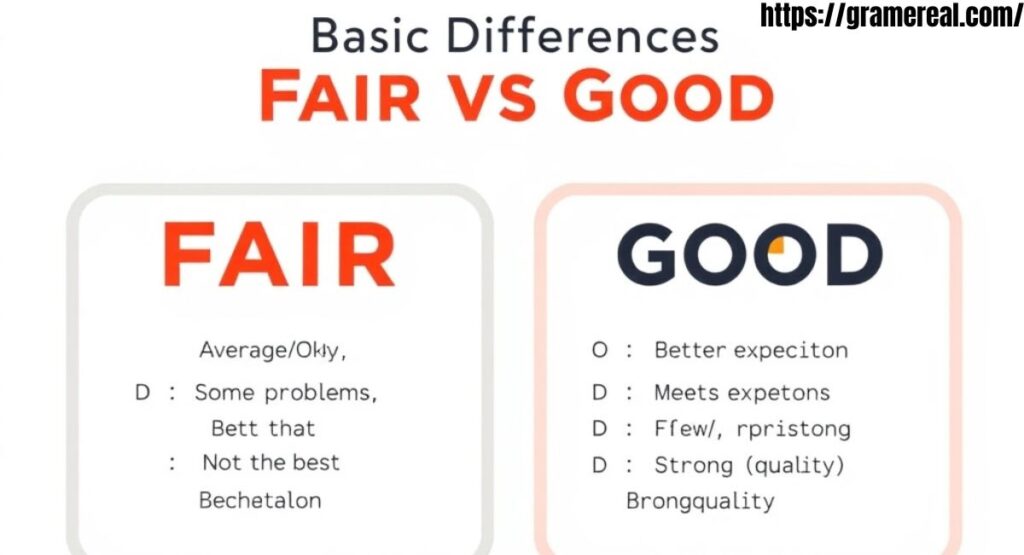
Basic differences between Fair vs good refers to the distinction between two commonly used English adjectives that describe different levels of quality, performance, or condition. While both words sit on the positive side of evaluation, fair denotes something that is merely acceptable or average sufficient but unremarkable whereas good signals a noticeably higher standard, one that meets or exceeds expectations with clear, positive merit.
Basic differences between Fair vs good One word quietly changes everything. Call a product fair, and buyers hesitate. Call it good, and they buy. That single-word shift in rating, review, or feedback carries enormous weight shaping perceptions, driving decisions, and signaling standards in ways most people never fully realize.
Basic differences between Fair vs good Understanding the basic differences between fair and good matters in nearly every area of life from academic grades and workplace evaluations to credit scores, health reports, and product listings. Mastering this distinction sharpens your communication, removes ambiguity from your writing, and ensures your words always land with the precise meaning you intend.
Parts of Speech and Grammar Check
Before diving into differences, let’s confirm how both words function grammatically.
| Word | Part of Speech | Function in Sentence |
|---|---|---|
| Fair | Adjective | Modifies a noun or follows a linking verb |
| Good | Adjective | Modifies a noun or follows a linking verb |
Grammar examples:
- “Her essay is fair.” fair follows the linking verb is and describes the noun essay
- “His performance is good.” good follows is and modifies performance
Both words can also be modified with adverbs:
- very good, quite fair, fairly good, reasonably fair
Grammar tip: Never say “She did good on the exam.” Basic differences between Fair vs good The correct phrasing is “She did well on the exam.” well is the adverb form of good used to modify verbs.
What “Fair” Means
The word fair carries two distinct meanings depending on context:
1. Fair = Average or Acceptable (Quality Context)
When describing quality, condition, or performance, fair means something is adequate but not impressive. It signals that something meets the minimum threshold without standing out positively.
Oxford English Dictionary definition: “Of average or acceptable quality.”
Key characteristics of “fair” in quality context:
- Implies limitations or flaws
- Sets low to moderate expectations
- Often used in ratings, reviews, grading, and evaluations
- Carries a neutral-to-slightly-negative emotional tone
2. Fair = Just or Impartial (Moral Context)
In an ethical sense, fair means honest, unbiased, and equitable as in “a fair judge” or “a fair deal.”
This article focuses primarily on the quality-related meaning, which is where most confusion with good arises.
What “Good” Means
Good signals positive quality that Basic differences between Fair vs good meets or exceeds expectations. It is one of the most versatile and frequently used adjectives in English.
Merriam-Webster definition: “Of a favorable character or tendency; suitable or efficient.”
Key characteristics of “good”:
- Indicates above-average quality
- Carries a positive emotional signal
- Creates confidence and approval in the listener
- Used widely in formal and informal contexts
When you hear something described as good, you expect it to be reliable, pleasing, and worthy of recommendation. It’s the difference between a product that works and one that works well.
Fair vs Good — Key Differences
Here is a clear side-by-side comparison of how these two words differ across several dimensions:
| Feature | Fair | Good |
|---|---|---|
| Quality Level | Average / Acceptable | Above average / Positive |
| Emotional Tone | Neutral to slightly negative | Positive / Reassuring |
| Expectation Set | Low to moderate | Moderate to high |
| Usage in Ratings | Below “good” on most scales | Above “fair” on most scales |
| Implies Flaws? | Often yes | Rarely |
| Common Contexts | Grading, product condition, reviews | Praise, approvals, casual conversation |
| Feeling for Listener | Uncertain, cautious | Confident, satisfied |
Standard quality scale for reference: Excellent → Very Good → Good → Fair → Poor
As you can see, good outranks fair on virtually every rating scale, from product listings and credit scores to school grades and health reports.
Contextual Examples
Seeing both words in action helps clarify their real-world meaning.
Academic Context
- “Your essay is fair it covers the topic but lacks depth and analysis.”
- “Your essay is good it is well-organized, clear, and thoughtful.”
Product Condition (e.g., online marketplace)
- “This phone is in fair condition functional but with visible scratches and worn battery life.”
- “This phone is in good condition minor signs of use, clean screen, and strong performance.”
Health Checkup
- “Your report is fair blood pressure needs monitoring, but nothing urgent.”
- “Your report is good all levels are within the healthy range.”
Workplace Performance Review
- “Her work this quarter is fair; she meets deadlines but rarely goes beyond the minimum.”
- “Her work this quarter is good; she consistently meets targets and supports her team.”
Weather Description
- “It’s a fair day today mild, with some clouds but no rain.”
- “It’s a good day for a hike sunny, warm, and clear skies.”
Common Mistakes and How to Fix Them
Mistake 1: Using “fair” when you intend mild praise
❌ “The movie was fair I really enjoyed it.” ✅ “The movie was good — I really enjoyed it.”
Mistake 2: Using “good” to describe something average or flawed
❌ “The exam was good.” (when the student barely passed) ✅ “The exam result was fair.” (accurately reflects average performance)
Mistake 3: Using “good” as an adverb
❌ “She performed good in the presentation.” ✅ “She performed well in the presentation.”
Mistake 4: Ignoring tone and context
Both fair and good might feel interchangeable in everyday speech, but in written evaluations, the difference is significant. In a letter of recommendation, calling someone’s work fair could seriously damage how they are perceived.
American vs British English Differences
Both words are used in American and British English, but with subtle nuances worth knowing.
| Aspect | American English | British English |
|---|---|---|
| “Fair” for weather | Less common | More commonly used (“a fair day”) |
| “Good” in casual speech | Extremely common for praise | Common, but slightly more reserved |
| “Fairly good” | Means moderately good | Can imply it’s barely above fair |
| Collective nouns | “The team is good” (singular) | “The team are good” (plural allowed) |
Despite these nuances, the core distinction fair = average, good = above average holds consistently across both dialects.
Idiomatic Expressions and Related Phrases
Both fair and good appear in dozens of common idioms and fixed expressions in English.
Idioms with “fair”:
- Fair play honest, ethical behavior in a situation (“That’s just fair play.”)
- Fair enough used to accept or agree with a point (“You had a good reason. Fair enough.”)
- Fair game something acceptable to target or criticize
- By fair means or foul by any method, whether honest or not
- Fair weather friend someone only present in good times
Idioms with “good”:
- Good to go ready to proceed (“Everything is set up. We’re good to go.”)
- For good permanently (“She moved to Canada for good.”)
- Good riddance relief at getting rid of something or someone
- Make good on fulfill a promise (“He made good on his word.”)
- As good as gold perfectly behaved or reliable
Related vocabulary to expand your word choice:
| Instead of “fair” | Instead of “good” |
|---|---|
| adequate, acceptable, mediocre, average, passable, sufficient | excellent, solid, satisfactory, strong, commendable, impressive |
Practical Tips for Choosing Between “Fair” and “Good”
Use these simple rules to make the right choice every time:
- Ask yourself: Am I impressed? If yes → good. If not really → fair.
- Think about the scale. Most rating systems place good above fair. If you’d tick the higher box, say good.
- Consider your audience. In professional or formal writing, these words carry real weight. Be precise.
- Check your intent. If you want to praise → good. If you want to be honest about limitations → fair.
- Watch for the adverb trap. Never use good to describe an action. Use well instead.
- Use context clues. In weather, health, and academic grading, both words appear frequently — just ensure the quality level you intend matches the word you choose.
Quick memory trick:
- 🏅 Good = a trophy (celebrating success, exceeding expectations)
- ⚖️ Fair = a balanced scale (just adequate, nothing exceptional)
Rewrite to Improve Grammar, Clarity, Style, and Vocabulary
Here are some weak sentences rewritten for greater precision using the right word:
| Original Sentence | Improved Version |
|---|---|
| “The service was fair and I liked it.” | “The service was good attentive and efficient.” |
| “Her result was good but she barely passed.” | “Her result was fair she met the minimum standard.” |
| “He did good in the interview.” | “He performed well in the interview.” |
| “The product is fair for daily use.” | “The product is adequate for daily use but lacks premium features.” |
| “The essay was good enough, I guess.” | “The essay was fair it covered the basics without much depth.” |
Conclusion
The difference between fair and good might seem small on the surface, but it shapes how your words are received in a big way. Basic differences between Fair vs good Fair signals that something is acceptable but unremarkable it sets low expectations and often implies limitations. Good signals positive quality, reliability, and satisfaction it reassures and encourages.
In academic writing, professional evaluations, product reviews, and everyday conversation, choosing the right word builds trust and clarity. When something truly earns praise, say good. When honesty requires a measured response, fair is your word.
FAQs
Is “good” better than “fair”?
Yes. On virtually every quality scale grades, product conditions, credit scores, or performance ratings good ranks above fair.
Can “fair” ever be a compliment?
Sometimes. In the sense of fair play or fair judgment, it means honest and just which is positive. But in quality assessments, it usually implies average or below expectations.
Is it correct to say “I did good on the test”?
No. The correct form is “I did well on the test.” well is the adverb; good is an adjective.
What does “fairly good” mean?
It means moderately or somewhat good sitting between fair and good on the quality scale. In British English, it can lean closer to barely good.
When should I use “fair” in a performance review?
Use fair when an employee meets the minimum requirements but doesn’t consistently exceed expectations or show initiative.
Are “fair” and “average” the same thing?
They’re close. Fair implies something is acceptable but limited slightly more positive than average but clearly below good.
Can “good” be used in formal writing?
Yes. Good is appropriate in both formal and informal contexts. In formal writing, however, more specific alternatives like commendable, satisfactory, or excellent may be preferable for precision.
Does “fair” mean the same in American and British English?
The core meaning is the same average quality but British English uses fair more commonly in weather descriptions, and phrases like “fairly good” can have slightly different nuances across dialects.