Hastle-vs-hassle You typed it fast, hit send, and then stared at the word: hastle. Something felt off. Was it hassle? Or hastle? Both look believable for half a second and that half-second confusion is exactly why this spelling mistake shows up everywhere, from professional emails to published blog posts.
Here’s the truth: hassle is the only correct spelling. The word hastle does not exist in any English dictionary not British, not American, not Australian. It is a misspelling, plain and simple, caused by the way the word sounds and the influence of similar-looking words like castle and hustle.
In this guide, you will learn exactly what hassle means, how to use it as a noun and a verb, where it came from, and why so many people keep writing hastle by mistake. By the end, you will have no doubt which spelling is right and a few easy tricks to make sure you never mix them up again.
What Is the Key Difference? Meaning and Correct Spelling
| Term | Status | Meaning |
|---|---|---|
| Hassle | ✅ Correct | Trouble, inconvenience, or the act of pestering someone |
| Hastle | ❌ Incorrect | Not a word a common misspelling of hassle |
The word hassle describes either a frustrating situation (noun) or the act of bothering someone (verb). It carries a tone of mild but persistent annoyance the kind of thing that wastes your time and patience without being catastrophic.
Word Forms and Parts of Speech
Understanding how hassle functions grammatically helps you use it confidently in any sentence.
| Form | Part of Speech | Example |
|---|---|---|
| hassle | Noun (singular) | Renewing my license was a real hassle. |
| hassles | Noun (plural) | Moving cities involves a lot of hassles. |
| hassle | Verb (base form) | Don’t hassle me about it. |
| hassles | Verb (3rd person singular) | He always hassles people about being late. |
| hassled | Verb (past tense / past participle) | She felt hassled by the constant emails. |
| hassling | Verb (present participle) | Stop hassling me while I’m working. |
| hassle-free | Adjective (compound) | We wanted a hassle-free experience. |
Key takeaway: Hassle is a regular verb and a countable noun. Both forms follow standard English grammar rules — no exceptions.
Etymology: Where Did “Hassle” Come From?
Knowing a word’s origin is one of the best ways to remember its correct spelling.
The word hassle first appeared in American English around 1928, with its earliest recorded use noted in American Speech journal. By 1945, it had entered popular usage notably appearing in the jazz magazine Down Beat and by the 1970s it was fully established in everyday speech and writing.
Linguists offer two possible origins:
- A blend of “haggle” and “tussle” both of which involve friction or dispute
- A derivative of American Southern dialectal hassle, meaning “to pant or breathe noisily from exertion”
The Longman Dictionary traces it to the 1800s and notes a possible link to “hatchel” (to harass), itself possibly derived from hazel the plant whose switches were once used for punishment.
Why Does the Misspelling “Hastle” Happen?
The error is entirely phonetic and visual. Here are the main reasons people write hastle instead of hassle:
- Influence from similar words Castle, hustle, whistle, and bristle all end in “-stle.” The brain pattern-matches and inserts a t where there isn’t one.
- Fast typing When writing quickly, the hand naturally moves toward familiar letter combinations.
- Autocorrect blind spots Some older or non-English-language keyboards fail to flag hastle as an error.
- Phonetic spelling habits Non-native speakers often write what they hear. The soft “ss” in hassle can sound like a “st” in connected speech.
Memory trick: Think of the two S’s as standing for stress and strain both things a hassle causes. No T, no trouble.
Contextual Examples With Parts-of-Speech Analysis
As a Noun
“Getting a refund without a receipt is a real hassle.”
- hassle → noun, subject complement; describes an inconvenient situation
“They had to deal with all the hassles of last-minute travel.”
- hassles → noun, plural; refers to multiple inconveniences
“It’s just not worth the hassle.”
- hassle → noun, object of the preposition the; used in a fixed collocation
As a Verb
“Please stop hassling me about the report.”
- hassling → verb, present participle; means to pester or nag persistently
“She was hassled by salespeople every time she entered the store.”
- hassled → verb, past passive; means to be bothered or pressured
“Don’t hassle your brother.”
- hassle → verb, base form in imperative; a direct instruction to stop pestering
Common Mistakes and How to Fix Them
| Mistake | Correction | Why It’s Wrong |
|---|---|---|
| What a hastle! | What a hassle! | Hastle is not a real word |
| Stop hastling me. | Stop hassling me. | Derived from the wrong base form |
| It was hastled through quickly. | It was hassled into it. | Verb form based on misspelling |
| No-hastle returns | Hassle-free returns | Common in marketing copy; always incorrect |
| She was hassle about it. | She was hassled about it. | Missing the past participle -d ending |
Editor’s tip: Run a find-and-replace search for “hastle” in any long document before publishing. Even polished writers miss it on first drafts.
American vs British English Differences
This is one of the few cases where American and British English fully agree.
Both varieties use hassle with the same spelling, pronunciation (/ˈhæs.əl/), and meaning. There is no regional variant, no alternate British spelling, and no difference in how the word functions grammatically.
However, tone and register differ slightly:
- In American English, hassle appears freely in informal and semi-formal writing (emails, casual articles, marketing).
- In British English, it is equally common in everyday speech but sometimes swapped out in professional writing for bother, trouble, or nuisance.
Neither dialect accepts hastle under any circumstances.
Idiomatic Expressions and Common Collocations
Hassle pairs naturally with a core set of words and phrases. Using these collocations correctly makes your writing sound natural and fluent.
Common Collocations
| Collocation | Example |
|---|---|
| a real hassle | Commuting by bus is a real hassle. |
| hassle-free | Book a hassle-free holiday today. |
| not worth the hassle | The discount wasn’t worth the hassle of returning it. |
| without any hassle | They resolved the issue without any hassle. |
| save the hassle | Order online and save the hassle. |
| avoid the hassle | Leave early to avoid the morning hassle. |
| no hassle | No hassle, no fuss — guaranteed. |
| what a hassle | What a hassle that whole process was! |
| give someone hassle | Stop giving me hassle about it. |
| a minor hassle | Setting up the app was a minor hassle. |
Fixed Idiomatic Phrases
- “Don’t hassle me” A direct way to tell someone to stop bothering you
- “Skip the hassle” Common in advertising; means to bypass inconvenience
- “Hassle-free experience” Signals ease and convenience; popular in customer service language
- “Not worth the hassle“ Suggests the effort outweighs the reward
Practical Tips for Writers and Editors
These are actionable strategies you can apply immediately:
- Enable spell-check everywhere Most modern tools Cofusion (Google Docs, Word, Grammarly) will flag hastle automatically. Don’t rely on memory alone.
- Use the double-S rule Remind yourself: hassle has two S’s, just like the stress it causes. Visualize it.
- Match the register Hassle is informal. In formal writing (legal documents, academic papers, official reports), replace it with inconvenience, difficulty, complication, or burden.
- Check verb agreement Singular subject takes hassles (verb); plural takes hassle. Example: “This process hassles users” vs. “These issues hassle users.”
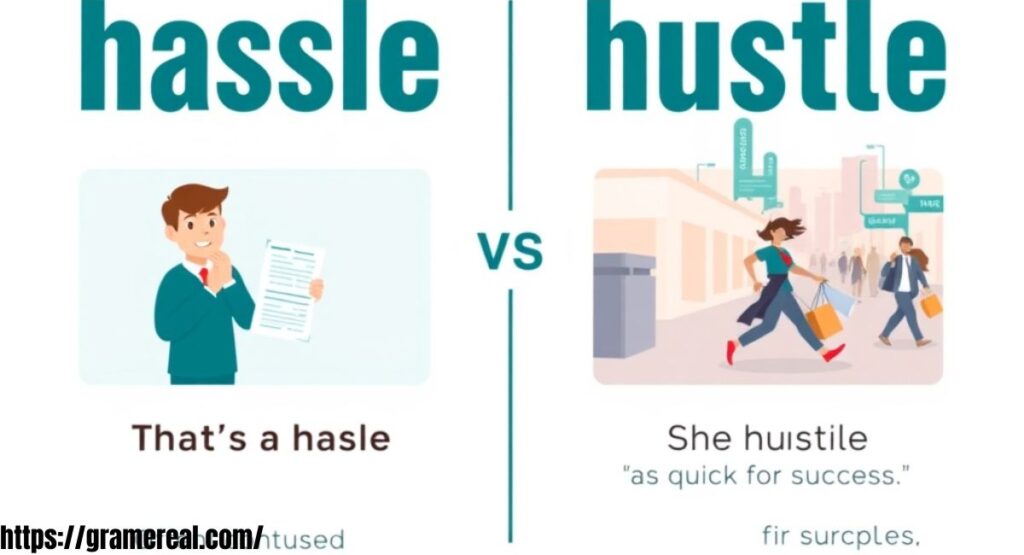
- Don’t confuse hassle with hustle Hustle means to move or work energetically. Hassle means to bother or cause inconvenience. They are completely different words.
- When quoting, annotate errors If you cite a source that uses hastle, keep the original quote but add [sic] to indicate you’re aware of the error.
Rewrite Example: Improved Grammar, Clarity, and Style
Before (Common draft with errors):
“Dealing with the insurance company was such a hastle. They kept hastling us for more documents even though we already sent everything. It just wasn’t worth the hastle.”
After (Corrected and improved):
“Dealing with the insurance company was a genuine hassle. They kept hassling us for additional documents despite our having submitted a complete file. Frankly, the whole process was not worth the hassle.”
Changes made:
- Hastle-vs-hassle hastle → hassle (three instances corrected)
- hastling → hassling (verb derived from correct base form)
- Sentences restructured for clarity and natural flow
- Redundancy reduced without losing meaning
Longer Practice Examples With Grammar Notes
Example 1 — Workplace Context
“My manager has been hassling the team about the deadline every single day this week. It’s becoming such a hassle that people are starting to dread Monday mornings.”
Grammar notes:
- hassling present continuous verb; action ongoing in the present
- a hassle singular countable noun with indefinite article
- becoming present continuous linking verb; shows a developing state
Example 2 — Travel Context
“Airport security can be a hassle, but arriving early means you can move through without too much hassle. The real hassle starts when flights get delayed.”
Grammar notes:
- First hassle noun, subject complement after linking verb be
- Second hassle noun used after a preposition (without)
- Third hassle noun, subject of the main clause
- All three are countable uses; the article or quantifier changes based on context
Example 3 — Customer Service Context
“We redesigned our return process to be completely hassle-free. Customers no longer have to deal with the hassle of long queues or complicated forms.”
Grammar notes:
- hassle-free compound adjective modifying process; note the hyphen
- the hassle of common noun phrase followed by a gerund (long queues, complicated forms)
Conclusion
Hastle-vs-hassle The distinction between hastle and hassle is straightforward: only one of them is a real word. Hassle spelled with a double S and no T is the correct,Hastle-vs-hassle dictionary-verified spelling accepted in all English-speaking countries and all registers of writing.
Hastle-vs-hassle Whether you use it as a noun (“what a hassle”) or a verb (“stop hassling me”), the rules remain consistent. Knowing its origin, understanding why the misspelling happens, Hastle-vs-hassle and applying the double-S memory trick will keep your writing clean and professional.
Hastle-vs-hassle One small correction can make a measurable difference in how readers perceive your credibility. When in doubt, remember: if it causes stress, it has two S’s.
FAQs
Is “hastle” ever correct in any form of English?
No. Hastle is not recognized in British, American, or Australian English dictionaries and should be avoided in all writing.
What does “hassle” mean?
Hassle means a situation that is irritating, inconvenient, or requires unnecessary effort or the act of persistently annoying someone.
Can “hassle” be used as both a noun and a verb?
Yes. As a noun: “It was a big hassle.” As a verb: “Don’t hassle me about it.”
How do I remember the correct spelling of “hassle”?
Think: two S’s for stress hassle causes it, and it shows in the spelling.
Is “hassle” formal or informal?
It is informal. In professional or academic writing, prefer inconvenience, difficulty, or complication.
What is the difference between “hassle” and “hustle”?
Hustle means to work energetically or move quickly. Hassle means to bother someone or describe an inconvenient situation hey are unrelated in meaning.
Are “hassle” and “bother” interchangeable?
They are close in meaning. Bother is slightly more formal; hassle is more casual and implies persistent or unnecessary trouble.
What are some synonyms for “hassle”?
Common synonyms include: inconvenience, bother, nuisance, trouble, difficulty, aggravation, and complication.
Does “hassle” have the same meaning in British and American English?
Yes. The spelling, pronunciation, and meaning are identical in both varieties.
What is the past tense of “hassle”?
The past tense is hassled. Example: “They hassled him constantly.”